

 SkillClick
How XBRL Tagging Software Supports Financial Statement Filing
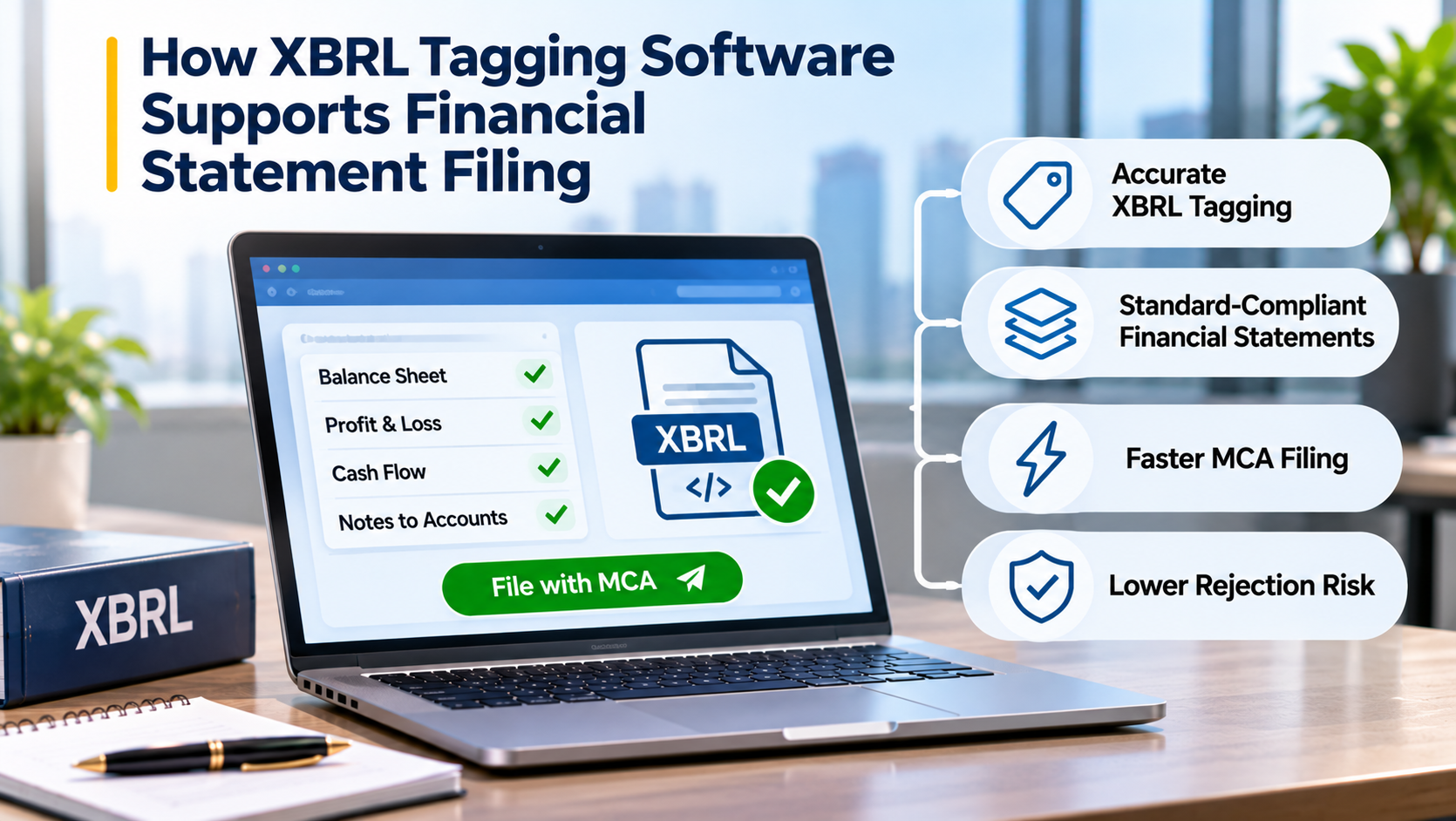
Every year, finance teams hand over a finished set of accounts and then wait while someone converts it into XBRL. Much of the delay often sits in tagging, validation and rework. This is where XBRL tagging software earns its place.
The short answer: XBRL tagging software maps each line of your financial statements to the right taxonomy element, builds the instance file, checks it for errors and prepares it for the AOC-4 XBRL form. It does not decide what your numbers should be. Before you evaluate XBRL tagging software, be clear about which of these steps it covers.
As of November 2026, under Ministry of Corporate Affairs (MCA) rules, listed companies and their Indian subsidiaries, companies with paid-up capital of ₹5 crore or more, companies with turnover of ₹100 crore or more and Ind AS companies file financial statements in XBRL, generally within 30 days of the AGM.
What Does XBRL Tagging Software Actually Do?
It automates the repetitive, error-prone steps between your finished accounts and the MCA portal. Think of it as a translator with a built-in checker.
- Import: Takes in your financial statements, usually from Excel or an export.
- Map: Links each line item to an element in the MCA taxonomy, often reusing last year’s mapping.
- Tag details: Adds the notes, dimensions and context the taxonomy expects.
- Generate: Builds the XBRL instance document in the required format.
- Validate: Runs checks for missing elements, calculation mismatches and taxonomy rules.
- Prepare for filing: Produces the file you attach to AOC-4 XBRL, ready for the signing and upload steps.
Features vary by product, so treat this as a reference flow, not a promise from any single tool.
Tagging also catches problems earlier. A calculation mismatch between a note and the balance sheet shows up at validation, when it is still cheap to fix.
For companies with several subsidiaries, consistent mapping across entities saves the most time, because one decision applies many times.
What Still Needs Human Judgement?
Software speeds up the mechanics. Choices about meaning, disclosure and accuracy stay with your finance team, company secretary and auditor.
| Task | Software helps with | You still decide |
|---|---|---|
| Mapping a line item | Suggests and reuses elements | Whether the element truly matches the meaning |
| Custom elements | Lets you create them | Whether a standard element already exists |
| Validation errors | Flags them | What the correct figure or disclosure is |
| Taxonomy version | Loads the right version | Which taxonomy applies to your accounts |
| Sign-off | Prepares the file | Who reviews and approves before filing |
A file that passes validation can still be wrong. Validation checks structure and rules, not whether a number is right or a tag is the best fit.
Hypothetical example: a finance team maps “other expenses” to a generic element because it validates. A reviewer later notes that a more specific element exists for part of the balance. The file was valid, but the disclosure was weaker than it should have been.
Keep a short mapping policy: when to use a standard element, when to create a custom one and who approves it.
Which Features Matter When You Compare Software?
Match XBRL tagging software features to your filing reality: your company type, number of entities and how much rework you expect each year.
Feature differences help explain the spread in cost xbrl filing software quotes, so compare them side by side.
- Taxonomy coverage: Support for the Ind AS and Indian GAAP taxonomies that apply to you, with timely updates.
- Mapping reuse: Saved mappings carry forward, so next year starts from this year’s work.
- Validation depth: Clear error messages that point to the element and the fix, not just a pass or fail.
- Consolidated support: Handling of consolidated statements and subsidiaries, if you file AOC-4 CFS XBRL.
- Audit trail: A record of who mapped and changed what, so reviewers can follow decisions.
- Review workflow: Ways for the auditor or company secretary to comment before sign-off.
- Support and training: Help during the filing window, when questions are most urgent.
Ask for a trial with your own prior-year accounts. A demo with clean sample data hides the problems you will actually face.
What Drives the Cost of XBRL Filing Software?
Cost depends on how the product is licensed and how much support you need. Ask for scope in writing before comparing prices.
- Licence model: Annual subscription, per-filing fee or one-time licence can give very different totals.
- Entities and filings: More companies, subsidiaries and consolidated filings usually raise the price.
- Taxonomy updates: Check whether updates are included or charged separately.
- Support level: Email help, phone help and hands-on review services are priced differently.
- Review services: Some providers tag and review for you, which costs more than a self-service tool.
- Hidden effort: Staff time spent mapping and fixing errors is a real cost, even when the licence is cheap.
Decision rule: compare total cost across one full filing cycle, including staff hours, rework and support, not just the licence price.
Hypothetical comparison: Tool A is cheaper but needs two days of manual mapping every year. Tool B costs more but reuses mappings and flags errors clearly. If those two days involve senior staff, the cheaper tool may not be cheaper.
Ask providers what happens if the taxonomy changes mid-year or the portal rejects a file. The answer shows what support really includes.
How Should You Prepare for the Filing Window?
Start tagging on near-final accounts, then refresh after sign-off. Waiting for the last number leaves no room for review.
- Confirm applicability: Check listing status, paid-up capital, turnover and Ind AS status against the latest accounts.
- Choose the taxonomy: Use the version current for your financial year, as published on the MCA website.
- Reuse last year: Start from last year’s mappings and review only what changed.
- Run a trial tag: Tag a draft early to find gaps in notes and disclosures.
- Review and sign off: Have the auditor or company secretary check mappings and key disclosures.
- File within the deadline: Plan upload and signing time, since AOC-4 XBRL is generally due within 30 days of the AGM.
Share a one-page checklist so finance, company secretary and auditor know their parts. After filing, save the instance file, mapping and review notes, because next year’s team will need them.
XBRL tagging software saves the most time where work repeats: mapping, validation and year-on-year reuse. Confirm applicability, taxonomy version and due dates against current MCA notifications and your professional adviser’s advice, because no tool guarantees an error-free filing.
- Managerial Effectiveness!
- Future and Predictions
- Motivatinal / Inspiring
- Fitness and Wellness
- Medical & Health
- Manufacturing
- Education
- Real-Estate
- Food Industry
- Hospitality
- Online Games
- Sports
- Home Services
- Civil Engineering
- Safety and Protection
- Software Products & Services
- Fashion and Jewellery
- Artificial Intelligence
- Entrepreneurship
- Mentoring & Guidance
- Marketing
- Networking
- HR & Recruiting
- Literature
- Shopping
- Career Management & Advancement