

 SkillClick
UAE Electronic Invoicing Software: A Founder’s Checklist
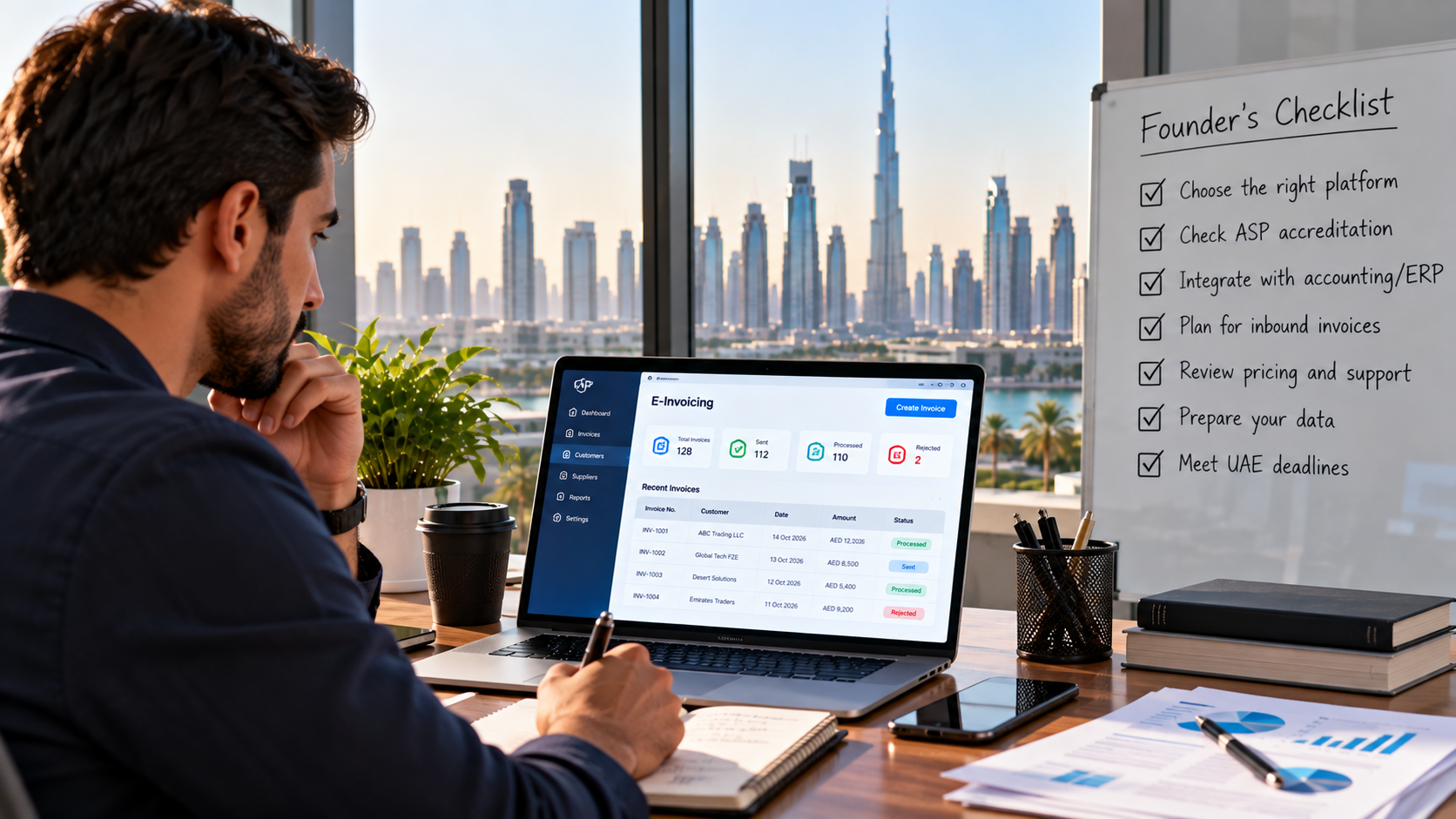
Early-stage founders often handle invoicing in whatever tool was quickest to set up: a spreadsheet, an accounting app or a template saved on a shared drive. That works while volumes are small. It stops working when a customer’s system expects structured invoice data and your process produces a PDF.
That is where UAE electronic invoicing software comes in. Under the Ministry of Finance’s framework, in-scope invoices must be exchanged as structured data through Accredited Service Providers (ASPs) on the Peppol network, and businesses with annual revenue below AED 50 million must appoint an ASP by 31 March 2027.
Larger businesses have earlier dates, so check your phase first. This checklist helps founders compare their options, avoid rework and pick software that will still fit as the company grows.
What UAE Electronic Invoicing Software Needs to Do
The software is only one part of the system, so start by being clear about its job. It should create or receive invoice data in the required format and connect to your ASP. It should also show you what happened to every invoice.
Software Versus ASP
Your ASP validates invoices, sends them across the network and receives invoices for you. Your software creates the data, manages the workflow and stores the records. Some vendors are accredited themselves, while others work with an accredited provider, so ask which model applies.
Both Directions
Recipients must process e-invoices and credit notes through the system. Your software therefore needs an inbound process as well as an outbound one, even if most of your volume is sales. Finance and procurement should agree who reviews incoming invoices before go-live.
Rejection Messages and Support
Some invoices can fail validation. Look for software that names the missing or incorrect field, and a vendor that responds quickly when something goes wrong. A founder with no finance operations team needs clear messages, not technical codes.
Three Routes Founders Usually Consider
There is no single right answer. The table below compares the three routes most startups weigh, with typical trade-offs rather than product claims.
| Route | Best for | Main advantage | Main risk |
|---|---|---|---|
| Add-on to your existing accounting tool | Simple operations with one system | Fewer moving parts and familiar workflow | May not support every invoice type or inbound handling |
| ERP-connected e-invoicing software | Growing companies with an ERP | Automated data flow from ERP to provider | Needs mapping, testing and ongoing maintenance |
| Standalone platform or provider portal | Teams without an integrated system | Quick to start without IT work | Manual data entry or uploads can create errors and delays |
Some startups may start with the first or third route and move to the second as volumes grow. If you expect rapid growth, ask now what migration would involve.
How to Choose Between Them
Match the route to your invoice volume, number of systems and available time. If you have one system and low volume, the simplest route may be enough. If you already use an ERP or expect several entities, connected software usually saves effort once it is set up.
Count the Full Cost
Pricing Structure
Ask what the base price includes and what costs extra. Common variables include invoice volume, number of users, additional entities, integrations, support level and testing environments. For a startup, a price that scales predictably is usually safer than a low entry fee that jumps as you grow.
Hidden Effort
Manual uploads, repeated corrections and time spent chasing rejected invoices all cost founder and team hours. Ask each vendor to estimate how much weekly work remains with your team after setup.
Exit Terms
Check data ownership, archive access and what happens if you switch providers. Early-stage companies change systems often, so an easy exit is worth more than it first appears.
Check the Connection to Your Systems
Where Your Invoice Data Lives
Most invoice data starts in your accounting tool or ERP. Ask who builds the field mapping, how rejected invoices return to your team and whether statuses flow back into your accounts. If your system is not supported, ask exactly how data would reach the software.
What Vendors Publish
Published integration details help you shortlist. Webtel’s page on ERP integration for UAE electronic invoicing lists SAP ECC 6, S/4HANA, Oracle ERP and Microsoft Dynamics 365 among the systems it integrates with. Founders running one of these can use the list to prepare specific questions, but a test with your own version and setup is the only real confirmation.
Clean Data First
Structured invoices are validated as data, so check customer names, tax registration details, item descriptions and invoice references. An electronic credit note is required in cases such as cancellations, refunds, price adjustments or numerical errors, so plan for those too.
Questions to Ask Before You Buy
Put these questions to every vendor of UAE electronic invoicing software:
- Are you accredited, or do you work with an accredited provider?
- How do you handle supplier invoices that arrive through the network?
- Which accounting systems or ERPs have you connected before?
- How are rejected invoices shown, and who helps us fix them?
- What does pricing look like if our invoice volume doubles?
- How can we export our records if we leave?
Dates Founders Should Know
Based on Ministry of Finance announcements and advisory summaries:
- AED 50 million or more: appoint an ASP by 30 October 2026 and go live on 1 January 2027.
- Below AED 50 million: appoint by 31 March 2027 and go live on 1 July 2027.
- In-scope government entities: appoint by 31 March 2027 and go live on 1 October 2027.
Dates can change, so confirm your phase on the official Ministry of Finance portal.
Frequently Asked Questions
Do startups and small companies need e-invoicing?
Yes, if their transactions are in scope. The system covers business-to-business and business-to-government transactions, and advisory summaries indicate that VAT registration status does not change that. Business-to-consumer sales are currently excluded.
Can I use my existing accounting software?
Possibly, if it can produce the required structured data and connect to an ASP. Ask your software vendor in writing what it supports and whether an add-on or a separate provider is needed.
Is a PDF still acceptable?
A PDF alone does not meet the requirement for in-scope transactions, because invoices must be issued and exchanged as structured data through the system.
When should I start?
Start with provider and software evaluation well before your appointment deadline, because onboarding, mapping and testing all take time.
Final Thoughts
The right UAE electronic invoicing software for a founder is the one that fits today’s team and tomorrow’s volume. Confirm your phase, decide which route suits your systems, count the full cost and test with real invoices before you commit. A little structure now saves rework later.
- Managerial Effectiveness!
- Future and Predictions
- Motivatinal / Inspiring
- Fitness and Wellness
- Medical & Health
- Manufacturing
- التعليم
- Real-Estate
- Food Industry
- Hospitality
- Online Games
- Sports
- Home Services
- Civil Engineering
- Safety and Protection
- Software Products & Services
- Fashion and Jewellery
- Artificial Intelligence
- Entrepreneurship
- Mentoring & Guidance
- Marketing
- Networking
- HR & Recruiting
- Literature
- Shopping
- Career Management & Advancement