

 SkillClick
HR Software with Payroll: Where Integration Really Matters
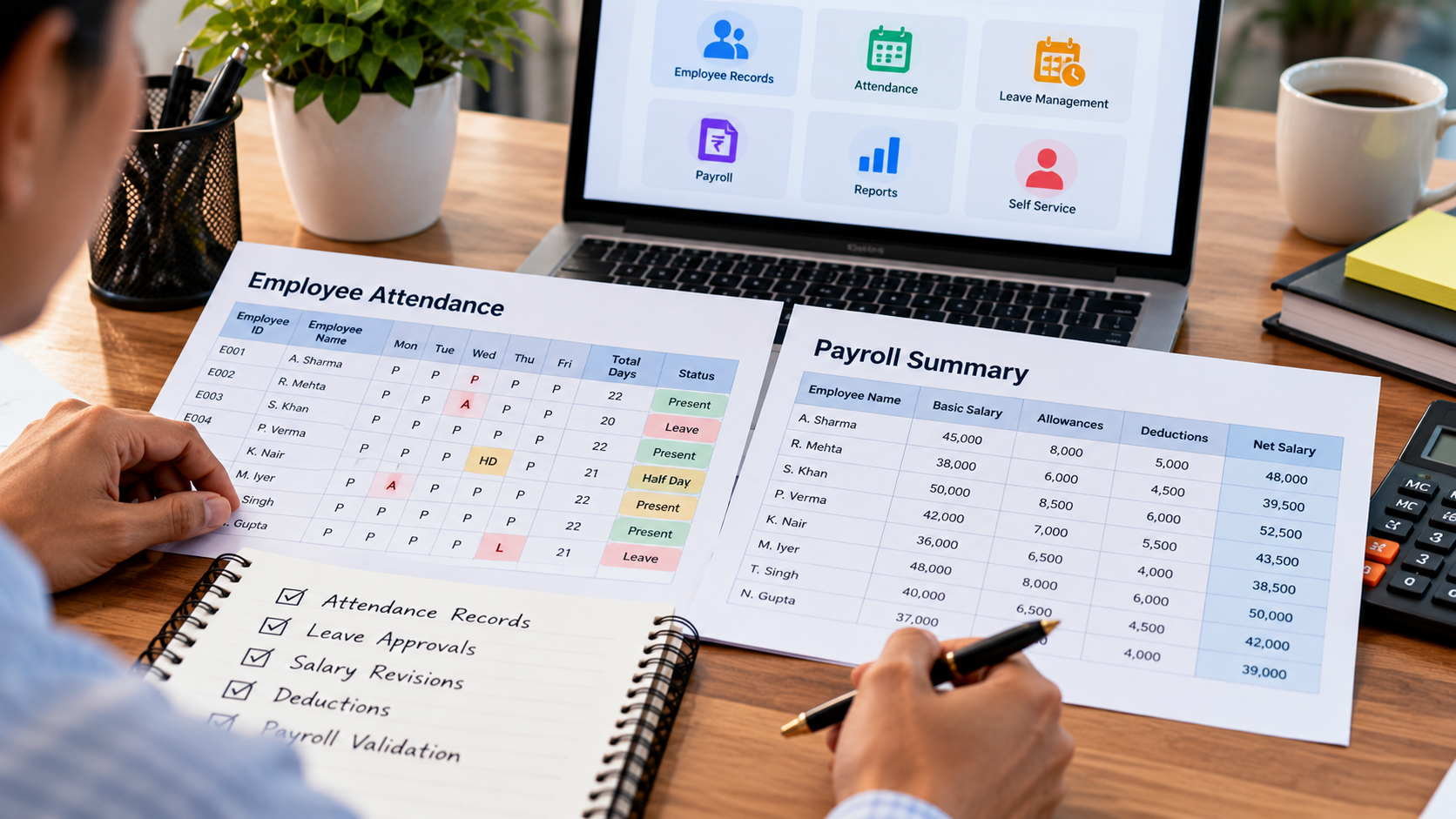
Payroll problems often begin long before salaries are calculated. An employee's revised salary may not reach the payroll team, an approved leave request may be missing from attendance records, or a change in employment status may go unnoticed until the monthly payroll review.
HR software with payroll can help businesses connect employee information with salary processing, but the value depends on how well these activities work together. A connected HR management system can bring related records and workflows into one place, helping teams reduce repetitive data handling.
The important question is not simply whether a software package includes HR and payroll modules. It is whether information moves correctly between them, and whether the system makes it easy to identify problems before payroll is finalised.
The Hidden Work Between HR and Payroll
HR and payroll may have different responsibilities, but their work is closely connected.
HR teams maintain employee records, process joining formalities, manage leave, and record changes in employment. Payroll teams use relevant information to calculate earnings, deductions, and net salary. Managers may also be involved in approving attendance corrections, overtime, or employee requests.
When these activities are handled through disconnected tools, someone must transfer information from one place to another. That handoff creates an opportunity for missing updates, inconsistent records, and unnecessary follow-ups.
For example, an employee receives a salary revision halfway through the month. HR records the change, but the payroll team continues using the previous salary structure. The issue is not necessarily a calculation error; it is a failure to pass the correct information into the payroll process.
Integrated software can reduce these handoffs, but businesses still need clear responsibilities, approval rules, and checks.
Integration Means More Than Having Two Modules
A software provider may offer both HR management and payroll, but that does not automatically mean every relevant record updates across the system.
There are several ways the two functions may be connected. Some platforms share information automatically. Others rely on scheduled transfers, manual imports, or integrations with separate applications.
These approaches can produce different results in day-to-day use. A business should understand exactly what happens when an employee's details change, attendance is corrected, or a leave request is approved.
During a demonstration, ask the provider to show the complete process rather than displaying each module separately.
| Business event | What to check in the software |
|---|---|
| Employee joins | Are approved employee and salary details available for payroll setup? |
| Salary changes | Does the revised salary reach the correct payroll period? |
| Leave is approved | Is the approved leave reflected in relevant attendance and payroll inputs? |
| Attendance is corrected | Can the correction be reviewed before payroll is finalised? |
| Employee exits | Can final salary-related information be prepared and checked? |
The purpose of this exercise is to discover where manual work remains. A system that automates most of a process but leaves one critical handoff unresolved may still require considerable month-end effort.
Pay Attention to Exceptions, Not Just Routine Cases
Software demonstrations often show a straightforward process: an employee is added, attendance is recorded, and payroll is generated. Real workplaces also involve exceptions.
An employee may forget to record attendance. A manager may approve leave after the payroll cut-off. A salary revision may be entered with an incorrect effective date. A new employee may join in the middle of a pay period.
These situations reveal how well a system supports the people responsible for maintaining accurate records.
Before choosing a platform, ask how it handles incomplete information, conflicting entries, late approvals, and changes made after payroll preparation has started. Find out whether authorised users receive alerts, whether corrections are recorded, and whether the system allows payroll to be reviewed before finalisation.
A useful system should make exceptions visible rather than allowing them to pass unnoticed.
Establish Who Owns Each Record
Integration can reduce duplicate data entry, but it does not eliminate the need for accountability.
If an employee's bank details are incorrect, who is responsible for correcting them? If attendance differs from a manager's approved record, which team investigates? Who can change a salary component, and who approves that change?
Businesses should define these responsibilities before implementation.
A simple ownership structure might assign employee personal records to HR, attendance approvals to designated managers, and payroll validation to the payroll team. The exact arrangement will depend on the organisation, but each important record should have a clear owner.
Access permissions should reflect those responsibilities. Not every manager needs access to salary information, and employees should only be able to view or update information they are authorised to handle.
Clear ownership makes it easier to resolve discrepancies and reduces confusion when something goes wrong.
Use a Parallel Payroll Run Before Switching
One practical way to test new software is to run it alongside the existing payroll process for a limited period.
During this comparison, the payroll team prepares results using both systems and investigates differences before relying on the new platform. The purpose is not simply to check whether the final salary totals match. Individual calculations and the records behind them should also be reviewed.
Choose sample employees with different circumstances, such as:
-
A new joiner with a partial month's salary.
-
An employee who has taken unpaid leave.
-
An employee with a recent salary revision.
-
A staff member with overtime or variable earnings.
-
An employee whose records require a correction.
Compare the relevant inputs, calculations, deductions, and payslips. Document any differences and determine whether they result from incorrect data, configuration, timing, or an existing payroll rule.
This process can expose issues that a standard product demonstration may not reveal. It also gives HR and payroll teams an opportunity to become familiar with the system before it becomes the main source of payroll results.
What to Evaluate Before Making a Decision
The right software should fit the organisation's actual working practices, not force every process into an unsuitable workflow.
When comparing options, look beyond the feature list and consider the following:
Workflow compatibility: Can the software accommodate existing approval structures, salary components, attendance policies, and employee categories?
Data visibility: Can authorised users identify which information was used for a payroll calculation?
Correction process: Are errors easy to investigate, correct, and review?
Reporting: Can the payroll team access the reports required for internal checks and financial records?
Security: Are employee information, salary details, and payroll records protected through appropriate permissions?
Implementation: Is support available for data migration, configuration, testing, and employee training?
Cost: Are the required modules, integrations, implementation services, and ongoing charges included in the quoted price?
Businesses comparing HR management and payroll software should ask providers to demonstrate these requirements using realistic examples. The aim is to understand how the software will behave under normal working conditions, including situations that need manual review.
Make the Monthly Payroll Process More Predictable
A well-connected HR and payroll workflow should make it easier to identify what is ready, what needs approval, and what requires correction before salaries are processed.
That does not mean every task should be automated without oversight. Payroll still needs review, employee information must be maintained accurately, and authorised people must remain responsible for important decisions.
The most useful measure of integration is how much unnecessary reconciliation it removes while keeping the process transparent and controllable.
Conclusion
HR software with payroll can help businesses connect employee records, attendance, leave, and salary processing. But simply purchasing a system with both functions does not guarantee a smooth workflow.
The real difference comes from accurate information flow, clear ownership, effective exception handling, and careful testing. By examining these areas before implementation, businesses can identify weak points early and build a payroll process that is easier to manage, review, and improve.
- Managerial Effectiveness!
- Future and Predictions
- Motivatinal / Inspiring
- Fitness and Wellness
- Medical & Health
- Manufacturing
- Education
- Real-Estate
- Food Industry
- Hospitality
- Online Games
- Sports
- Home Services
- Civil Engineering
- Safety and Protection
- Software Products & Services
- Fashion and Jewellery
- Artificial Intelligence
- Entrepreneurship
- Mentoring & Guidance
- Marketing
- Networking
- HR & Recruiting
- Literature
- Shopping
- Career Management & Advancement