

 SkillClick
Why AI Companies Need Revenue Operations Before Growth Becomes Difficult to Manage
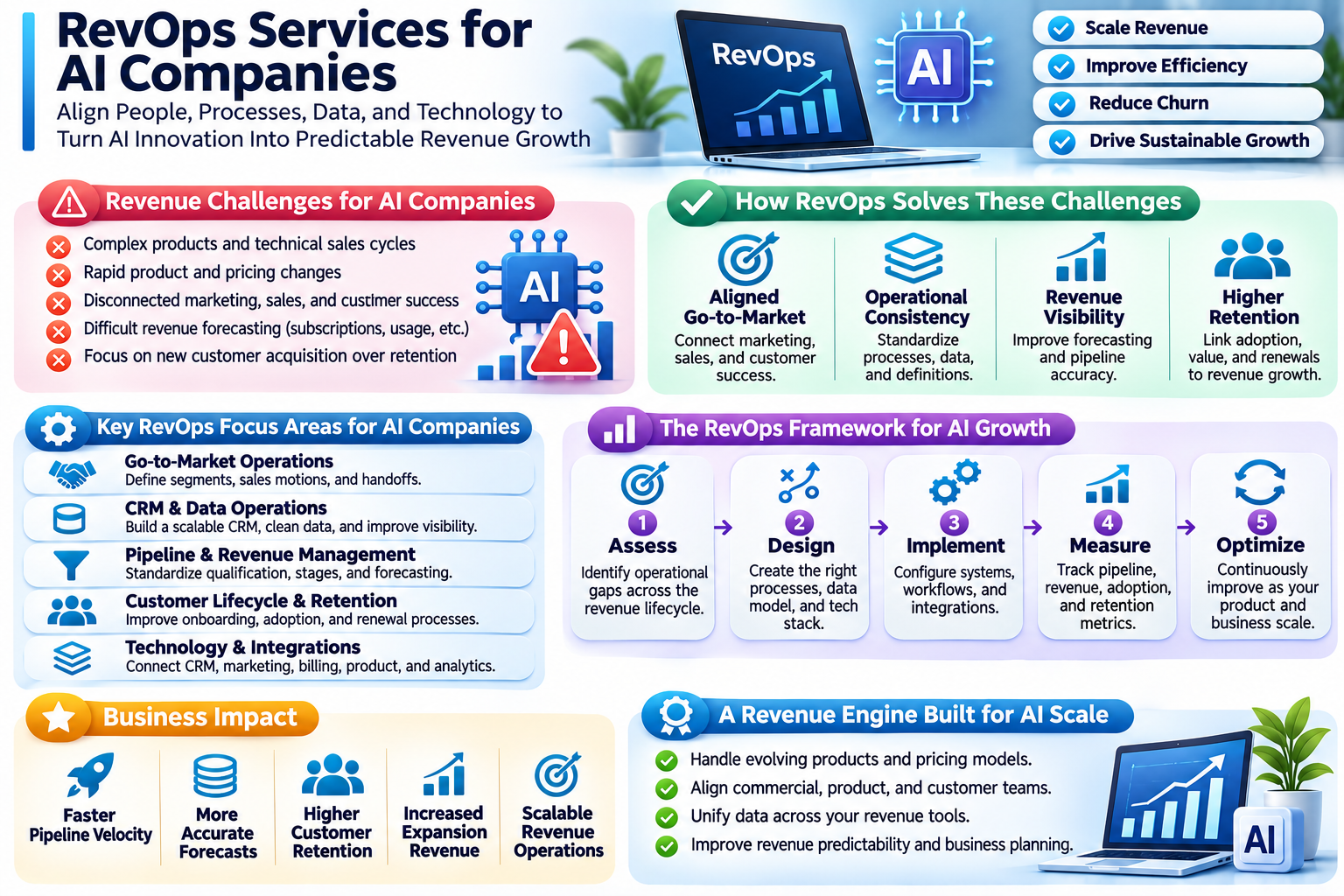
Artificial intelligence companies often experience a different growth pattern from traditional software businesses. A promising product can attract significant market attention, generate early demand, and acquire customers quickly. However, product adoption does not automatically create a predictable revenue model.
As an AI company expands, its commercial operations become increasingly complicated. Sales teams must explain technical capabilities to different buyers, marketing teams need to distinguish genuine purchase intent from general AI interest, and customer success teams must demonstrate measurable value to support renewals.
At the same time, pricing models may change, product capabilities evolve, and new customer segments emerge. The systems responsible for tracking leads, managing opportunities, forecasting revenue, and measuring customer retention must keep pace.
Without a coordinated operating structure, these activities can become disconnected. Marketing may report strong lead generation while sales struggles to convert opportunities. Finance may use different revenue assumptions from the sales team. Customer success may identify adoption problems that never reach the commercial forecasting process.
This is why RevOps Services for AI Companies are becoming increasingly relevant. Revenue operations creates a connected framework for managing the systems, data, processes, and teams responsible for generating and retaining revenue.
Why Revenue Operations Is Different for AI Companies
AI businesses share some operational requirements with other technology companies, but their commercial environments can introduce additional complexity.
The product itself may evolve rapidly. Pricing can depend on usage, subscription tiers, API consumption, licensing, or a combination of these models. Buyers may include technical evaluators, department heads, procurement teams, and executive decision-makers.
This creates several challenges for revenue teams.
1. Product complexity makes sales qualification more difficult
An AI product may have multiple applications across different industries and business functions.
For example, an AI platform could support customer service automation, document processing, predictive analytics, or internal knowledge management. Each use case may attract a different buyer with different requirements.
A general lead qualification process may not capture these distinctions.
Sales representatives need to understand:
-
The customer's intended use case
-
Existing technical infrastructure
-
Integration requirements
-
Expected implementation effort
-
Data security and governance considerations
-
Budget ownership and purchasing authority
-
The business outcome the buyer expects
If these details are not captured consistently, opportunities may progress through the pipeline without sufficient qualification.
A structured revenue process helps teams distinguish between general product interest and a commercially viable opportunity.
2. Rapid product development creates commercial misalignment
AI companies frequently introduce new features, models, integrations, and product capabilities.
The product team may understand these changes immediately, but marketing and sales need time to translate them into customer-facing value.
Without communication between departments, sales representatives may continue using outdated positioning. Marketing campaigns may promote capabilities that have changed, while customer success teams may lack the information needed to support new use cases.
Revenue operations helps establish processes for sharing product updates, maintaining sales documentation, updating CRM information, and aligning customer-facing teams.
The objective is not to slow product development. It is to ensure that commercial teams can respond accurately as the product evolves.
3. Revenue models can become difficult to forecast
Traditional subscription businesses often rely on recurring contract values and renewal dates. AI businesses may combine subscriptions with variable usage charges, implementation fees, API consumption, or additional service revenue.
This creates forecasting challenges.
A customer with a relatively small initial contract may generate significant usage revenue later. Another customer may sign a large agreement but consume fewer resources than expected.
If the CRM captures only contract value, management may not have a complete view of expected revenue.
Revenue operations can help establish consistent definitions for recurring revenue, usage-based revenue, expansion, contraction, and customer renewals. These definitions should align with finance and the organisation's accounting policies.
The Operational Problems That Appear During AI Company Growth
Many revenue problems become visible only after a company begins scaling.
A small team can often manage processes through direct communication and spreadsheets. As the number of customers, sales representatives, and product use cases increases, informal coordination becomes less reliable.
Disconnected marketing, sales, and customer success processes
A prospect may interact with several marketing campaigns before speaking with a sales representative. After becoming a customer, the account moves to implementation and customer success.
If each department maintains separate information, important context can disappear during these transitions.
Sales may not understand which use cases initially attracted the customer. Implementation teams may lack details about what was promised during the sales process. Customer success may not know which business outcomes influenced the purchasing decision.
These gaps can create poor customer experiences and increase the risk of churn.
A connected revenue process establishes clear handoff requirements and shared customer information across departments.
Weak visibility into the sales pipeline
AI companies may generate considerable interest because the technology category attracts attention. However, interest does not always translate into buying intent.
Some prospects are exploring possibilities without having an approved budget, defined implementation timeline, or clear business requirement.
If pipeline reporting treats every opportunity equally, forecasts can become unreliable.
A better qualification framework considers business need, technical feasibility, decision-making authority, commercial readiness, and next steps.
Customer acquisition receives more attention than retention
Early-stage companies often prioritise acquiring new customers. This is understandable when the business is still establishing product-market fit.
However, acquisition becomes less sustainable when customer onboarding, adoption, and renewal processes remain underdeveloped.
For AI products, customers may need assistance with integrations, workflow changes, employee adoption, data preparation, and performance evaluation.
If customers cannot achieve the expected value, renewal discussions become more difficult.
Revenue operations helps connect acquisition processes with post-sale performance so that customer retention is treated as part of the revenue model rather than a separate activity.
How Revenue Operations Builds a More Predictable Growth Structure
Revenue operations is not simply a CRM administration function. It brings together the processes, technology, data, and performance measures that support the entire revenue lifecycle.
For AI companies, this can involve several interconnected areas.
1. Establishing a consistent go-to-market process
A go-to-market strategy defines how a company identifies, reaches, converts, and retains customers.
AI businesses may target several industries or buyer groups. Each segment can have different sales cycles, purchasing requirements, and product applications.
Revenue operations helps translate the go-to-market strategy into operational processes.
This includes defining customer segments, lead qualification criteria, opportunity stages, handoff requirements, and ownership across departments.
For example, an enterprise opportunity involving a complex AI integration may require technical discovery before a commercial proposal is prepared. A smaller business purchasing a standard subscription may follow a shorter sales process.
Both opportunities should be managed consistently, but they may require different workflows.
2. Creating reliable CRM architecture
The CRM should reflect how the business actually generates revenue.
An AI company may need to track more than contacts, accounts, and opportunities. Depending on its business model, relevant information could include:
-
Product or subscription type
-
Customer use case
-
Deployment model
-
Integration requirements
-
Contract structure
-
Usage-related commercial details
-
Implementation status
-
Renewal and expansion opportunities
The goal is to capture information that supports decisions without making the CRM unnecessarily complicated.
A well-designed CRM architecture also considers which system owns each data point and how information moves between platforms.
3. Aligning marketing and sales measurement
Marketing and sales often use different measures of performance.
Marketing may focus on traffic, campaign engagement, and lead volume. Sales may focus on qualified opportunities, conversion rates, and closed revenue.
Both perspectives are useful, but they need to connect.
Revenue operations can establish shared definitions and reporting processes that show how marketing activity contributes to pipeline creation and revenue outcomes.
This helps management understand whether campaigns are attracting the right buyers rather than simply generating activity.
4. Improving revenue forecasting
Forecasting should reflect the company's actual commercial model.
For an AI business, relevant factors may include contract value, recurring subscriptions, usage patterns, implementation revenue, renewal timing, and expansion potential.
The exact model depends on how the company recognises revenue and structures customer agreements.
Revenue operations can improve forecasting by standardising opportunity stages, requiring meaningful next steps, reviewing pipeline quality, and aligning sales assumptions with finance.
This makes forecasts more useful for hiring decisions, resource allocation, and business planning.
5. Connecting customer success with revenue performance
Customer success should have visibility into the expectations established during the sales process.
That information helps teams understand why customers purchased the product and what outcomes they are trying to achieve.
Revenue operations can support this through structured handoffs, lifecycle tracking, renewal workflows, and consistent account information.
Where appropriate, product adoption and usage indicators can also help identify customers who may need additional support.
These indicators should be interpreted in context. High usage does not always mean high customer value, and low usage does not automatically indicate churn risk.
Choosing the Right Revenue Technology Stack
AI companies often adopt several platforms as they expand. The technology stack may include a CRM, marketing automation, customer support software, product analytics, billing systems, data warehouses, and integration tools.
The challenge is ensuring that these systems work together.
CRM and marketing automation
The CRM should provide a reliable view of customer and opportunity information. Marketing automation should support campaign execution, lead engagement, and relevant lifecycle communications.
Integration between the two systems helps reduce duplicate records and disconnected reporting.
Billing and subscription management
Companies with subscription or usage-based pricing need accurate commercial information.
Billing systems should provide the information required to understand customer contracts, invoices, subscription changes, and usage charges.
Where this data is used for revenue analysis, the organisation should define how it connects with CRM and finance systems.
Product analytics and customer success systems
Product analytics can provide insight into how customers interact with an AI application.
Customer success teams may use this information alongside onboarding progress, support history, business objectives, and renewal timelines.
Connecting relevant information can improve account visibility, but organisations should establish appropriate access controls and data governance.
Integration and data architecture
As the number of platforms grows, integration architecture becomes increasingly important.
Poorly designed integrations can create duplicate records, inconsistent customer information, and reporting discrepancies.
A scalable architecture defines system ownership, synchronisation requirements, data validation, and exception handling.
The technology stack should support the revenue process rather than forcing employees to work around disconnected applications.
Common Mistakes AI Companies Make When Scaling Revenue Operations
Building processes around the current product instead of the business model
A product may change substantially as the company discovers new use cases and customer segments.
If revenue processes are built around temporary assumptions, they may require repeated redesign.
The better approach is to create a flexible operating structure that can accommodate new products, pricing models, and sales motions without losing consistency.
Treating CRM implementation as the complete RevOps strategy
A CRM is an important part of revenue operations, but installing software does not automatically align departments.
If teams have conflicting definitions, unclear ownership, and inconsistent processes, the CRM will simply reflect those problems.
Business requirements and process design should come before extensive system customisation.
Tracking too many metrics without clear ownership
AI businesses can access large amounts of product and commercial data. This does not mean every available metric should become a management KPI.
Too many metrics can make performance reviews difficult and obscure the indicators that genuinely influence business decisions.
Each important measure should have a clear definition, owner, source, and intended use.
Scaling sales before establishing qualification standards
Hiring additional sales representatives may increase activity, but it does not automatically improve pipeline quality.
Without consistent qualification and opportunity management, new employees may introduce different sales practices and reporting assumptions.
A documented sales process helps maintain consistency as the team expands.
Expert Insight: What Revenue Operations Should Prioritise First
AI companies do not need to redesign every revenue process at once.
The first step should be identifying where the current operating model creates the greatest commercial friction.
An experienced RevOps assessment generally examines the customer journey, sales pipeline, CRM structure, data quality, technology integrations, forecasting process, and post-sale handoffs.
The findings should be prioritised according to business impact.
For example, if opportunities are frequently lost because technical requirements are discovered too late, improving the discovery and qualification process may be more valuable than introducing another reporting dashboard.
If renewals are unpredictable because customer adoption information is unavailable to account managers, connecting product and customer success data may deserve attention first.
The most effective approach is to solve the underlying process problem before adding more technology.
Revenue operations should also evolve with the company. An early-stage AI business may need basic pipeline discipline and CRM ownership. A larger organisation may require more sophisticated forecasting, territory management, data architecture, and lifecycle reporting.
The operating model should reflect the company's current stage while allowing for future complexity.
Frequently Asked Questions
1. Why do AI companies need revenue operations?
AI companies often manage complex products, changing pricing structures, technical sales requirements, and evolving customer segments. Revenue operations connects marketing, sales, customer success, data, and technology so that these activities support a consistent revenue process.
2. When should an AI startup establish RevOps?
An AI startup should consider formalising revenue operations when informal processes begin creating problems with lead qualification, pipeline visibility, forecasting, CRM management, or customer handoffs. There is no universal employee or revenue threshold; operational complexity is a more useful signal.
3. How does RevOps help AI companies improve sales forecasting?
RevOps improves forecasting by standardising opportunity stages, qualification criteria, pipeline reviews, and revenue definitions. It can also help connect contract and usage-related information where the business model requires it.
4. What technology should an AI company use for revenue operations?
The appropriate stack depends on the company's sales model, customer lifecycle, and operational requirements. Common components include a CRM, marketing automation, billing or subscription management, customer success software, analytics platforms, and integration tools.
5. Can RevOps help reduce customer churn for AI businesses?
Yes. RevOps can connect sales expectations, onboarding information, customer success processes, renewal tracking, and relevant product adoption indicators. This helps teams identify potential problems earlier and coordinate appropriate customer support.
6. Should an AI startup hire an internal RevOps team or use external consultants?
The decision depends on operational complexity, available budget, and the amount of ongoing work. External consultants can help establish processes, improve systems, and provide specialist expertise. As requirements become continuous and more complex, an internal team may become appropriate.
7. What should an AI company measure to evaluate RevOps performance?
Useful measures may include lead-to-opportunity conversion, opportunity win rates, sales cycle length, forecast accuracy, customer acquisition cost, recurring revenue, expansion, renewal performance, and customer retention. The selected metrics should reflect the company's business model and have consistent definitions.
Building Revenue Operations That Can Keep Pace With AI Growth
AI companies operate in markets where products, customer expectations, and commercial models can change quickly. Revenue processes that work during the early stages may become unreliable as the business expands.
Disconnected systems, unclear ownership, inconsistent qualification, and limited customer lifecycle visibility can make growth harder to manage.
A structured revenue operations model addresses these issues by connecting people, processes, data, and technology across the customer lifecycle.
For companies looking to improve operational alignment, RevOps Services for AI Companies can provide a framework for building more consistent sales processes, improving revenue visibility, and supporting sustainable growth.
The objective is not to introduce complexity for its own sake. It is to create an operating structure that allows the business to scale without losing control of how revenue is generated, measured, and retained.
- Managerial Effectiveness!
- Future and Predictions
- Motivatinal / Inspiring
- Fitness and Wellness
- Medical & Health
- Manufacturing
- Education
- Real-Estate
- Food Industry
- Hospitality
- Online Games
- Sports
- Home Services
- Civil Engineering
- Safety and Protection
- Software Products & Services
- Fashion and Jewellery
- Artificial Intelligence
- Entrepreneurship
- Mentoring & Guidance
- Marketing
- Networking
- HR & Recruiting
- Literature
- Shopping
- Career Management & Advancement