

 SkillClick
How to Understand LL-37 Peptide Therapy in Bellevue, WA: Research, Immune Function, and Safety
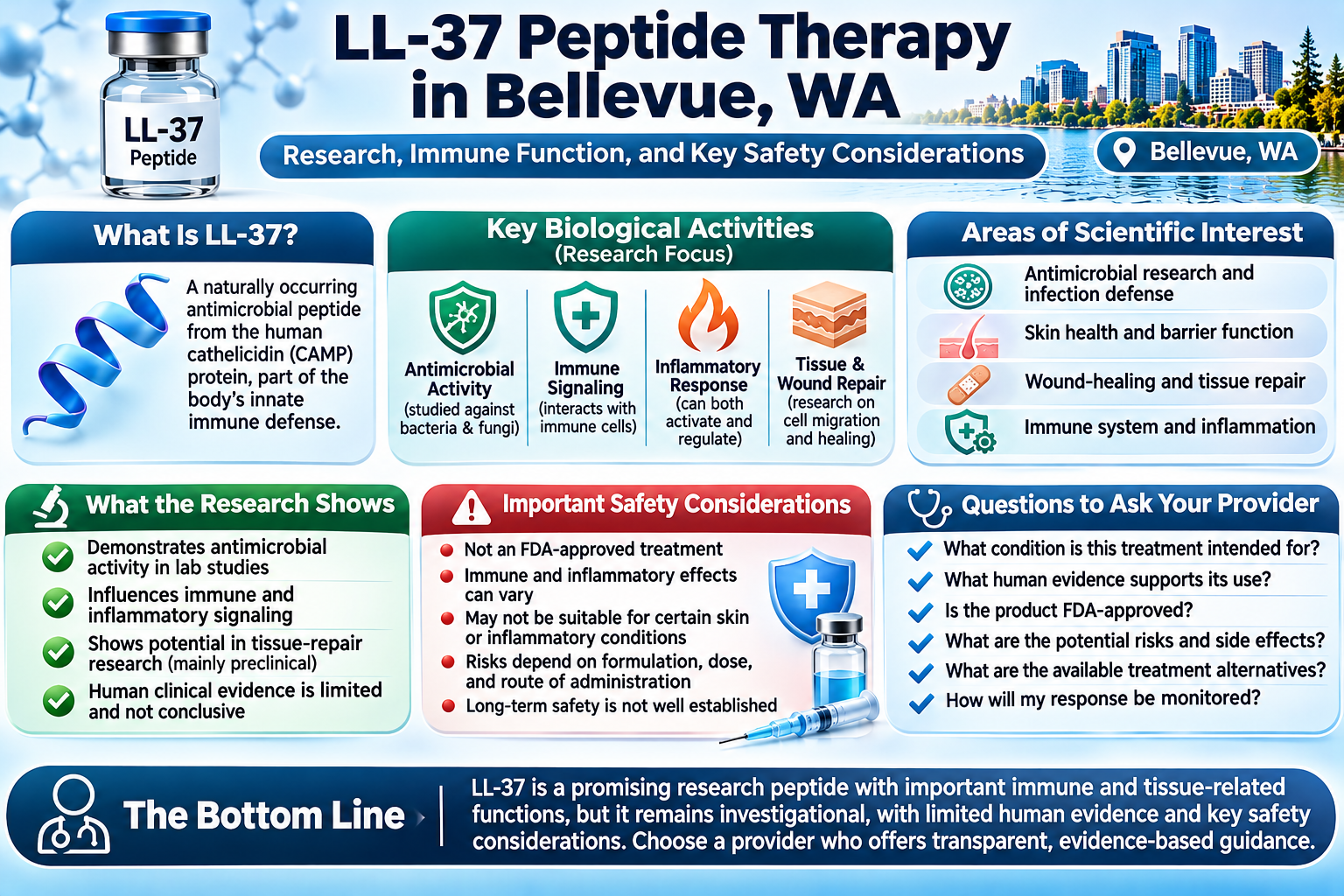
Interest in peptide research has expanded as scientists investigate how small protein fragments interact with cells, immune signaling, tissue responses, and biological defense mechanisms. One peptide that has received attention is LL-37, a naturally occurring antimicrobial peptide involved in the body's innate immune system.
LL-37 is often discussed online in connection with immune support, inflammation, infection defense, wound healing, and tissue repair. However, much of the scientific research comes from laboratory experiments, animal models, or investigations into biological mechanisms rather than large clinical trials demonstrating treatment benefits in humans.
People searching for LL-37 peptide therapy in Bellevue, WA should understand the distinction between research involving a naturally occurring peptide and the use of an unapproved peptide product as a treatment.
This guide explains what LL-37 is, how researchers study it, its biological functions, limitations in clinical evidence, safety concerns, and questions to consider when discussing peptide-related treatments with a healthcare professional.
What Is LL-37?
LL-37 is a peptide produced from a precursor protein called cathelicidin antimicrobial peptide (CAMP). In humans, the precursor is processed to produce LL-37, which is part of the innate immune defense system.
Innate immunity is the body's first line of defense against potentially harmful microorganisms. Unlike adaptive immunity, which involves highly specific responses involving antibodies and specialized immune cells, innate immunity relies on mechanisms that respond broadly to threats.
LL-37 has been studied for several biological activities, including:
-
Antimicrobial activity
-
Interaction with immune cells
-
Inflammatory signaling
-
Cellular migration
-
Tissue repair processes
-
Interaction with the skin and mucosal barriers
Its biological activity is complex. LL-37 does not simply activate the immune system in one direction. Depending on the environment, concentration, cell type, and biological context, it may influence immune responses in different ways.
How LL-37 Works in the Body
LL-37 is classified as a cathelicidin-derived antimicrobial peptide. Researchers study it because it can interact with microbial membranes and several host-cell signaling pathways.
1. Antimicrobial activity
LL-37 has been investigated for activity against different types of microorganisms, including certain bacteria and fungi.
In laboratory conditions, antimicrobial peptides can interact with microbial membranes, potentially disrupting their integrity and affecting microbial survival.
However, laboratory antimicrobial activity does not establish that a peptide is an effective treatment for an infection in humans.
Factors such as tissue penetration, concentration, stability, biological environment, toxicity, and pathogen characteristics can significantly influence whether laboratory results translate into clinical outcomes.
2. Immune-cell signaling
LL-37 interacts with various immune cells and signaling pathways.
Researchers have investigated its involvement in the movement, activation, and communication of immune cells. These activities are part of the broader study of innate immunity and host defense.
Immune signaling is highly regulated, however. More immune activity is not necessarily better, and altering a signaling pathway may produce unwanted effects depending on the underlying condition.
3. Inflammatory responses
LL-37 has been studied in both pro-inflammatory and inflammation-regulating contexts.
It may influence cytokine production, immune-cell recruitment, and other processes associated with inflammation. The effects are not uniform across all tissues or diseases.
This complexity is important because claims that LL-37 universally reduces inflammation or provides generalized immune enhancement oversimplify the available science.
4. Tissue and wound-related research
Researchers have also studied LL-37 in processes involving cellular migration, tissue responses, and wound healing.
Certain laboratory and animal studies suggest that LL-37 may participate in biological processes involved in tissue repair.
These findings remain research evidence. They do not establish that commercially available LL-37 products are proven wound treatments or that administration of the peptide safely accelerates healing in humans.
Why LL-37 Is Being Studied
LL-37 has attracted research interest because it is involved in several interconnected biological systems rather than acting through a single narrowly defined pathway.
Scientists are investigating its potential relevance to different areas of medicine.
Antimicrobial research
Antimicrobial resistance is an important global health challenge. Researchers are investigating antimicrobial peptides as possible sources of new strategies against microorganisms.
LL-37 is one of several peptides studied for its interactions with microbial membranes and potential antimicrobial mechanisms.
Despite this interest, LL-37 is not an established replacement for antibiotics, and research findings should not be interpreted as evidence that it can safely treat bacterial, fungal, or viral infections in people.
Skin biology
LL-37 is relevant to skin research because skin serves as a physical and biological barrier against the environment.
Studies have explored its role in skin defense, cellular responses, and tissue repair. These areas are of scientific interest in dermatology and wound-related research.
However, its role in skin biology is complex. LL-37 has also been associated with inflammatory skin conditions, illustrating that its effects can be context-dependent.
Wound-healing research
The processes involved in wound healing include inflammation, cellular migration, tissue formation, and remodeling.
LL-37 has been investigated for its potential role in these processes, including its interactions with cells involved in tissue responses.
Preclinical research can help scientists understand these mechanisms, but human clinical trials are required to establish whether a treatment improves healing, reduces complications, or produces clinically meaningful outcomes.
Immune signaling research
LL-37 is part of the broader study of innate immunity and immune regulation.
Scientists investigate how antimicrobial peptides interact with immune signaling pathways and how these interactions may differ across diseases and biological environments.
This does not mean LL-37 is an appropriate treatment for immune dysfunction or that using an externally administered product will produce beneficial immune effects.
What Does Scientific Research Actually Establish?
When evaluating LL-37, it is important to separate different levels of evidence.
Laboratory research
In-vitro studies can investigate how LL-37 interacts with microorganisms, cell membranes, proteins, and signaling pathways under controlled conditions.
These studies are valuable for understanding biological mechanisms.
However, laboratory findings do not directly predict how an administered peptide will behave in a human body, where distribution, metabolism, tissue barriers, and interactions with other biological components can change its effects.
Animal research
Animal studies allow researchers to investigate biological effects in more complex systems than cell cultures.
They may help evaluate mechanisms, potential therapeutic applications, and preliminary safety signals.
Nevertheless, results from animal models cannot be assumed to translate directly into human effectiveness or safety.
Human clinical evidence
Human trials are necessary to establish whether LL-37 is beneficial for a particular medical condition, whether the benefits outweigh the risks, and how the compound should be administered in a clinically appropriate manner.
The evidence available for LL-37 does not establish it as a broadly effective treatment for immune enhancement, infection prevention, generalized inflammation, or wellness.
Biological activity is not the same as clinical effectiveness.
Is LL-37 Peptide Therapy FDA Approved?
LL-37 is not an FDA-approved drug for routine therapeutic use in humans.
FDA approval requires evidence supporting the safety and effectiveness of a medication for a specific indication, together with evaluation of its manufacturing quality and regulatory requirements.
A peptide appearing in scientific publications, being naturally present in the human body, or being offered by a peptide provider does not mean it has received FDA approval as a treatment.
Consumers should carefully distinguish between:
-
Research compounds
-
Compounded products
-
Products marketed for laboratory research
-
Cosmetic ingredients
-
FDA-approved prescription medications
These categories have different regulatory requirements and are not interchangeable.
Why regulatory status matters
The regulatory status of a product can affect what is known about its manufacturing quality, purity, stability, potency, formulation, and appropriate use.
Products sold under a research label should not be assumed to be suitable for human use.
Similarly, the availability of a compounded product does not mean that FDA has independently established its effectiveness or safety for a particular medical condition.
Potential Risks and Safety Considerations
The safety of LL-37 depends on factors such as its formulation, route of administration, concentration, exposure, biological context, and individual health characteristics.
Because LL-37 is not an FDA-approved medication for routine human therapeutic use, an approved prescribing label does not establish its dosing, contraindications, interactions, or long-term safety for proposed wellness applications.
Inflammation-related effects
LL-37 can influence immune signaling. Because immune responses are complex, manipulating these pathways may have unintended effects.
The same peptide may produce different biological responses depending on the tissue, concentration, and surrounding inflammatory environment.
Skin-related concerns
LL-37 has been investigated in skin biology, but its activity is not uniformly beneficial in all dermatological conditions.
Research has associated LL-37-related signaling with certain inflammatory skin processes. This is one reason it should not be assumed to be universally beneficial for skin or wound conditions.
Product quality
Peptide products may vary in purity, stability, concentration, formulation, storage conditions, and manufacturing quality.
These factors may affect how a product behaves and introduce potential safety risks.
Route of administration
A topical, oral, or injectable formulation cannot be assumed to have the same effects.
Different routes can alter exposure, absorption, distribution, metabolism, and potential adverse effects. Evidence from one route does not establish safety or effectiveness for another.
Long-term safety
Long-term safety information for many proposed uses of LL-37 remains limited.
Consumers should be wary of providers or marketers who describe an investigational peptide as completely safe, risk-free, or suitable for everyone.
LL-37 Compared With Conventional Medical Treatment
LL-37 research should not replace established medical evaluation or treatment.
For example, individuals experiencing persistent infections, inflammatory symptoms, skin conditions, delayed wound healing, or unexplained immune-related symptoms should receive an appropriate medical assessment.
Depending on the condition, established care may involve:
-
Diagnostic testing
-
Prescription medications
-
Evidence-based antimicrobial treatment
-
Dermatological care
-
Wound management
-
Specialist referral
-
Monitoring of underlying medical conditions
An investigational peptide should not delay proven treatment, particularly when an infection or other potentially serious condition requires prompt care.
Questions to Ask When Exploring LL-37 Peptide Therapy in Bellevue, WA
If you are researching LL-37 peptide therapy Bellevue WA, use your consultation to understand the medical rationale, available evidence, and potential risks.
1. What condition is this treatment intended to address?
Ask whether the proposed treatment is intended for a diagnosed condition or a general wellness goal.
A provider should explain the medical reasoning and whether established treatments are available.
2. What human clinical evidence supports this use?
Ask whether the proposed benefit is supported by controlled human clinical trials or primarily by laboratory and animal research.
The level of evidence should match the strength of the claims being made.
3. Is the product FDA-approved for this indication?
Ask for a clear explanation of the product's regulatory status.
Do not rely on vague statements such as "medical grade," "pharmaceutical quality," or "doctor prescribed" as substitutes for understanding the regulatory pathway.
4. What are the potential adverse effects?
Discuss possible reactions, interactions, contraindications, immune effects, and risks associated with the formulation and administration route.
5. What alternatives are available?
Ask about conventional medical treatments and whether the proposed peptide offers any demonstrated advantage over established options.
6. How will treatment outcomes be evaluated?
If a provider proposes treatment, ask what measurable outcomes will be used, how follow-up will be performed, and what criteria would indicate that the approach is ineffective or should be discontinued.
How to Evaluate a Peptide Provider
Choosing a healthcare provider requires more than evaluating the range of peptides they offer.
A responsible provider should explain the scientific limitations of investigational compounds and avoid presenting experimental findings as proven patient benefits.
Look for transparency regarding:
-
Professional credentials and clinical qualifications
-
Medical history and assessment
-
Evidence supporting the proposed treatment
-
Product sourcing and quality information
-
Regulatory status
-
Risks and potential adverse effects
-
Follow-up and monitoring
-
Conventional treatment alternatives
Be cautious of providers who promise guaranteed immune support, infection protection, rapid healing, or broad improvements in health.
The quality of a medical decision depends on evidence, patient-specific evaluation, and realistic expectations—not marketing language.
Frequently Asked Questions About LL-37
What does LL-37 stand for?
LL-37 is the active peptide derived from the human cathelicidin precursor protein. It is part of the body's innate immune defense system and has been investigated for antimicrobial and immunological activities.
Is LL-37 a naturally occurring peptide?
Yes. LL-37 is naturally produced by the human body. However, the fact that a compound is naturally occurring does not automatically mean that externally administering it is safe.
Is LL-37 an antibiotic?
No. LL-37 is an antimicrobial peptide studied for biological activity against certain microorganisms, but it is not an approved antibiotic treatment and should not replace prescribed antimicrobial therapy.
Can LL-37 boost the immune system?
LL-37 interacts with immune pathways, but it is not scientifically established as a safe and effective general immune-boosting treatment for humans.
Is LL-37 approved for wound healing?
LL-37 is not FDA-approved as a routine wound-healing medication. Research into its role in tissue repair does not establish that commercially available LL-37 products are proven treatments.
Can LL-37 reduce inflammation?
LL-37 can influence inflammatory signaling, but its effects vary depending on the biological context. It should not be described as a universally anti-inflammatory compound.
Is LL-37 peptide therapy safe?
Its safety for many proposed therapeutic uses has not been adequately established. Formulation, product quality, route of administration, and individual health factors can all affect risk.
Making an Informed Decision About LL-37
LL-37 is an important subject in antimicrobial peptide and innate immunity research. Scientists continue to investigate its interactions with microorganisms, immune cells, inflammatory signaling, and tissue-related biological processes.
However, many of the proposed clinical benefits remain unproven in humans. Research findings from laboratory studies and animal models should not be interpreted as evidence that LL-37 is an effective treatment for infections, immune disorders, inflammation, or wound healing.
For individuals researching LL-37 in Bellevue, WA, the most responsible approach is to understand the evidence, verify the regulatory status of any product, and discuss health concerns with a qualified healthcare professional.
A scientifically informed decision should prioritize proven medical care, product quality, safety, and realistic expectations over claims that an investigational peptide can deliver broad health benefits.
Medical Disclaimer
This article is intended for educational and informational purposes only and does not constitute medical advice, diagnosis, or treatment. LL-37 is not an FDA-approved drug for routine human therapeutic use. Research findings may evolve, and individuals should consult a qualified healthcare professional before making decisions about peptides, medications, or other treatments. Never use research-labeled products for human treatment.
- Managerial Effectiveness!
- Future and Predictions
- Motivatinal / Inspiring
- Fitness and Wellness
- Medical & Health
- Manufacturing
- Education
- Real-Estate
- Food Industry
- Hospitality
- Online Games
- Sports
- Home Services
- Civil Engineering
- Safety and Protection
- Software Products & Services
- Fashion and Jewellery
- Artificial Intelligence
- Entrepreneurship
- Mentoring & Guidance
- Marketing
- Networking
- HR & Recruiting
- Literature
- Shopping
- Career Management & Advancement