

 SkillClick
What Is a Healthcare Ecosystem Platform and How Is It Different From a Hospital Management System?
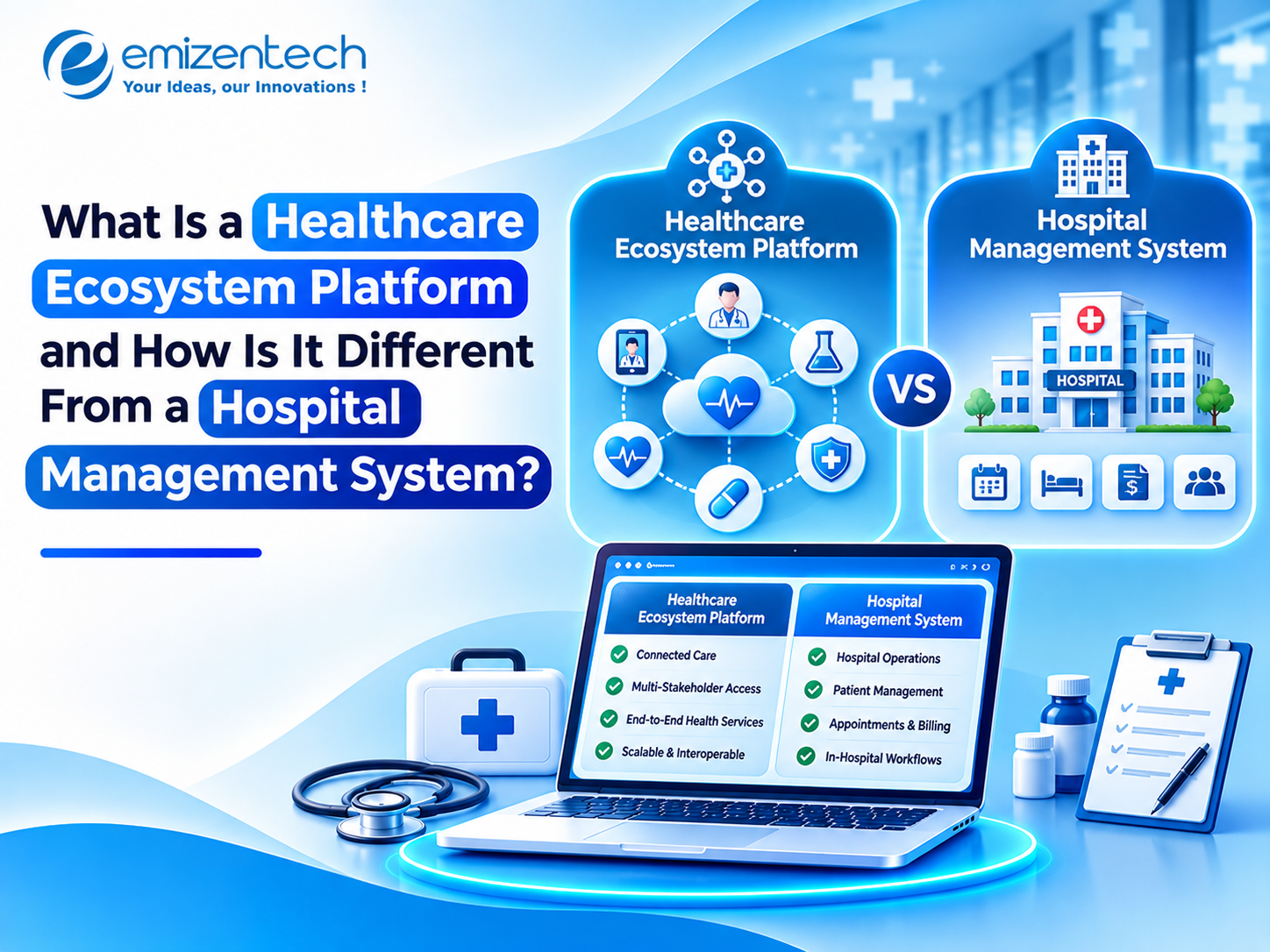
Ask three hospital administrators about their biggest technology headache, and you will probably hear the same story in different words. The pharmacy runs on one system, the lab on another, and billing lives in a spreadsheet. Meanwhile, the patient app shows information that the front desk has never seen. Everyone is working hard. The data just does not travel.
A healthcare ecosystem platform is built to fix exactly that problem. This guide explains what it is, what it contains, how it differs from a hospital management system, and who can realistically use one.
The Basic Idea: One Patient, One Record
At its simplest, a healthcare ecosystem platform is a connected system that brings patient care, pharmacy, laboratory, billing, administration and digital channels together around a single patient record. A patient registers once, at any desk, site or channel, and every department and partner works from that same record.
The practical payoff is easy to picture. Staff stop retyping details, duplicate files stop piling up, and routine tasks such as charge posting or appointment reminders happen automatically. That cuts down manual work, billing gaps and the delays patients feel when departments cannot see each other's information.
Why Connected Platforms Are Gaining Ground in the US
The numbers explain the shift. US health spending reached roughly $5.3 trillion, or 18 percent of GDP, and CMS projects it will climb to $9.0 trillion by 2034. With that much money moving through the system, even small inefficiencies add up quickly.
Digital tools are already deeply embedded. About 95 percent of office-based physicians have an EHR, and 77 percent of individuals were offered online access to their medical records, up from 42 percent in 2014. Around 37 percent of US adults used telemedicine within a recent twelve-month period.
Data sharing is moving in the same direction. Two in three hospitals now use FHIR APIs to give patients access to their data through apps. Once records, portals and telehealth are all digital, the next challenge is making them work together. That is the gap a platform approach addresses.
What Sits Inside a Healthcare Ecosystem Platform
A complete platform is made up of 38 modules, grouped into five parts:
- Clinical core (12 modules): patient registration, appointments, outpatient care, inpatient and bed management, electronic medical records, doctor management, nursing, operation theatre, emergency and ambulance, laboratory, blood bank, and telemedicine.
- Medicine, supplies and support (6 modules): pharmacy, inventory and procurement, biomedical equipment, hospitality, dietary and kitchen, and housekeeping and laundry.
- Administration, people and money (7 modules): hospital administration, human resources, duty roster, payroll, billing and revenue cycle, insurance and corporate claims, and finance.
- Digital channels (5 modules): patient app, doctor app, staff and nursing app, website and patient portal, and an administrative web console.
- Intelligence, integration and governance (8 modules): reporting and analytics, AI decision support, patient engagement and CRM, notifications, interoperability, security and access control, compliance support, and multi-facility and localization.
Nobody needs all 38 on day one. That point matters a lot, and we will come back to it shortly.
How It Differs From a Hospital Management System
A hospital management system, or HMS, supports the day-to-day operations of a single hospital: admissions, billing, pharmacy, lab and the like. It is genuinely useful, but it mostly lives inside the hospital's walls.
A healthcare ecosystem platform covers the same ground and then reaches outward. It connects pharmacies, labs, insurers, corporate payers and referring doctors on the same patient record, and it gives patients their own digital entry points.
| Aspect | Typical HMS | Healthcare Ecosystem Platform |
|---|---|---|
| Scope | One hospital's internal operations | Hospital operations plus partners and patients |
| Partner connections | Often limited or manual | Pharmacies, labs, insurers and referrers on one record |
| Patient access | Usually front desk only | Apps, portal and website on the same data |
| Data exchange | Frequently closed or file-based | Open standards such as HL7 and FHIR, plus a documented API |
| Growth path | Single site | Single clinic to multi-site group, or a licensed product |
The difference is less about features and more about where the data can go. An HMS keeps information in one place. A platform is designed so that information moves safely to everyone who needs it.
Who Can Use One, and Do You Need Every Module?
Clinics, diagnostic centers, hospitals, multi-site groups and healthtech companies that license a product to other operators can all use one. Each picks only the modules it needs. A clinic may start with registration, appointments, outpatient care, billing and pharmacy. A hospital group might add inpatient care, theaters, emergency services and shared reporting.
That is why scoping comes first. In healthcare ecosystem platform development, the team sits down with clinical, administrative and finance leads, maps current workflows to the module list, and decides what gets built now, what waits, and what is not needed at all.
The usual first phase delivers a complete outpatient operation: patient management, appointments, outpatient care, billing, pharmacy, the admin console and core reporting. Inpatient care, diagnostics, digital channels and specialist modules follow in later phases, once the underlying data is reliable. Building in phases keeps the first release manageable and lets each department accept its modules before the next batch begins.
Digital Channels: Where Patients Actually Meet the Platform
Patients rarely care about the architecture behind a system. What they notice is whether they can book a slot, see a report and pay a bill without calling anyone. That is the job of the patient app, the portal and the website, all of which read from the same data as the front desk.
Doctors and staff get their own apps because their working patterns are so different. A doctor needs a quick view of the day and instant alerts for critical results between rounds. A nurse needs a task list and barcode scanning at the bedside. Teams that deliver healthcare app development services usually design these as separate experiences that share one account and one data model, so a visit that starts on the app can finish at the front desk without anyone repeating details.
Intelligence Layered on Top of the Data
Once the data lives in one place, it becomes far more useful. Dashboards can show occupancy, length of stay, payer mix and collection efficiency without anyone stitching reports together by hand.
AI features sit on this same foundation, and they tend to focus on paperwork and planning rather than replacing clinical judgment. Examples include draft consultation notes that a clinician reviews before saving, no-show prediction to guide overbooking and reminders, inventory forecasting to reduce stock-outs, and early warnings when claims are likely to be denied. Adoption is already well underway: according to AMA survey data, 66 percent of physicians now use health AI in some form, up from 38 percent in 2023.
The honest caveat is that these features depend on clean data and clinical sign-off. A platform makes them possible, but it does not make them automatic.
Build or Buy?
There is no universal answer here. Buying an existing product suits standard needs and a fast start. Building suits multi-site groups with unique workflows, deep integrations, or a product they plan to license to other operators.
When comparing the two, look at the cost of workarounds over several years, not only the first year's price. A cheaper system that forces staff into manual workarounds can end up costing more over time.
If licensing the platform to other providers is a possibility, decide that before development starts. A multi-tenant setup affects architecture, data separation and cost, and it is quite difficult to add later.
What a Platform Does and Does Not Do for Compliance
Access controls, encryption, audit trails and consent workflows help support HIPAA and HITECH requirements, and they produce the evidence auditors ask for. What a platform cannot do is make a facility compliant on its own. Policies, staff training, risk assessments and vendor agreements, including a Business Associate Agreement, remain the organization's responsibility.
The stakes are real. HHS OCR reported 663 large breaches in 2024, affecting about 242.9 million people, and hacking was behind 81 percent of them. Security design, therefore, belongs in the earliest planning conversations rather than being added at the end.
Final Thoughts
A healthcare ecosystem platform is best understood as a shift in thinking. Instead of every department keeping its own version of the truth, the whole organization works from one patient record, and partners and patients connect to it through safe, standard channels. A hospital management system handles operations inside the building. A platform extends the same logic to everyone the care journey touches.
For a clinic or hospital group weighing this step, the most useful first move is simple: list the workflows that cause the most rework today and rank them. EmizenTech works with healthcare teams on this kind of scoping, and an honest scoping conversation often shows that the right starting point is much smaller than the full module list.
Frequently Asked Questions
1. What is a healthcare ecosystem platform?
A healthcare ecosystem platform is one connected system that links patients, doctors, staff, pharmacies, labs, insurers and partners on a single patient record. It is made up of 38 modules across five parts: clinical care, supplies and support services, administration and finance, digital channels, and intelligence and governance.
2. Who can use a healthcare ecosystem platform?
Clinics, diagnostic centers, hospitals, multi-site groups and healthtech companies that license a product to other operators can all use one. Each organization picks the modules it needs. A clinic may begin with registration, appointments, outpatient care, billing and pharmacy, while a hospital group can add inpatient care, theaters, emergency services and shared reporting.
3. How is a healthcare ecosystem platform different from a hospital management system?
A hospital management system supports the internal operations of a single hospital. A healthcare ecosystem platform covers those operations and also connects pharmacies, labs, insurers, corporate payers and referring doctors on the same patient record. It gives patients their own entry points through an app and a portal as well.
4. Can a clinic use only some of the modules?
Yes. Every module can be kept, deferred or removed. A common first phase covers a complete outpatient operation, including patient management, appointments, outpatient care, billing, pharmacy, the admin console and core reporting. Inpatient care, theater, emergency and blood bank modules can wait until the facility needs them.
5. Can the platform be licensed to other healthcare providers?
Yes, through a multi-tenant setup that supports tenant provisioning and subscription control. This decision should be made before development begins, because it affects architecture, data separation and cost, and it is difficult to add later.
6. Does a healthcare platform make a facility HIPAA compliant?
No. The platform provides controls such as access management, encryption, audit trails and consent workflows, and it produces the evidence auditors expect. Compliance itself stays with the organization, including its policies, staff training, risk assessments and agreements with vendors.
- Managerial Effectiveness!
- Future and Predictions
- Motivatinal / Inspiring
- Fitness and Wellness
- Medical & Health
- Manufacturing
- Education
- Real-Estate
- Food Industry
- Hospitality
- Online Games
- Sports
- Home Services
- Civil Engineering
- Safety and Protection
- Software Products & Services
- Fashion and Jewellery
- Artificial Intelligence
- Entrepreneurship
- Mentoring & Guidance
- Marketing
- Networking
- HR & Recruiting
- Literature
- Shopping
- Career Management & Advancement