

 SkillClick
How Startups Can Build Scalable Revenue Operations Before Growth Becomes Difficult
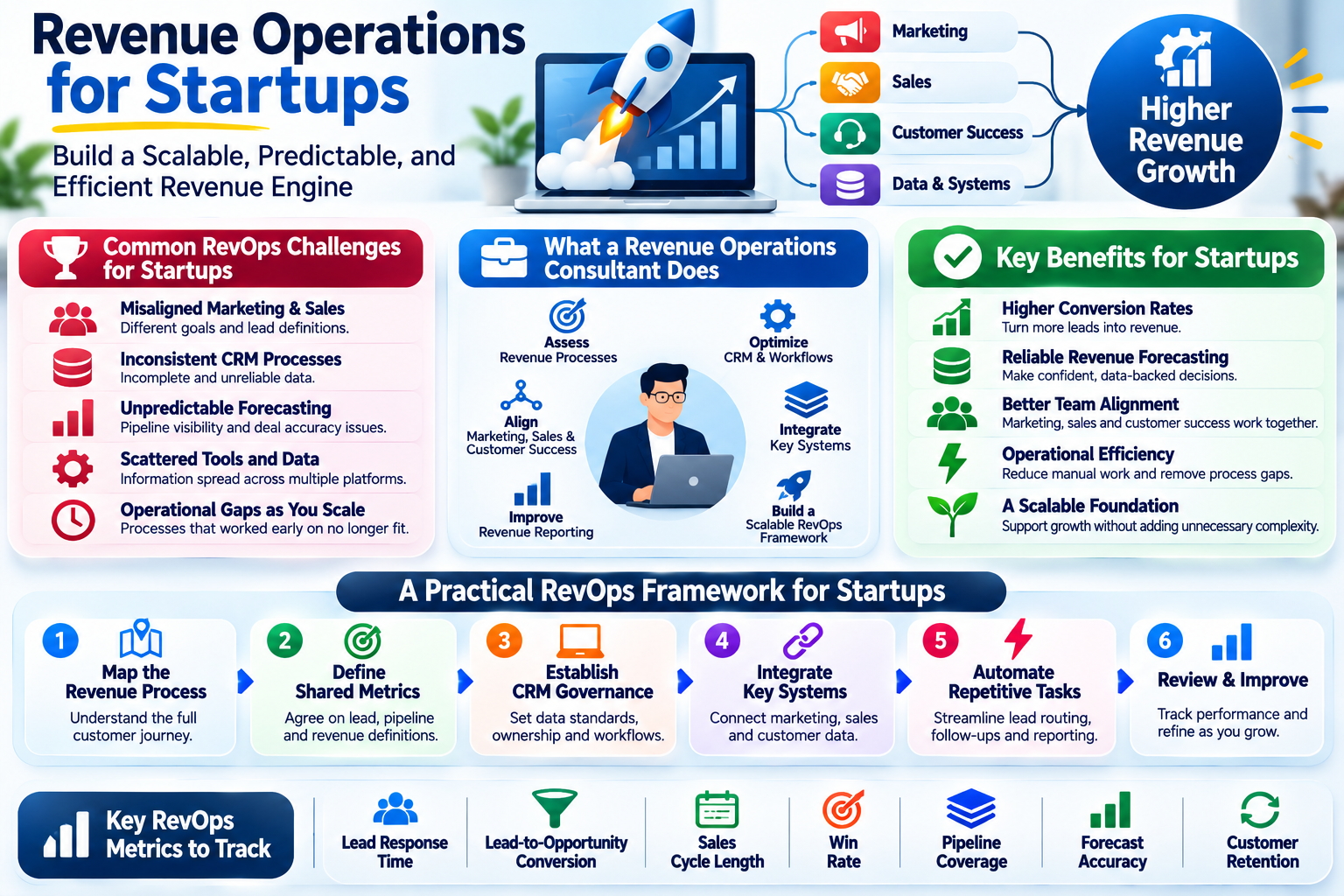
Startups often build their initial sales and marketing processes around speed. Founders manage sales conversations, marketing teams experiment with acquisition channels, and early employees handle customer information using whichever tools are easiest to adopt.
This approach is understandable. During the early stages, flexibility matters more than operational sophistication.
The difficulty begins when the business starts growing. Lead volumes increase, additional sales representatives join, marketing campaigns become more complex, and customer information spreads across multiple platforms. Processes that once worked through informal communication become difficult to manage consistently.
At this stage, growth can expose weaknesses that were previously hidden. Leads may receive delayed responses, sales forecasts become unreliable, CRM records lose consistency, and management struggles to understand which activities actually generate revenue.
A revenue operations consultant for startups can help identify these operational gaps and establish processes that support sustainable growth. The objective is not simply to introduce more technology. It is to create a coordinated revenue system that can accommodate increasing business complexity without unnecessary costs or manual work.
Why Revenue Operations Becomes Important as Startups Scale
Early-stage startups frequently prioritize product development, customer acquisition, and funding milestones. Revenue operations may receive less attention because the initial team is small and communication happens naturally.
However, informal processes become less reliable as the organization expands.
Consider a startup that initially has two sales representatives and one marketing manager. Everyone understands how leads are generated, who handles enquiries, and how opportunities progress.
After a year, the company may have several marketing channels, multiple sales representatives, a customer success function, and a growing customer database.
The original operating model may no longer provide enough visibility or accountability.
Several problems commonly emerge.
1. Marketing and Sales Start Measuring Different Outcomes
Marketing teams may prioritize website traffic, campaign engagement, and lead generation. Sales teams concentrate on qualified opportunities, deal progression, and closed revenue.
When these teams do not share qualification criteria, marketing can generate leads that sales considers unsuitable.
The result is not necessarily poor marketing performance. It may indicate that the organization has not established a shared definition of lead quality.
A coordinated revenue process connects campaign performance with downstream sales outcomes. It helps teams evaluate not only how many leads are generated, but also how effectively those leads progress through the pipeline.
2. CRM Processes Become Inconsistent
Startups often introduce CRM software early, but initial configuration may not account for future operational requirements.
As more employees use the system, different working habits develop. Some representatives update opportunity stages consistently, while others maintain important information in spreadsheets or personal notes.
This creates inconsistent records and makes management reporting less reliable.
A CRM should provide a shared operational view of customer relationships, not become another administrative task that employees update only when required.
3. Revenue Forecasting Becomes Difficult
A startup may have a growing pipeline but limited confidence in its actual revenue outlook.
This can happen when opportunity stages are poorly defined, deal values are outdated, or expected closing dates are based on assumptions.
Forecasting becomes particularly important when leadership needs to plan hiring, marketing expenditure, product investment, or cash requirements.
Without reliable pipeline information, management may make important decisions using incomplete data.
What Does a Revenue Operations Consultant Actually Do?
A revenue operations consultant examines the processes, technology, data, and reporting systems that influence revenue generation.
Rather than focusing exclusively on one department, the consultant evaluates how marketing, sales, and customer success operate together.
The specific responsibilities depend on the startup's maturity, technology stack, and operational challenges.
Revenue Process Assessment
The first responsibility is understanding how the business currently generates and manages revenue.
This includes reviewing:
-
Lead acquisition channels.
-
Lead qualification criteria.
-
Sales ownership and assignment.
-
Opportunity stages.
-
Follow-up processes.
-
Customer onboarding.
-
Renewal and retention workflows.
The assessment should identify where information, ownership, or communication breaks down.
For example, a startup may generate sufficient demand but lose opportunities because incoming leads are not assigned consistently. Improving the assignment process may be more valuable than increasing advertising expenditure.
CRM Optimization and Implementation
A consultant may review the existing CRM configuration or support a new implementation.
The objective is to ensure that the system reflects the actual sales process.
Important areas include contact and company records, opportunity management, custom properties, workflow automation, user permissions, reporting, and data quality.
The right configuration depends on how the startup sells. A business with a short self-service sales cycle will have different requirements from an enterprise software company managing lengthy, multi-stakeholder deals.
Revenue Data and Reporting
Leadership needs accurate information to understand business performance.
A consultant can help establish reporting structures that connect marketing activity, pipeline progression, sales performance, and customer retention.
This may include dashboards for:
-
Lead source performance.
-
Lead-to-opportunity conversion.
-
Pipeline coverage.
-
Sales cycle duration.
-
Win rates.
-
Forecast accuracy.
-
Customer retention.
Reports should answer practical business questions. A dashboard containing dozens of metrics is not useful if leadership cannot determine what action to take.
Technology Integration
Startups frequently use separate systems for marketing automation, CRM, customer support, subscription management, and financial reporting.
When these platforms operate independently, employees may need to transfer information manually.
A consultant can evaluate integration requirements and help establish reliable data flows between systems.
This reduces repetitive work while improving the consistency of customer information across departments.
When Should a Startup Hire a Revenue Operations Consultant?
There is no universal revenue threshold at which a startup must invest in RevOps support.
The decision should be based on operational complexity rather than company age or funding alone.
The following indicators suggest that additional expertise may be useful.
| Business indicator | Underlying operational problem |
|---|---|
| Increasing lead volume but inconsistent conversion | Lead qualification or follow-up gaps |
| Multiple CRM users maintaining different processes | Lack of standardized workflows |
| Unreliable sales forecasts | Inconsistent pipeline management |
| Marketing and sales disagreements | Misaligned performance definitions |
| Manual reporting across platforms | Fragmented data and systems |
| Growing customer base with rising churn | Weak onboarding or retention processes |
| Expansion into new markets | Increasing operational complexity |
A startup does not need to wait until these problems become severe.
In many cases, addressing process and technology issues before hiring additional employees is more efficient than trying to repair an increasingly complicated operating model later.
How to Build a Scalable Revenue Operations Framework
Effective RevOps implementation should follow the startup's actual business requirements. A framework that works for a small product-led company may not be appropriate for an enterprise-focused organization.
A phased approach reduces implementation risk and makes operational improvements easier to measure.
Step 1: Document the Existing Revenue Process
Start by mapping the complete customer journey.
Identify how prospects discover the business, how enquiries are captured, who qualifies them, how opportunities are managed, and what happens after a purchase.
This establishes a baseline against which improvements can be evaluated.
It also exposes areas where employees rely on undocumented knowledge or manual coordination.
Step 2: Define Shared Revenue Metrics
Marketing, sales, and customer success should work with consistent definitions of important performance indicators.
For example, teams should agree on what qualifies as a sales-ready lead and when an opportunity moves from one pipeline stage to another.
Without shared definitions, reports may show different versions of business performance depending on the department producing them.
Step 3: Establish CRM Governance
CRM governance defines how customer and opportunity information should be created, maintained, and used.
Startups should establish:
-
Required fields and data standards.
-
Clear ownership of customer records.
-
Opportunity stage definitions.
-
Duplicate management procedures.
-
User access and permissions.
-
Rules for updating records.
-
Reporting responsibilities.
These controls reduce the risk of poor data quality as the number of CRM users increases.
Step 4: Improve System Integration
Identify which systems need to exchange information and determine which platform should be the authoritative source for each type of data.
For example, marketing campaign information may originate in a marketing automation platform, while opportunity values and sales stages are maintained in the CRM.
Integration rules should specify what information is transferred, when synchronization occurs, and how conflicts or errors are handled.
This is particularly important when a startup is preparing to scale its sales and marketing technology stack.
Step 5: Automate Repetitive Processes
Once workflows are clearly defined, identify tasks that can be automated safely.
Potential examples include:
-
Lead assignment.
-
Follow-up reminders.
-
Opportunity notifications.
-
Customer onboarding tasks.
-
Data synchronization.
-
Reporting updates.
-
Renewal alerts.
Automation should reduce repetitive work without removing necessary human judgment.
For example, a workflow can assign a new lead based on territory or product interest, while a sales representative still evaluates whether the prospect is genuinely qualified.
Step 6: Review Performance and Improve Continuously
Revenue operations is not a one-time implementation project.
Startups change their products, pricing, customer segments, acquisition channels, and sales strategies as they grow.
Their operating processes must evolve accordingly.
Regular reviews help identify whether the existing CRM configuration, reporting structure, and workflows still support business objectives.
Fractional RevOps Support vs. Full-Time Hiring
A startup may need specialized revenue operations expertise without having enough work to justify a full-time senior hire.
This is where fractional support can be useful.
| Consideration | Fractional RevOps support | Full-time RevOps employee |
|---|---|---|
| Cost structure | Usually based on an agreed engagement or scope | Ongoing employment cost |
| Availability | Defined hours or project requirements | Dedicated internal availability |
| Expertise | Can provide access to specialized experience | Depends on the individual hired |
| Flexibility | Can scale with changing requirements | Role may need to evolve internally |
| Best suited for | Defined improvements and ongoing advisory needs | Continuous, complex internal operations |
The choice depends on the startup's size, operational maturity, budget, and expected workload.
Fractional support may be appropriate when the business needs a CRM assessment, implementation guidance, process redesign, or ongoing strategic oversight.
A full-time employee may become more suitable when revenue operations requires continuous internal ownership across several departments and systems.
Neither model is automatically better. The important consideration is whether the business has sufficient expertise and accountability to maintain its revenue processes.
Common Mistakes Startups Make When Building RevOps
Choosing Technology Before Understanding Business Requirements
A popular CRM or automation platform may offer extensive functionality, but that does not mean every feature is necessary.
Selecting software before documenting workflows can lead to unnecessary customization, overlapping tools, and increased administration.
The technology stack should support the operating model rather than determine it.
Scaling Lead Generation Before Fixing Conversion Problems
Increasing marketing expenditure can create more enquiries, but additional volume will not solve inconsistent qualification or follow-up.
Before expanding acquisition activity, startups should understand where leads are being lost and whether the sales team can manage existing demand effectively.
Treating CRM Data as an Administrative Responsibility
CRM data quality is a shared operational requirement.
If employees do not understand why accurate records matter, data maintenance becomes inconsistent. Leadership should establish clear ownership and explain how information supports forecasting, customer management, and business decisions.
Automating Without Monitoring Results
A workflow that functions correctly during implementation may fail when business conditions change.
Changes to territories, sales ownership, product offerings, or qualification criteria can affect automation rules.
Every important workflow should have an owner and a process for reviewing failures, exceptions, and performance.
Expert Insight: Revenue Infrastructure Should Grow With the Business
One of the most common mistakes in startup operations is postponing process improvements until growth creates visible problems.
This often happens because operational work competes with activities that appear more directly connected to revenue, such as product launches, sales hiring, and customer acquisition.
However, the consequences of weak revenue infrastructure accumulate.
A small data inconsistency may initially affect only a few CRM records. As the database expands, the same issue can affect reporting, automation, segmentation, and forecasting.
Similarly, an unclear sales handoff may be manageable with three employees but become a serious operational bottleneck when the team grows to fifteen.
Experienced RevOps professionals generally examine three things before recommending major changes:
First, process maturity. Are the business's existing workflows documented, understood, and consistently followed?
Second, system reliability. Does the technology stack support these workflows without unnecessary manual intervention or duplicated information?
Third, management visibility. Can leadership understand where revenue is generated, where opportunities are lost, and which operational changes are producing measurable improvements?
These questions help distinguish between problems that require additional technology and those that require better process ownership.
The most effective approach is usually to address the highest-impact operational weakness first, measure the improvement, and expand the framework as the business grows.
Frequently Asked Questions
1. What does a revenue operations consultant do for a startup?
A revenue operations consultant evaluates and improves the processes, systems, data, and reporting that support revenue generation. Responsibilities may include CRM optimization, sales process design, marketing and sales alignment, automation, system integration, and performance reporting.
2. At what stage should a startup invest in RevOps?
A startup should consider RevOps when increasing sales activity, team size, or technology complexity makes existing processes difficult to manage. There is no fixed revenue or employee threshold. Operational requirements are more important than company age.
3. How much does a revenue operations consultant cost?
Costs vary according to project scope, consultant experience, technology requirements, and engagement duration. A focused CRM assessment will generally require a different level of investment from a broader implementation involving multiple departments and platforms. Startups should request clearly defined deliverables before committing to an engagement.
4. Can a startup implement RevOps without hiring a full-time employee?
Yes. A startup can assign internal process ownership and use fractional or project-based consulting support for specialized work. This can provide access to expertise without immediately creating a permanent senior role.
5. Which CRM is best for startups?
The appropriate CRM depends on the startup's sales model, customer lifecycle, integration requirements, reporting needs, and budget. Businesses should evaluate their workflows and future requirements before selecting a platform rather than choosing software based solely on popularity.
6. How does RevOps improve startup revenue forecasting?
RevOps helps establish consistent opportunity stages, accurate deal information, shared reporting definitions, and regular pipeline reviews. These practices make it easier to assess expected revenue and identify opportunities that may be delayed or lost.
7. What is the difference between RevOps and sales operations?
Sales operations primarily supports the efficiency and effectiveness of the sales function. Revenue operations takes a broader view by coordinating marketing, sales, and customer success processes, systems, and data across the customer lifecycle.
Building Revenue Operations That Can Support the Next Stage of Growth
A startup's operating model should not become a barrier to its growth.
As teams expand and customer acquisition becomes more complex, the business needs reliable processes for managing leads, opportunities, customer information, and revenue performance.
The right improvements do not necessarily require a complete technology overhaul or a large internal department. They begin with understanding existing problems, establishing clear ownership, improving data reliability, and creating consistent workflows.
A structured revenue operations consultant for startups approach can help businesses make these improvements in a way that reflects their current maturity and future requirements.
The goal is a revenue infrastructure that supports growth without making everyday operations unnecessarily complicated.
- Managerial Effectiveness!
- Future and Predictions
- Motivatinal / Inspiring
- Fitness and Wellness
- Medical & Health
- Manufacturing
- Education
- Real-Estate
- Food Industry
- Hospitality
- Online Games
- Sports
- Home Services
- Civil Engineering
- Safety and Protection
- Software Products & Services
- Fashion and Jewellery
- Artificial Intelligence
- Entrepreneurship
- Mentoring & Guidance
- Marketing
- Networking
- HR & Recruiting
- Literature
- Shopping
- Career Management & Advancement