

 SkillClick
Environmental Impact Assessment Consulting Services in India: Scope, Process and Key Benefits
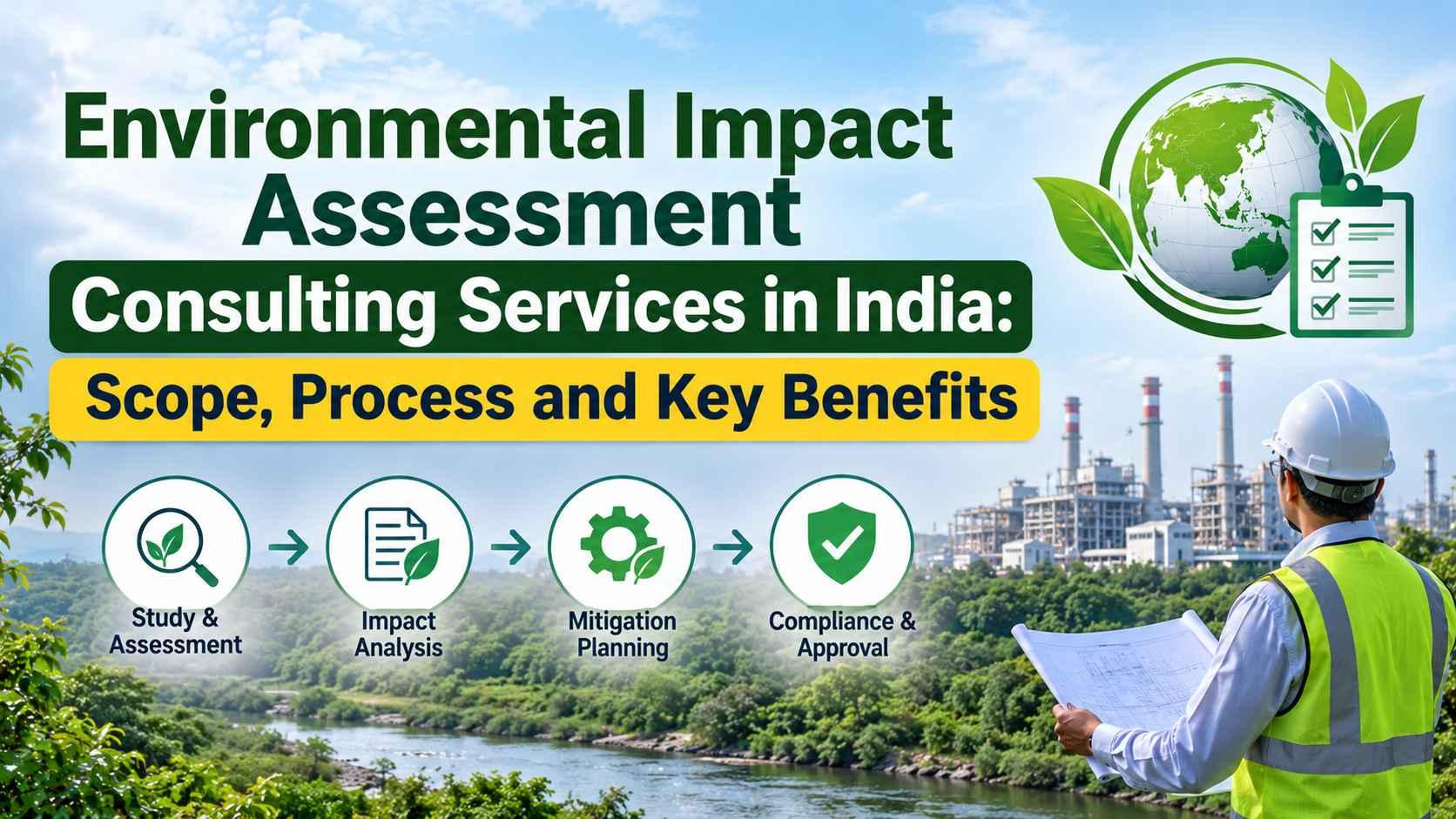
Environmental impact assessment (EIA) consulting in India means hiring a NABET-accredited team to handle project categorisation, scoping, baseline studies, impact assessment, the Environmental Management Plan (EMP), public consultation and appraisal support for an Environmental Clearance (EC). Done well, it keeps your project inside the 105-day appraisal window that the EIA Notification prescribes after a complete application, and it protects you from penalties of ₹10,000 to ₹15 lakh per contravention under the Environment (Protection) Act.
For plant owners, the real risk is not the report itself. It is a wrong category, a weak scope or thin baseline data that sends the file back for clarification and delays construction, financing and revenue. 2026 has also brought structural changes to the appraisal system, covered below.
What Do Environmental Impact Assessment Consulting Services Cover?
Professional environmental impact assessment consulting services cover the full chain from project categorisation to post-clearance compliance. A complete scope typically includes:
- Screening and categorisation: Confirming whether the project falls under Category A (central appraisal), B1 (state appraisal with full EIA) or B2 (exempt from full EIA but needing state consents).
- Pre-feasibility report and Form 1: Preparing the documents that start the process on the PARIVESH portal.
- Terms of Reference (ToR): Drafting the scoping proposal and securing a ToR that defines the study.
- Baseline data collection: Monitoring air, water, soil, noise, ecology and socio-economic conditions, ideally across seasons.
- Impact prediction: Using dispersion, water quality and noise models to assess effects on surroundings.
- Environmental Management Plan: Designing project-specific mitigation, budgets and monitoring indicators.
- Public consultation: Supporting the public hearing and written comments, and documenting responses.
- Appraisal support: Answering committee queries and tracking the file through to the EC letter.
- Post-clearance compliance: Preparing periodic compliance reports against EC conditions.
What Is the EIA Process in India, Step by Step?
IMARC Engineering's planning guide on environmental impact studies outlines six stages with typical durations:
- Screening: 2-4 weeks
- Scoping (ToR): 8-12 weeks
- EIA study: 12-26 weeks
- Public consultation: 6-10 weeks
- Appraisal by EAC or SEAC: 8-16 weeks
- Grant or refusal: 4-8 weeks
End to end, the guide estimates 12-24 months for larger Category A projects and 6-12 months for Category B projects. The 105-day statutory clock applies to the decision after a complete proposal is submitted, so the schedule you control is mostly the work before submission. Only a NABET-accredited organisation can prepare the EIA report for EC submission.
What Changed in Environmental Clearance in 2026?
Plant owners should plan around four developments:
- Standing bodies for continuity (13 July 2026): MoEFCC notified amendment S.O. 3862(E) creating a Standing Authority and Standing Committee on Environment Impact Appraisal for each state and Union Territory. They take over automatically when the state appraisal bodies lapse, for up to 6 months, extendable by another 6 months. This is meant to stop Category B files from piling up centrally.
- Longer tenure and tighter accountability: The tenure of SEIAA and SEAC moves from 3 to 4 years, reconstitution must begin 6 months before expiry, members need 10-15 years of domain experience, and bodies are capped at 15 members. Members can be removed for delays beyond prescribed timelines.
- Forest clearance remains selective: Parliament was told in July 2026 that of 775 forest land diversion proposals considered between July 2023 and May 2026, 378 (48.77%) were recommended for in-principle approval. Sites with forest land need extra planning time.
- Mining decentralisation (18 November 2026): MoEFCC amended the EIA Notification to decentralise clearance for non-coal mining, which matters for plants with captive mineral linkages.
Law firm analysis of the July amendment describes it as an administrative reform, not a change in substantive standards. Study quality still decides outcomes.
What Are the Key Benefits for Plant Owners?
- Schedule certainty: A correct category, a precise ToR and complete baseline data reduce clarification rounds, which are the main cause of slippage.
- Lower design and rework cost: Impacts identified at planning stage lead to correctly sized effluent treatment, air pollution control and waste systems, instead of expensive retrofits.
- Stronger legal defensibility: IMARC's guide notes that weak EIA studies, thin public consultation and generic EMPs are what typically attract National Green Tribunal challenges.
- Penalty avoidance: Violations of the Environment (Protection) Act now attract adjudicated penalties of ₹10,000 to ₹15 lakh per contravention, with the Environment (Protection) Fund Rules notified in January 2026 to govern use of collected penalties.
- Financing readiness: Lenders applying IFC Performance Standards or Equator Principles review EIA quality, so strong documentation supports faster financial close.
- Community acceptance: A documented consultation record reduces opposition during construction and operation.
- Compliance discipline after EC: Defined conditions and reporting formats keep operations audit-ready.
Which Plant-Owner Problems Does Good EIA Consulting Solve?
- Wrong category assumed: Verifying the schedule item and thresholds before budgeting.
- ToR gaps: Missing study requirements force supplementary work later.
- Single-season data: IMARC's guide recommends a three-season baseline for most projects because thinner data often draws appraisal queries.
- Parallel clearances ignored: Forest, wildlife and CRZ approvals can set the real critical path.
- Box-tick public hearings: Perfunctory consultation raises litigation risk.
- Generic EMPs: Plans without quantified commitments, budgets and indicators face appraisal and compliance difficulties.
How Should You Choose an EIA Consultant?
- Check accreditation: Confirm the NABET certificate is current and that your project's sector and category are within its accredited scope. Consultants must work only in sectors they are accredited for.
- Ask for sector track record: Look for completed ToRs and ECs in your category and state.
- Verify data capability: Ask about field teams, laboratory arrangements and modelling tools.
- Look for PARIVESH fluency: Online submission quality affects how quickly the file moves.
- Prefer integrated engineering input: Process, utility and layout teams should work with environmental specialists.
- Insist on a timeline and deliverable list: Each stage should have an owner and a date.
- Plan beyond the EC: Compliance reports and expansion approvals should be in scope.
How Can IMARC Engineering Help?
IMARC Engineering's environmental and sustainability team supports plant owners across the EIA lifecycle:
- Category confirmation and clearance roadmap
- ToR, baseline and EIA-EMP support through accredited channels
- Public consultation preparation
- Integration of findings into plant layout, utilities and waste design
- Post-EC compliance planning and ESG-aligned studies
Talk to Our Experts About Your Requirements: https://www.imarcengineering.com/contact?service=environmental-impact-sustainability-studies
Conclusion
EIA consulting protects schedule, capex and legal standing. Confirm your category early, invest in a precise ToR and full baseline data, treat public consultation seriously and choose an accredited team with sector experience. With the 2026 amendments strengthening continuity in state appraisal, well-prepared files stand to move faster.
Contact Us:
IMARC Engineering
Phone: +91-782-786-0593
Email: sales@imarcengineering.com
India: C-130, Sector 2, Noida, Uttar Pradesh 201301
LinkedIn: https://www.linkedin.com/showcase/imarc-engineering/
- Managerial Effectiveness!
- Future and Predictions
- Motivatinal / Inspiring
- Fitness and Wellness
- Medical & Health
- Manufacturing
- Education
- Real-Estate
- Food Industry
- Hospitality
- Online Games
- Sports
- Home Services
- Civil Engineering
- Safety and Protection
- Software Products & Services
- Fashion and Jewellery
- Artificial Intelligence
- Entrepreneurship
- Mentoring & Guidance
- Marketing
- Networking
- HR & Recruiting
- Literature
- Shopping
- Career Management & Advancement