

 SkillClick
Cost of Setting Up a Lithium-Ion Battery Recycling Plant in India: Investment Requirements and Project Planning
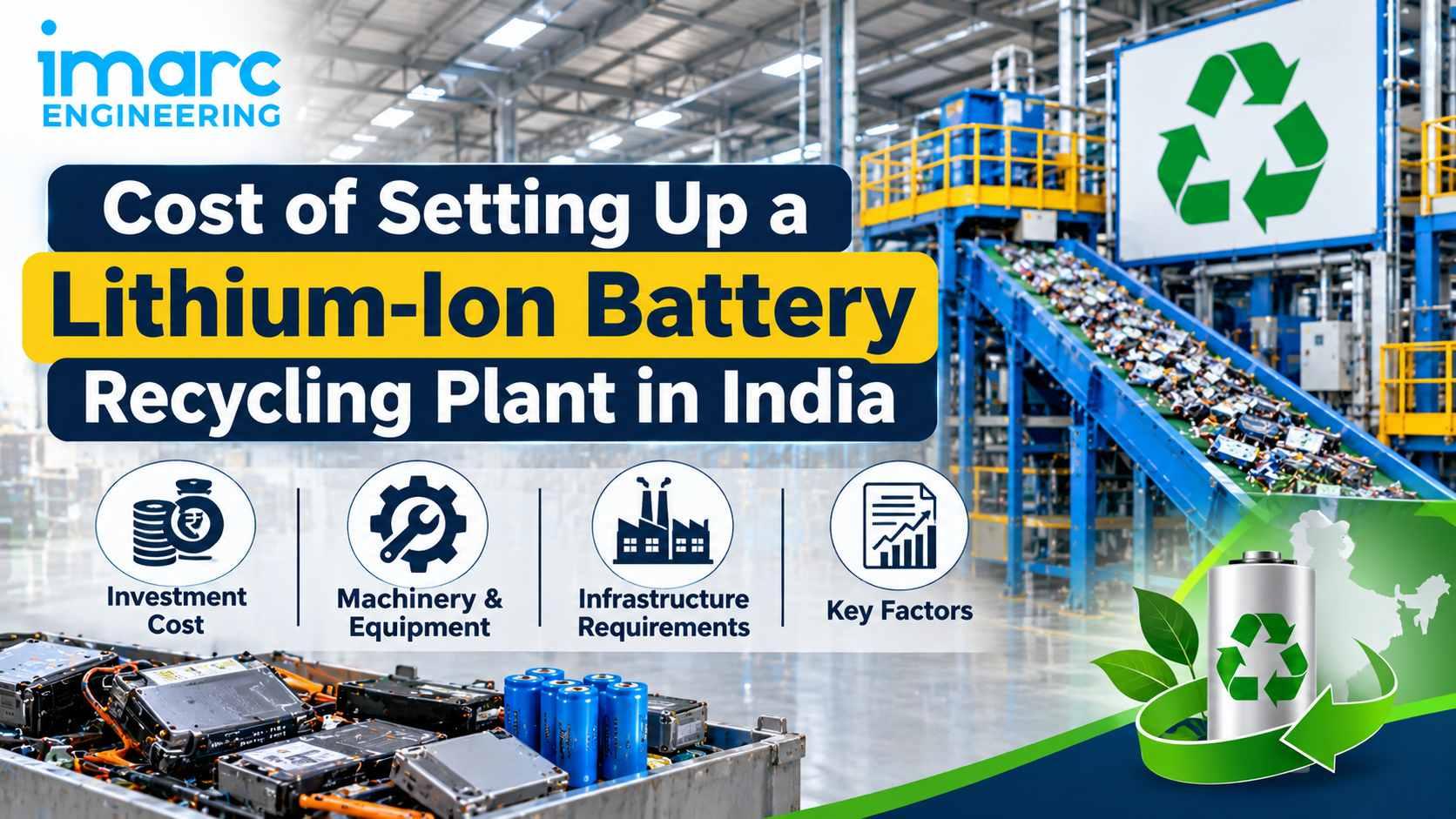
India’s battery recycling sector has moved from pilot projects to bankable capacity. By April 2026, the Ministry of Mines had approved 58 recyclers under its INR 1,500 crore incentive scheme, and together they pledged 850 KTPA of capacity and about INR 5,000 crore of investment against a scheme target of 270 KTPA.
For an investor, the next question is practical: how much capital does a plant need, where does it go, and how much can policy support recover? The honest answer is a range, because route, scale and feedstock chemistry move the number more than any rule of thumb.
A realistic view of the cost of setting up a lithium-ion battery recycling plant therefore starts with three decisions made early in project planning: the recovery route, the processing capacity and the battery chemistry the plant will receive. The sections below put numbers against each.
How Much Does a Lithium-Ion Battery Recycling Plant Cost in India?
A lithium-ion battery recycling plant of 2,000 to 20,000 tonnes per annum (TPA) typically needs INR 5 crore to INR 50+ crore in total investment, according to IMARC Group’s 2026 estimates. Plant and machinery account for 40-50% of the capital, and the 20% capital subsidy under the Critical Mineral Recycling scheme can reduce the net outlay for approved applicants.
Investment by Recovery Route and Scale
- Mechanical black mass unit: covers discharge, dismantling, shredding and separation. A 500-1,000 TPA unit can start at about INR 3-6 crore, while a 2,000 TPA line begins near INR 5 crore.
- Integrated hydrometallurgical plant: adds leaching and solvent extraction to produce battery-grade metal salts. Large integrated facilities can need INR 50 crore or more.
- Why the route matters under the rules: the Battery Waste Management Rules set EV battery recovery targets of 70% in FY2024-25 rising to 90% by FY2026-27, measured on dry weight. Pyrometallurgy loses most lithium to slag, so new plants increasingly lean towards hydrometallurgical or hybrid routes, which carry higher capital cost.
Where the Capital Goes: CapEx Breakdown
Based on a 2,000-20,000 TPA facility, IMARC Group’s 2026 analysis splits capital as follows:
- Plant and machinery: 40-50%
- Civil works and construction: 12-18%
- Land and site development: 10-15%
- Pollution control, effluent treatment and safety systems: 10-15%
- Working capital: 10-15%
- Contingency reserve: 5-8%
- Auxiliary equipment: 4-7%
- Pre-operative costs, including engineering fees, DPR and approvals: 4-7%
Pollution control and fire safety are not optional line items. Fire from damaged or improperly discharged cells is the plant’s most significant hazard, so safety and effluent treatment need their own budget from day one rather than being trimmed later.
Site and Infrastructure Requirements That Shape the Budget
- Land: 3,000-10,000 square metres in total, of which 1,500-4,000 square metres is processing area.
- Power: 500 kW to 2 MW through an industrial high-tension connection, with backup for critical safety systems.
- Water: 30-120 KLD for hydrometallurgical routes, with an effluent treatment plant mandatory under CPCB and SPCB norms.
- Location: proximity to EV, battery and electronics clusters in states such as Maharashtra, Gujarat, Tamil Nadu, Karnataka and Haryana lowers collection logistics and improves margins.
Operating Cost Structure
Feedstock procurement is the largest recurring cost, which makes supply strategy a financial decision as much as a technical one:
- Feedstock procurement: 45-60% of operating cost, with spent EV batteries alone at 35-50%
- Labour and skilled manpower: 10-15%
- Reagents and consumables: 8-14%, mainly for hydrometallurgy
- Utilities: 8-14%
- Compliance and hazardous disposal: 5-10%
- Maintenance and repairs: 3-5%, higher for corrosion-prone leaching and solvent extraction equipment
Government Support That Lowers Net Investment
The Incentive Scheme for Promotion of Critical Mineral Recycling runs from FY2025-26 to FY2030-31 and covers spent lithium-ion batteries and e-waste. Its main terms are:
- Capex subsidy: up to 20% on plant, machinery, equipment and associated utilities, falling to 14% if production starts late after environmental clearance.
- Caps: total incentive of INR 50 crore for large (Group A) entities and INR 25 crore for small (Group B) entities, with opex sub-ceilings of INR 10 crore and INR 5 crore.
- Sales milestones: Group A must reach INR 60 crore and INR 150 crore in years two and five; Group B INR 30 crore and INR 75 crore.
- Reserved share: 30% of the outlay is earmarked for small and newly set up recyclers.
As an illustration, if machinery makes up 40-50% of a INR 20 crore project, that is INR 8-10 crore, and a 20% subsidy on it returns roughly INR 1.6-2 crore. Eligible spend is defined by the guidelines, so treat this as indicative. Note that the application window ran from 2 October 2025 to 1 April 2026, so new investors should confirm whether any fresh window or the battery mineral processing scheme flagged by the Mines Secretary in June 2026 is open.
Returns, Payback and Break-Even
- Gross profit margin: 25-40%, driven by recovered battery-metal value
- Net profit margin: 12-20% after depreciation and taxes
- IRR: 15-25%, higher for hydrometallurgical and export-oriented plants
- Payback: 3-6 years, faster for integrated plants with contracted feedstock
- Break-even capacity utilisation: 55-70%, so an under-supplied plant erodes returns quickly
Project Planning Steps That Protect the Budget
- Feasibility before commitment. Quantify feedstock within an economic collection radius, test technology against the chemistry mix, and model revenue against volatile cobalt, nickel and lithium prices before buying land or long-lead equipment.
- Phase the capital. Commission an initial line sized to near-term feedstock, with civil and utility infrastructure designed for expansion.
- Sequence approvals. The core stack is CPCB recycler registration, SPCB consent to establish and operate, hazardous waste authorisation, a factory licence and a fire NOC. The SPCB must grant hazardous waste authorisation within 120 days of a complete application, valid for five years, and it depends on inspection of installed infrastructure.
- Prepare for lenders. Documented feedstock offtake agreements, a technology performance guarantee and a regulatory roadmap shorten the path to financial closure.
- Plan for the recycled-content mandate. From FY2027-28, producers must use 5% domestically recycled critical minerals in new batteries, rising to 20% by FY2030-31, which favours recyclers delivering battery-grade output.
Common Causes of Cost Overruns
- Sizing capacity to theoretical market volume rather than contracted feedstock
- Finalising machinery before confirming the mix of LFP, NMC and NCA chemistries
- Assuming a fixed EPR certificate price, when it is market-determined
- Underestimating working capital tied up in quarantine and controlled discharge of damaged cells
- Starting civil construction before hazardous waste authorisation, which risks retrofits
- Budgeting for generic industrial hiring when hydrometallurgy needs chemical process engineers and analytical chemists
How IMARC Engineering’s Expertise Can Help in Battery Recycling Plant Setup
- Feasibility studies and DPRs with CapEx and OpEx models by route and capacity
- Technology and machinery selection matched to feedstock chemistry
- Site selection, plant layout, utility and fire-safety design
- CPCB, SPCB, hazardous waste and environmental clearance coordination
- Feedstock and offtake structuring, and lender documentation
- End-to-end project management from site selection to commissioning
Planning to set up a lithium-ion battery recycling plant in India? Contact IMARC Engineering for expert guidance on investment planning, project feasibility and plant setup. https://www.imarcengineering.com/contact-us
Conclusion
A lithium-ion battery recycling plant is priced by its route, scale and feedstock security rather than by a single per-tonne figure, and the INR 5-50+ crore range reflects exactly that. Investors who size capacity to contracted supply, budget for safety and effluent treatment, sequence approvals ahead of construction and test returns against a 55-70% break-even range will reach financial closure with fewer surprises, and will be better placed as recovery targets and recycled-content mandates tighten across the decade.
Contact Us:
IMARC Engineering
Phone: +91-782-786-0593
Email: sales@imarcengineering.com
India: C-130, Sector 2, Noida, Uttar Pradesh 201301
LinkedIn: https://www.linkedin.com/showcase/imarc-engineering/
- Managerial Effectiveness!
- Future and Predictions
- Motivatinal / Inspiring
- Fitness and Wellness
- Medical & Health
- Manufacturing
- Educação
- Real-Estate
- Food Industry
- Hospitality
- Online Games
- Sports
- Home Services
- Civil Engineering
- Safety and Protection
- Software Products & Services
- Fashion and Jewellery
- Artificial Intelligence
- Entrepreneurship
- Mentoring & Guidance
- Marketing
- Networking
- HR & Recruiting
- Literature
- Shopping
- Career Management & Advancement