

 SkillClick
NEET 2027 Physics: How to Master Electrostatics and Improve Problem-Solving Skills
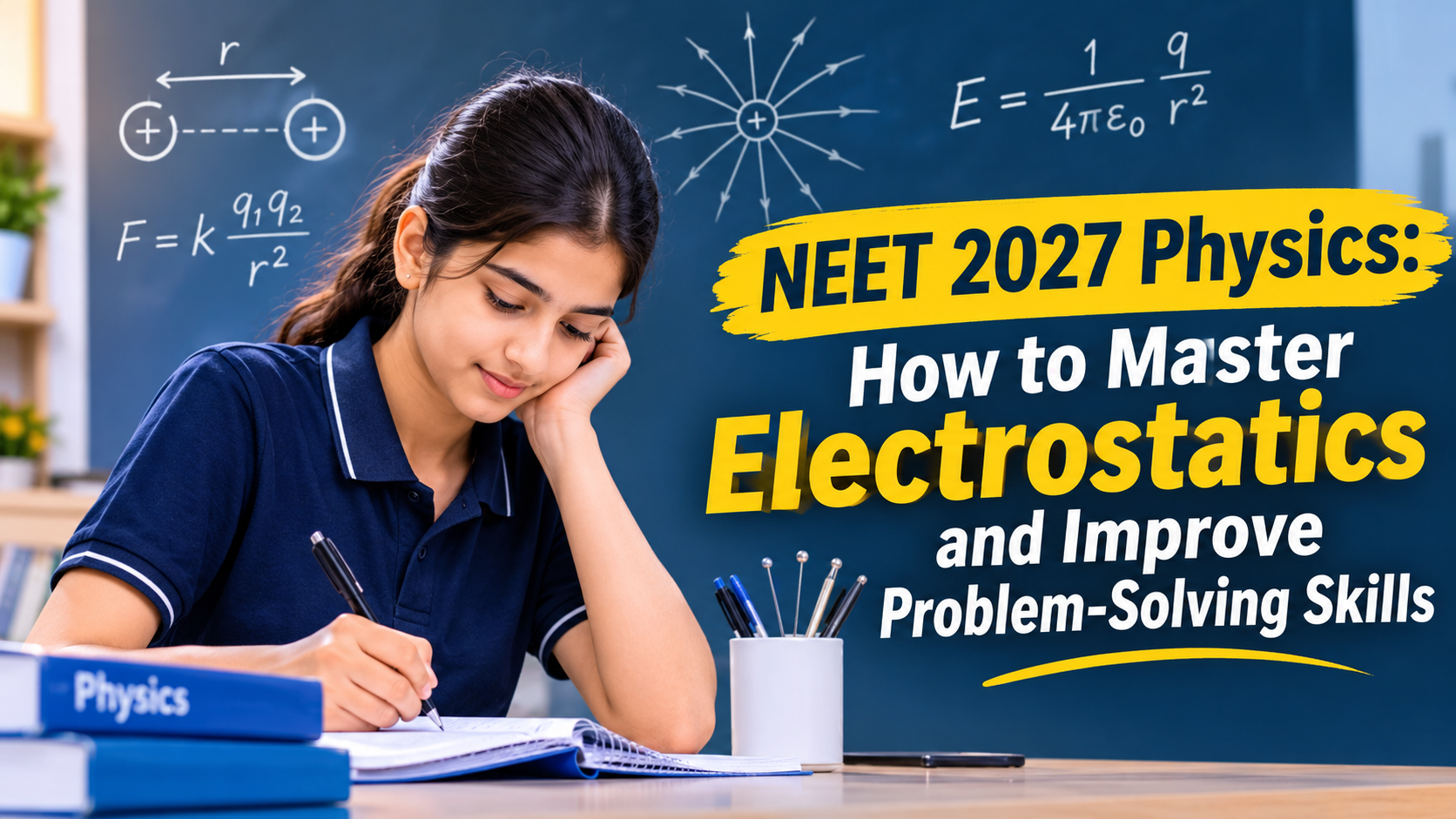
Electrostatics is an important chapter in NEET Physics that deals with electric charges, electric fields, electric potential, and the behaviour of charged particles. Students often find it challenging because it involves vector concepts, mathematical calculations, and the application of multiple formulas.
For NEET 2027, the best way to prepare Electrostatics is to understand the basic principles, practise numerical problems, and revise important formulas regularly.
1. Understand the Basic Properties of Electric Charges
Start with the fundamental properties of electric charges before moving towards complex numerical problems.
Focus on:
-
Positive and negative charges
-
Conservation of electric charge
-
Quantisation of charge
-
Additivity of charges
-
Conductors and insulators
-
Charging by conduction and induction
Understand how objects become charged and how electric charges interact. These concepts form the foundation for the entire chapter.
2. Master Coulomb's Law
Coulomb's law explains the electrostatic force between two stationary point charges.
The magnitude of the force is given by:
[
F=\frac{1}{4\pi\varepsilon_0}\frac{|q_1q_2|}{r^2}
]
Understand the effect of charge magnitude, separation distance, and the surrounding medium on electrostatic force.
Practise questions involving multiple charges and remember that electrostatic force is a vector quantity. Pay attention to the direction of force when solving numerical problems.
3. Understand Electric Field and Electric Field Lines
An electric field describes the region around a charge where another charge experiences an electrostatic force.
Revise:
-
Electric field due to a point charge
-
Electric field due to multiple charges
-
Superposition principle
-
Electric field lines
-
Properties of electric field lines
-
Electric dipole and its electric field
Learn how electric field lines behave around positive and negative charges. Also understand the difference between electric field and electric force.
Practise vector addition problems to improve your understanding of electric fields produced by multiple charges.
4. Learn Electric Dipole and Its Applications
An electric dipole consists of two equal and opposite charges separated by a small distance.
Important concepts include:
-
Electric dipole moment
-
Electric field on the axial line
-
Electric field on the equatorial line
-
Torque acting on an electric dipole
-
Potential energy of an electric dipole
Understand the direction of the dipole moment and how an electric dipole behaves in a uniform electric field.
Use diagrams to remember the direction of electric field and torque in different situations.
5. Master Electric Flux and Gauss's Law
Electric flux and Gauss's law are important topics for understanding electric fields due to symmetric charge distributions.
Gauss's law is expressed as:
[
\oint \vec{E}\cdot d\vec{S}=\frac{q_{\text{enclosed}}}{\varepsilon_0}
]
Focus on:
-
Meaning of electric flux
-
Dependence of flux on surface orientation
-
Gaussian surfaces
-
Applications of Gauss's law
-
Electric field due to an infinite line charge
-
Electric field due to an infinite plane sheet
-
Electric field due to a uniformly charged spherical shell
Understand when Gauss's law can simplify a problem. Practise identifying the correct Gaussian surface based on the symmetry of the charge distribution.
6. Understand Electric Potential and Potential Energy
Electric potential is the work done per unit positive test charge in bringing it from infinity to a point without acceleration.
Revise these concepts:
-
Electric potential due to a point charge
-
Potential due to multiple charges
-
Potential difference
-
Equipotential surfaces
-
Potential energy of a system of charges
-
Relation between electric field and potential
Remember that electric potential is a scalar quantity, whereas electric field is a vector quantity. This distinction is useful when choosing the correct method for numerical problems.
7. Study Capacitance and Capacitors
Capacitance measures the ability of a conductor or capacitor to store electric charge.
Focus on:
-
Capacitance of a parallel plate capacitor
-
Effect of dielectric materials
-
Capacitors in series
-
Capacitors in parallel
-
Energy stored in a capacitor
-
Energy density of an electric field
Practise circuit-based questions involving combinations of capacitors. Understand how inserting a dielectric changes capacitance and how different conditions affect charge and potential difference.
8. Follow an NCERT-Based Practice Strategy
After completing each topic, solve numerical questions and NEET-level MCQs.
Follow this routine:
-
Read the relevant NCERT concepts carefully.
-
Prepare a formula sheet for quick revision.
-
Practise basic numerical questions.
-
Move towards vector-based and application-oriented problems.
-
Solve previous-year NEET questions.
-
Attempt timed chapter tests.
-
Analyse mistakes and revise weak concepts.
Maintain a mistake notebook for calculation errors, incorrect vector directions, and confusion between electric field and electric potential.
Conclusion
Electrostatics becomes easier when you understand the relationship between electric charges, fields, potential, and capacitance. For NEET 2027, focus on conceptual clarity, formula application, diagrams, and consistent numerical practice.
Regular revision and mock-test analysis can help improve problem-solving speed and accuracy. Students planning a structured preparation routine can also explore NEET coaching in Agra while organising their study schedule.
- Managerial Effectiveness!
- Future and Predictions
- Motivatinal / Inspiring
- Fitness and Wellness
- Medical & Health
- Manufacturing
- Education
- Real-Estate
- Food Industry
- Hospitality
- Online Games
- Sports
- Home Services
- Civil Engineering
- Safety and Protection
- Software Products & Services
- Fashion and Jewellery
- Artificial Intelligence
- Entrepreneurship
- Mentoring & Guidance
- Marketing
- Networking
- HR & Recruiting
- Literature
- Shopping
- Career Management & Advancement