

 SkillClick
AI Infrastructure for AI Agents: Multi-Agent Benefits, Risks, and the Future of Enterprise AI | THQ.digital
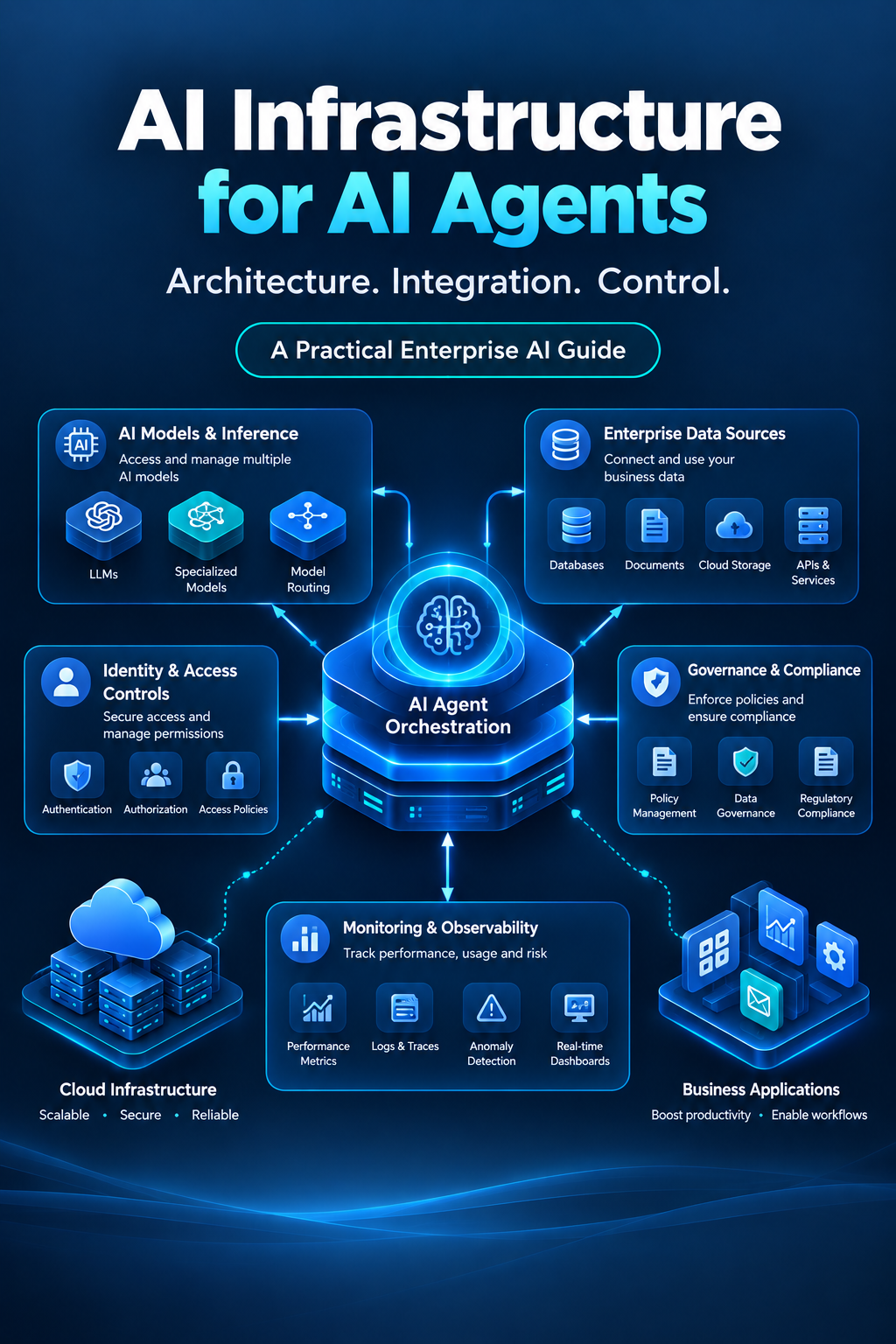
Artificial intelligence is moving beyond standalone chatbots and basic automation toward AI agents that can plan tasks, use tools, retrieve information, and collaborate with other agents. This shift is creating a growing need for reliable AI infrastructure for AI agents.
For enterprises, deploying advanced AI is no longer just about selecting a powerful language model. Businesses also need infrastructure that supports agent coordination, enterprise data access, memory management, security, and governance. These capabilities become especially important when multiple AI agents work together across business functions.
Multi-agent systems can help organisations manage complex workflows through specialised agents, but they also introduce new risks involving coordination failures, data security, unexpected behaviour, and accountability. Understanding both sides is essential before bringing advanced AI into enterprise operations.
What Is AI Infrastructure for AI Agents?
AI infrastructure for AI agents is the combination of technologies, services, and architectural components that allows AI agents to operate, communicate, retrieve information, and perform assigned tasks.
Traditional AI applications generally respond to user instructions or process specific inputs. AI agents can go further by breaking objectives into smaller tasks, selecting tools, accessing authorised information, and executing multi-step workflows within defined boundaries.
A reliable infrastructure supports these activities through several interconnected components:
-
AI models and inference: Provide the reasoning and language capabilities required for agent tasks.
-
Data and knowledge infrastructure: Connect agents with relevant business documents, databases, and applications.
-
AI agent memory: Maintains useful information from previous interactions, tasks, and business activities.
-
Agent orchestration: Coordinates task execution and communication between specialised agents.
-
Security and identity management: Controls agent access to enterprise systems, tools, and sensitive information.
-
AI agent governance: Establishes policies, permissions, monitoring, and accountability for agent activities.
These components form the foundation for building AI systems that can operate within real business environments.
Understanding Multi-Agent AI Systems
A multi-agent AI system consists of multiple AI agents working together to achieve a shared objective. Each agent can have a specialised responsibility, allowing complex workflows to be divided into smaller and more manageable tasks.
For example, consider an enterprise handling a customer service request involving a delayed order.
-
A customer support agent receives and understands the request.
-
An information retrieval agent checks authorised order and delivery records.
-
An analysis agent identifies the reason for the delay.
-
A resolution agent prepares an appropriate response or recommended action.
-
A human employee reviews the case when approval or intervention is required.
An orchestration layer manages the sequence of tasks and information exchange between these agents.
This architecture can support more flexible workflows than relying on a single general-purpose agent. However, the quality of the overall system depends on how well the agents communicate, share information, and follow their assigned permissions.
Major Benefits of Multi-Agent AI Systems
Multi-agent architecture can offer several advantages when applied to appropriate business processes.
1. Specialised Task Execution
Different agents can focus on specific responsibilities, such as research, document processing, data analysis, or customer support. This separation can make complex workflows easier to organise and manage.
2. Improved Workflow Coordination
Agents can exchange task results and pass information between workflow stages. This allows businesses to coordinate processes that involve multiple applications, teams, and information sources.
3. Flexible Enterprise Automation
Multi-agent systems can support workflows that require several steps, tools, or types of information. Organisations can design agents around individual business functions rather than relying on one system to perform every task.
4. Reusable AI Capabilities
Specialised agents may be reused across different workflows when their responsibilities and interfaces are clearly defined. This can simplify the development of additional AI-powered business processes.
5. Better Human-AI Collaboration
AI agents can assist with information retrieval, preparation, analysis, and routine actions, while employees retain oversight of sensitive decisions and exceptions.
These benefits are not automatic. More agents do not necessarily mean better results. Effective orchestration, suitable use cases, reliable data, and appropriate controls remain essential.
Why AI Agent Memory Is Important for Enterprise Infrastructure
An AI agent may complete an individual task successfully but struggle to maintain continuity across multiple interactions if it cannot retrieve relevant information from previous activities.
This is where AI agent memory becomes important.
AI agent memory refers to the mechanisms that allow an agent to retain, organise, and retrieve useful information beyond its immediate input or working context.
In enterprise environments, memory can include:
-
Previous interactions and task history.
-
Relevant customer or business entity information.
-
Organisational preferences and established workflows.
-
Previous decisions and useful task outcomes.
-
Information needed to continue long-running activities.
For example, a sales support agent may need to retrieve previous customer interactions before preparing a follow-up. Without suitable memory and retrieval mechanisms, it may treat every interaction as an entirely new task.
Enterprise AI infrastructure should therefore distinguish between temporary working context and persistent memory. It should also establish how information is stored, updated, retrieved, protected, and retained.
Memory must not be treated as an unrestricted collection of information. Access permissions, data quality, retention requirements, and privacy controls are important considerations.
The Role of AI Agent Governance in Multi-Agent Systems
As organisations deploy more autonomous agents, controlling individual model responses is not enough. Businesses must also govern the actions, tools, data access, and interactions of the complete agent system.
AI agent governance provides the policies and operational controls required to manage how agents behave within enterprise environments.
Important governance capabilities include:
Identity and Access Management
Every agent should have an identifiable role and only the permissions required for its assigned responsibilities.
Policy Enforcement
Organisations need controls that define which actions agents can perform, which data they can access, and when additional approval is required.
Monitoring and Observability
Agent activities, tool calls, workflow execution, and system responses should be monitored to help identify errors and unusual behaviour.
Audit Trails and Accountability
Businesses need records of relevant agent actions, decisions, and system events to support investigation and operational accountability.
Human Oversight
Sensitive actions involving financial transactions, confidential information, or high-impact business decisions may require human review or approval.
Governance should be part of the infrastructure rather than an informal instruction added to an AI prompt. As agents become more interconnected, system-level controls become increasingly important.
Keys Multi Agent risks from advanced AI
Although multi-agent systems offer new opportunities, they also introduce risks that enterprises must consider before deployment.
1. Coordination Failures
Agents may misunderstand instructions, exchange incomplete information, or produce conflicting results. An incorrect output from one agent can affect the work of other agents.
2. Cascading Errors
When several agents depend on one another, an initial mistake can spread through the workflow. This makes testing and monitoring the complete system important.
3. Security and Unauthorised Access
Agents often interact with APIs, databases, and enterprise applications. Excessive permissions or weak identity controls can create opportunities for unintended access and actions.
4. Memory and Data Privacy Risks
Poorly managed memory can preserve outdated, incorrect, or sensitive information. Enterprises need appropriate access restrictions, retention policies, and mechanisms to correct or remove information.
5. Increased Infrastructure Costs
Multiple agents may generate additional model calls, tool requests, storage requirements, and monitoring activity. Organisations need to evaluate resource consumption and operational costs.
6. Accountability Challenges
When multiple agents contribute to a decision or action, identifying which component was responsible can become difficult without suitable logs and governance controls.
The Australian AI Safety Institute's research on multi-agent systems highlights how failures can emerge from interactions between agents, including cascading errors and coordination problems. This reinforces the need to assess the complete system rather than evaluating each agent in isolation.
Essential Components of Enterprise AI Infrastructure
A scalable enterprise architecture should bring the following capabilities together:
|
Infrastructure layer |
Primary responsibility |
|
Model and inference layer |
Runs models and manages inference requests |
|
Agent orchestration layer |
Coordinates agents, tasks, and workflows |
|
Enterprise context layer |
Supplies relevant business information |
|
AI agent memory layer |
Maintains and retrieves useful information over time |
|
Security and identity layer |
Manages permissions and authorised access |
|
AI governance layer |
Enforces policies and operational controls |
|
Observability layer |
Monitors activity, performance, and system events |
These layers have different responsibilities but must work together. For example, memory and context help agents access relevant information, while governance determines whether that information and the resulting actions are permitted.
How Enterprises Can Prepare for Multi-Agent AI Adoption
A practical implementation strategy can help organisations avoid unnecessary complexity.
1. Start with a defined business problem: Identify a workflow where multiple specialised agents can provide meaningful value.
2. Map the required data sources: Determine which documents, applications, databases, and systems agents need to access.
3. Design memory and context management: Establish how agents will retrieve relevant information and maintain continuity across tasks.
4. Define agent identities and permissions: Give each agent access only to the tools and information required for its role.
5. Implement orchestration and monitoring: Track task handoffs, tool usage, agent interactions, and workflow outcomes.
6. Establish governance controls: Define approval requirements, policy enforcement, audit records, and escalation procedures.
7. Test before scaling: Evaluate coordination failures, data security, memory quality, performance, and operational costs.
A controlled rollout allows businesses to identify weaknesses before expanding agent autonomy across critical operations.
How THQ.digital Approaches Enterprise AI Infrastructure
Building enterprise AI infrastructure requires more than connecting models and agents. Organisations also need a structured approach to governance, enterprise knowledge, memory, and inference.
THQ.digital approaches this challenge through an enterprise AI control plane built around three distinct capabilities:
Ritvam – Governance: Provides the governance control plane, with policy enforcement, access controls, observability, and auditability designed into the architecture.
Sutra – Intelligence: Acts as the enterprise context and memory layer. It connects AI agents with organisational knowledge, documents, structured records, interaction history, and live information from connected enterprise systems.
MIRA – Inference: Focuses on inference and model routing, helping direct AI tasks to appropriate models and available computing capacity.
These capabilities address different infrastructure requirements: Ritvam governs, Sutra connects, and MIRA handles inference and routing.
For organisations exploring advanced AI agents, this architecture highlights the importance of building governance and enterprise context into the foundation rather than treating them as optional additions.
Explore the platform: https://www.thq.digital/platform
Conclusion
AI infrastructure for AI agents is becoming a critical foundation for enterprises adopting autonomous and multi-agent workflows. Specialised agents can help coordinate complex tasks, access business information, and support operational processes. However, these opportunities also introduce challenges involving security, memory, coordination, governance, and accountability.
The next stage of enterprise AI will not be determined only by the number of agents an organisation deploys or the capabilities of its models. It will depend on how effectively those agents are connected, informed, governed, and monitored.
A well-designed infrastructure brings together AI agent memory, enterprise context, orchestration, inference, and AI agent governance to support more reliable and controlled AI operations.
Contact Details-
Mail us on -support@thq.digital
Phone us on - +919870112521
Our Location- B.K. Tower, H-65, Sector 63, Noida, Uttar Pradesh 201309, India
Frequently Asked Questions
Q1. What is AI infrastructure for AI agents?
AI infrastructure for AI agents is the combination of models, computing resources, data connections, memory, orchestration, security, and governance capabilities that enable agents to perform tasks and interact with enterprise systems.
Q2. What are the main benefits of multi-agent AI systems?
Multi-agent systems can support specialised task execution, workflow coordination, reusable AI capabilities, enterprise automation, and collaboration between AI agents and human employees.
Q3. Why is AI agent memory important?
AI agent memory helps agents retain and retrieve useful information from previous interactions, tasks, and business activities. It supports continuity across workflows and helps agents work with relevant historical context.
Q4. What is AI agent governance?
AI agent governance refers to the policies, permissions, monitoring, and accountability controls that manage how AI agents access information, use tools, and perform actions.
Q5. How can enterprises reduce risks in multi-agent AI systems?
Enterprises can reduce risks through clear agent identities, limited permissions, policy enforcement, secure memory management, workflow monitoring, audit trails, testing, and human oversight for sensitive actions.
- Managerial Effectiveness!
- Future and Predictions
- Motivatinal / Inspiring
- Fitness and Wellness
- Medical & Health
- Manufacturing
- Education
- Real-Estate
- Food Industry
- Hospitality
- Online Games
- Sports
- Home Services
- Civil Engineering
- Safety and Protection
- Software Products & Services
- Fashion and Jewellery
- Artificial Intelligence
- Entrepreneurship
- Mentoring & Guidance
- Marketing
- Networking
- HR & Recruiting
- Literature
- Shopping
- Career Management & Advancement