

 SkillClick
How Much Can Retailers Save With Retail AI Agents? Building the ROI Business Case
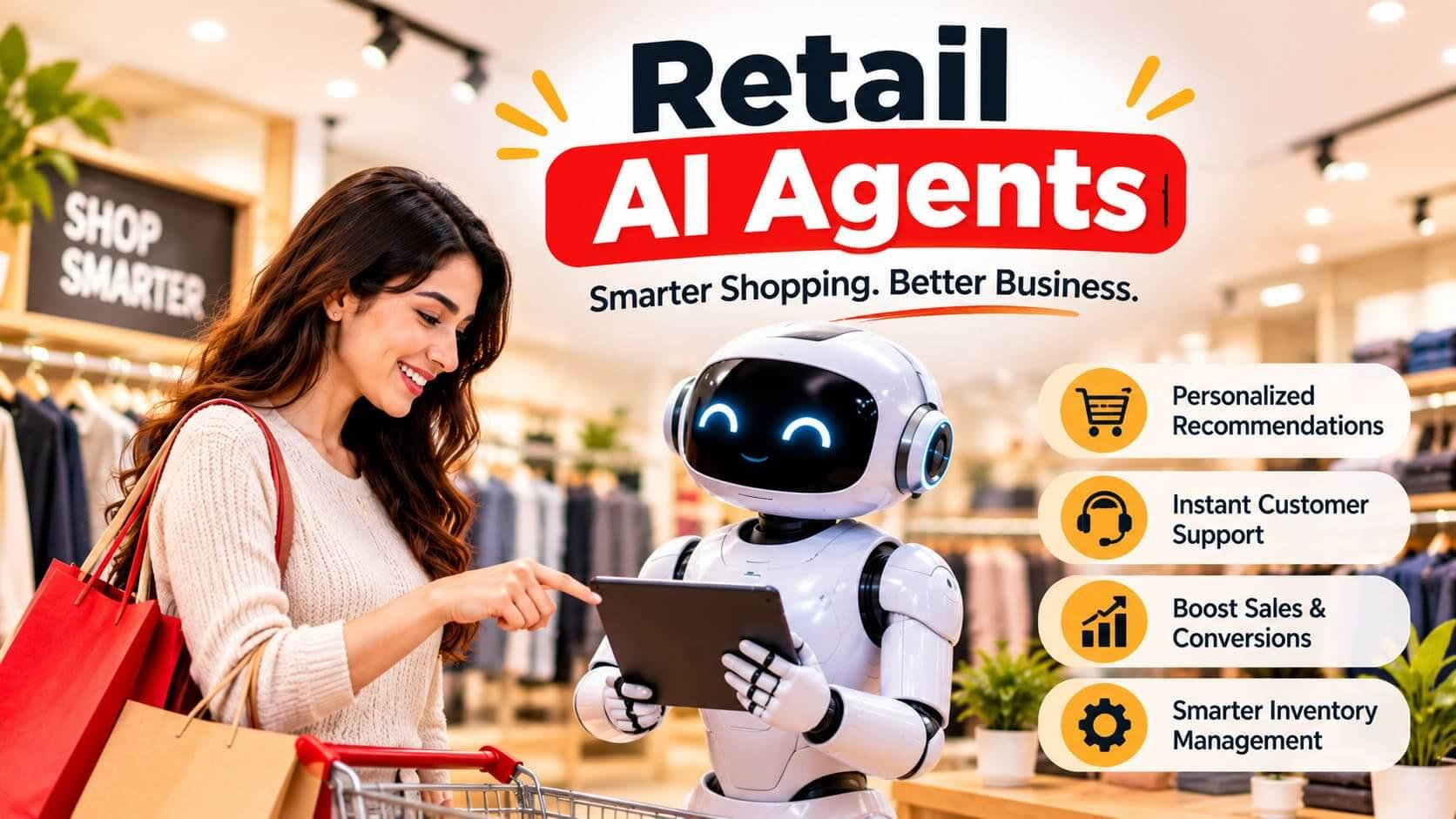
Retail margins have always been sensitive to labour costs, customer acquisition expenses, returns, inventory inefficiencies, and service overhead. At the same time, shoppers increasingly expect instant answers, personalized recommendations, correct product information, and support across every digital channel.
This combination creates a difficult equation for retailers: improve the customer experience while controlling the cost of delivering it.
Pre-trained retail ai agents are becoming an important part of that equation. Instead of functioning only as question-and-answer tools, modern AI-powered agents can support product discovery, order tracking, returns, recommendations, loyalty queries, store information, and customer service workflows. The financial opportunity comes from automating repetitive interactions while simultaneously improving shopping convenience and conversion.
Where Retailers Can Generate the Biggest Savings
The most visible opportunity is customer service.
Retail businesses can receive thousands or even millions of repetitive requests involving delivery status, product availability, refund policies, return eligibility, loyalty points, store hours, and order modifications. When every interaction requires a customer service representative, costs increase directly with contact volume.
AI-powered service automation changes this model. Routine requests can be handled instantly, while complicated, sensitive, or unusual situations are transferred to an employee.
This does not necessarily mean replacing the customer service workforce. Instead, retailers can reduce the number of repetitive interactions employees must manage and allow service teams to focus on cases requiring judgment, empathy, negotiation, or investigation.
For a retailer receiving 500,000 service requests annually, even automating 40% of those interactions means 200,000 requests no longer require the same level of manual handling.
The resulting monetary impact can include:
-
Lower cost per customer interaction
-
Reduced pressure on contact centers
-
Less overtime during seasonal peaks
-
Faster response times without proportional hiring
-
Greater productivity from existing employees
Revenue Growth Should Be Part of the ROI Equation
Cost reduction is only half of the business case.
Retailers should also evaluate whether AI can influence revenue. Product discovery is a good example. A shopper visiting an ecommerce website may know what they need but struggle to find the correct product through filters or traditional keyword search.
An intelligent shopping assistant can understand conversational requests such as, “I need running shoes for daily use under $120” or “Show me a sofa suitable for a small apartment.”
The system can then narrow the catalog, answer follow-up questions, compare options, and guide the shopper toward a purchase.
McKinsey has reported that, across realistic retail chatbot scenarios, a basket uplift of approximately 2% to 4% can be enough to justify underlying LLM operating costs. The same research found that AI-enabled conversational experiences reduced the time needed to complete an order by 50% to 70% in controlled customer experiments.
For large retailers, even a modest improvement in conversion rate, average order value, or purchase frequency can create significant incremental revenue.
Calculate ROI Using a Baseline
Retailers should avoid starting the business case with broad statements such as “AI will reduce costs.” A stronger approach is to document existing operating metrics before implementation.
Consider a hypothetical retailer with the following annual customer service profile:
-
1 million customer interactions
-
Average handling cost: $5 per interaction
-
Current annual service cost: $5 million
-
Percentage of inquiries suitable for automation: 40%
If automation successfully handles 400,000 interactions, the gross addressable service cost is approximately $2 million.
The retailer should not automatically record the entire $2 million as savings. Platform costs, implementation, integrations, AI usage, maintenance, governance, and escalation to human employees must be deducted.
If the total annualized technology and operating cost is $600,000 and the organization realizes $1.5 million in measurable operational savings, the resulting net benefit would be approximately $900,000.
That creates a much more credible ROI calculation than presenting automation percentages alone.
Look Beyond Customer Service
The broader value of this ai agent appears when automation connects with enterprise retail systems.
An agent integrated with ecommerce, CRM, order management, inventory, loyalty, and customer support systems can potentially complete tasks instead of simply answering questions.
Common opportunities include:
-
Checking real-time product availability
-
Helping customers compare products
-
Providing personalized recommendations
-
Tracking or changing orders
-
Initiating eligible returns
-
Answering loyalty-program questions
-
Guiding customers through promotions
-
Escalating complex situations with conversation context
Retailers can also apply AI internally. Store associates may use intelligent assistants to find product details, access policies, understand promotions, or answer customer questions without searching multiple systems.
These productivity gains are harder to calculate initially, but they can become significant when multiplied across hundreds or thousands of employees.
Measure the Metrics That Connect AI to Money
A successful ROI program needs clear performance indicators.
Retail leaders should measure automation rate, cost per interaction, average handling time, escalation rate, conversion rate, basket value, abandonment rate, customer satisfaction, repeat purchases, and AI operating cost per conversation.
The most useful metric will vary by use case. A service-focused implementation may prioritize cost per resolution, while a shopping assistant may be evaluated through conversion and basket uplift.
AI should therefore be treated like any other strategic retail investment: show a baseline, launch against measurable use cases, compare performance, and expand only where the economics work.
Building a Business Case That Executives Can Trust
Retail AI investments become easier to defend when the financial model connects technology directly to business outcomes.
Instead of asking, “How much can AI save us?” retailers should ask more specific questions: How many interactions can be automated? What does each interaction cost today? Can shopper complete purchases faster? Does assisted product discovery improve conversion? Can employees handle more valuable work?
The strongest business case combines operational savings, incremental revenue, employee productivity, and customer experience improvements while accounting for implementation and ongoing technology costs.
For retailers working at scale, relatively small improvements across millions of customer interactions can translate into substantial financial value. The opportunity is not simply to automate conversations. It is to create a more efficient retail operation where every automated interaction has a measurable connection to cost, revenue, or customer value.
Turn Retail AI ROI Into Measurable Business Value
Streebo is a leading digital transformation and AI company helping retailers design and deploy enterprise-grade AI solutions that improve customer experience, automate operations, and deliver measurable business outcomes.
Its retail AI solutions are built to deliver 99%+ response accuracy, supported by strong enterprise guardrails that help minimize hallucinations, protect sensitive information, and keep responses grounded in approved business data.
Powered by Google AI, these solutions can connect conversational experiences with ecommerce platforms, inventory systems, CRM, order management, loyalty programs, knowledge bases, and other enterprise applications.
With prebuilt and custom MCPs, retailers can accelerate integrations without building every connection from scratch. This makes it easier to enable product discovery, order tracking, returns, personalized recommendations, inventory checks, and workflow automation.
By combining advanced AI, enterprise guardrails, system integrations, and a strong focus on accuracy, retailers can scale AI confidently while keeping security, governance, customer experience, and ROI at the center of every implementation.
- Managerial Effectiveness!
- Future and Predictions
- Motivatinal / Inspiring
- Fitness and Wellness
- Medical & Health
- Manufacturing
- Education
- Real-Estate
- Food Industry
- Hospitality
- Online Games
- Sports
- Home Services
- Civil Engineering
- Safety and Protection
- Software Products & Services
- Fashion and Jewellery
- Artificial Intelligence
- Entrepreneurship
- Mentoring & Guidance
- Marketing
- Networking
- HR & Recruiting
- Literature
- Shopping
- Career Management & Advancement