

 SkillClick
How Many Ads Should Be in One Ad Set? A Practical Rule Based on Your Budget
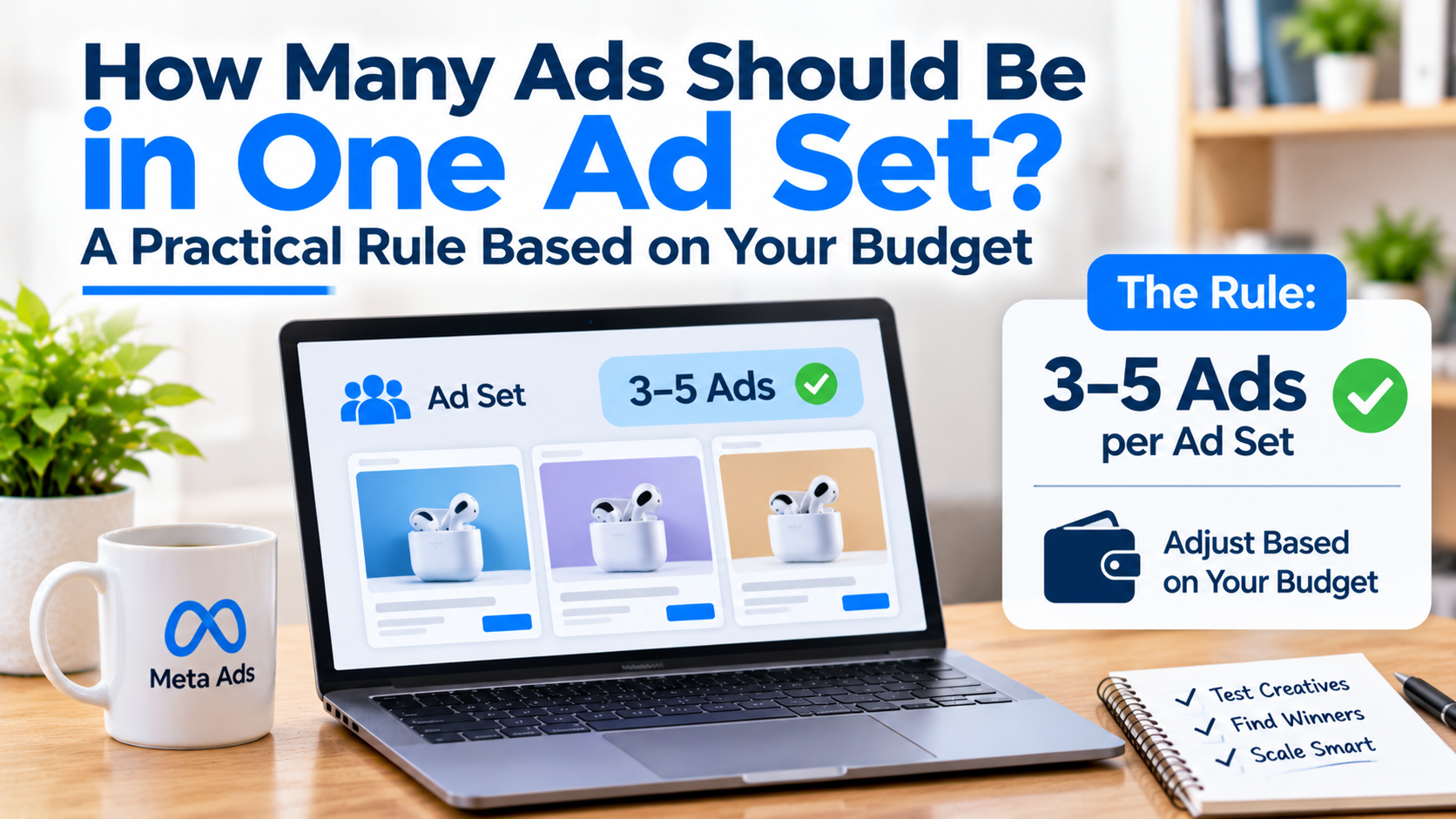
Every Meta advertiser eventually asks the same question: how many ads should I put inside one ad set? One feels risky. Twenty feels messy. And the advice online ranges from a handful to dozens, which does not help much.
The honest answer is that there is no single magic number. The right amount depends mostly on your budget, your conversion volume and how clearly you want to read your test results. This guide gives you a practical way to decide.
Why There Is No One Correct Number
Meta used to publish fairly specific guidance about the number of ads per ad set, and many advertisers still repeat it. Since then, delivery has changed, creative has become more important and plenty of successful accounts run far more ads than the old guidance suggested. The result is that advice has become scattered.
What has not changed is the logic underneath. Each ad needs enough budget and enough chances to show whether it works. When you give a small budget to too many ads, none of them learn anything. When you give a big budget to too few ads, you risk wearing them out quickly.
What Happens When You Run Too Many Ads
When a limited budget is split across many ads, each one gets only a thin slice of delivery. The system tends to favor a couple of early leaders and starve the rest, which means you cannot tell whether the quiet ads were genuinely weak or simply never got a fair chance.
Reporting also becomes harder to read. Ten ads with a few dozen clicks each create a lot of noise and very little certainty.
What Happens When You Run Too Few
The opposite problem is just as real. If you only run one or two ads, the same people see the same message repeatedly, and fatigue arrives sooner. You also have nothing in reserve when your main ad starts to decline.
A single ad per ad set can also limit learning, because you are not giving the system different messages to compare.
A Simple Budget-Based Way to Decide
Start from your daily budget for the ad set and ask a plain question: how many ads can this budget support while still giving each one a meaningful chance to produce results? A small daily budget supports only a few ads. A larger budget can support more.
A useful check is to divide the ad set's daily budget by the number of ads and then compare that figure with what a single conversion costs you. If each ad receives less than the price of a conversion or two per day, you are probably spreading things too thin.
Treat this as a starting framework, not a law. Many advertisers begin with a small group of ads and add more as budgets and conversion volume grow.
Group Ads by Idea, Not Just by Quantity
Rather than counting ads, think about what each ad is testing. Three ads that use the same message with different openings teach you something specific about hooks. Ten unrelated ads with different angles, formats and offers teach you almost nothing, because you cannot tell which difference mattered.
A clean approach is to organize ads around one idea at a time. For example, keep one group for a problem-first angle and another for a social-proof angle. It is much easier to learn from a test when the ads inside it are related.
How to Keep Your Ad Sets Healthy Over Time
Ad sets are not set-and-forget. Watch for ads that never get meaningful delivery, ads whose results are clearly fading and ads that take the majority of spend. Retire the ones that have had a fair chance and clearly failed, and add new ones that test a fresh idea.
Introduce new ads gradually rather than replacing everything at once. This keeps results more stable and lets you see which additions are actually helping.
If your account structure feels tangled and you are not sure how to organize testing, a performance media buyer can help set up campaigns so each ad set has a clear job and a fair test.
You can also browse a real portfolio of campaign work to see how structure and creative fit together in practice.
Frequently Asked Questions
Is there an official limit on ads per ad set?
Meta has changed its guidance over the years, and the old fixed limits are no longer treated as strict rules by many advertisers. Check Meta's current documentation, and let your own results guide how high you go.
Should small budgets use fewer ads?
Generally yes. With a limited budget, a smaller group of ads gives each one more data and makes results easier to read.
Is it better to have one ad per ad set?
Not usually. One ad per ad set limits comparison and spreads your data across many small pieces. A few related ads in one ad set typically gives clearer learning.
How often should I add new ads?
It depends on how quickly your creative tires. Many advertisers add fresh ads on a regular rhythm, such as every week or two, instead of waiting for performance to collapse.
Final Thoughts
The right number of ads in one ad set is the number your budget can support and your testing plan can explain. Start small enough to read your results, group ads by idea and add fresh creative before the old ads wear out. That approach beats any fixed rule.
- Managerial Effectiveness!
- Future and Predictions
- Motivatinal / Inspiring
- Fitness and Wellness
- Medical & Health
- Manufacturing
- Education
- Real-Estate
- Food Industry
- Hospitality
- Online Games
- Sports
- Home Services
- Civil Engineering
- Safety and Protection
- Software Products & Services
- Fashion and Jewellery
- Artificial Intelligence
- Entrepreneurship
- Mentoring & Guidance
- Marketing
- Networking
- HR & Recruiting
- Literature
- Shopping
- Career Management & Advancement