

 SkillClick
E-Invoicing for Trading Companies in UAE: Are You Ready?
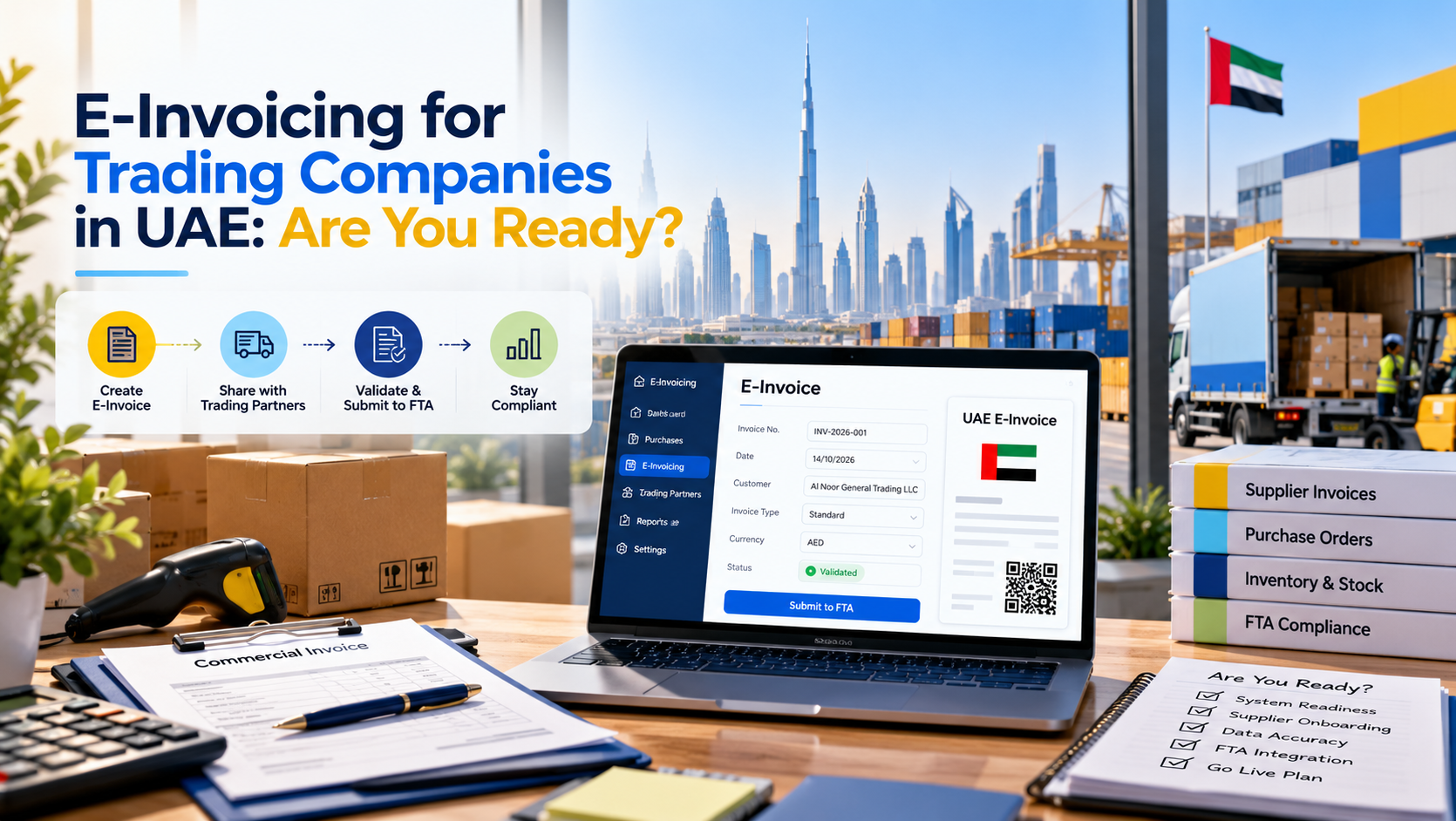
Trading companies in the UAE manage a continuous flow of commercial transactions. From purchasing goods and maintaining inventory to supplying distributors, retailers and corporate customers, each activity creates financial records that need to be managed accurately. As the UAE introduces mandatory electronic invoicing, businesses involved in wholesale trading, distribution and imports need to review how they generate, exchange and maintain invoices. Understanding e-invoicing for trading companies in UAE is therefore an important part of preparing for the upcoming compliance requirements.
For trading businesses, the transition involves more than replacing paper invoices with digital documents. It requires structured invoice data, compatible business software and coordination between suppliers and buyers. Companies operating across retail, wholesale and distribution channels should also understand how UAE e-invoicing requirements for trading and distribution businesses relate to their existing billing operations.
The UAE framework covers applicable business-to-business (B2B) and business-to-government (B2G) transactions. Trading companies should assess their transaction categories, prepare their customer and supplier records, and ensure their invoicing systems can exchange structured electronic invoices through Accredited Service Providers (ASPs).
Why E-Invoicing Matters for Trading Companies in UAE
Trading businesses frequently handle multiple transactions involving manufacturers, distributors, wholesalers, retailers and institutional buyers. A single company may purchase products from several suppliers and distribute them to customers across different locations.
Managing this activity through disconnected invoicing systems can create difficulties. Finance teams may need to compare purchase orders with invoices, check delivery details and resolve differences before processing payments.
Electronic invoicing introduces a structured approach to exchanging invoice information. Instead of relying on documents such as PDFs or scanned copies, businesses exchange machine-readable invoice data through the prescribed system.
For trading companies, this can support several operational improvements:
-
Better invoice processing: Structured information can reduce the need for manual data entry between connected systems.
-
Improved transaction visibility: Finance teams can track invoice exchange and validation statuses.
-
More consistent records: Standardised invoice data helps businesses maintain consistent information across transactions.
-
Simpler reconciliation: Invoice information can be compared with purchase orders and other transaction records.
-
Better system coordination: ERP and accounting platforms can connect with the electronic invoicing process through an ASP.
These benefits depend on proper implementation. Businesses still need accurate source data, suitable workflows and systems that can handle the required invoice information.
How UAE E-Invoicing Affects Trading and Distribution Operations
The impact of electronic invoicing becomes clearer when it is considered alongside the different activities performed by a trading company.
1. Purchase Orders and Supplier Invoices
Trading companies usually purchase products from manufacturers, importers or other distributors. These purchases may involve negotiated prices, product quantities, delivery schedules and payment terms.
For example, a UAE-based electronics distributor may purchase 500 laptops from a supplier. The purchase order records the agreed quantity and price, while the supplier's invoice records the amount payable.
Under the electronic invoicing framework, applicable business invoices must be exchanged in the required structured format.
Businesses should therefore check whether their purchasing and accounting systems can capture the necessary invoice information and connect it with their existing purchase order workflows.
2. Sales Invoices and Customer Transactions
A trading company may sell products to wholesalers, retailers, corporate buyers and government entities.
Each transaction can have different commercial conditions. A retailer may purchase products in bulk, while a corporate customer may require specific purchase order references before accepting an invoice.
Applicable B2B and B2G invoices must follow the UAE electronic invoicing requirements. Businesses should review how their sales systems generate invoice information and whether customer records contain the necessary details.
3. Delivery Records and Invoice Matching
In distribution businesses, goods may pass through warehouses, transport providers and customer delivery locations before a transaction is completed.
Delivery notes, goods received records and purchase orders help businesses verify whether the supplied products match the agreed transaction.
Although these supporting records are not automatically electronic invoices, they remain important to the wider billing workflow. Trading companies should examine how their existing systems connect delivery information with invoice generation and reconciliation.
4. Credit Notes and Invoice Corrections
Trading businesses sometimes need to adjust invoices because of returned products, pricing differences, cancelled orders or other changes in a transaction.
For example, a distributor may invoice a retailer for 100 products, but the customer may return 10 items because they were damaged.
Where an electronic credit note is required under the UAE framework, businesses must issue it through the prescribed electronic invoicing process.
Finance teams should understand how their systems handle invoice adjustments, refunds and credit notes rather than focusing only on standard sales invoices.
What Should Trading Companies Check Before Choosing E-Invoicing Software?
Selecting software for electronic invoicing requires an understanding of existing business operations. A trading company with multiple warehouses and high transaction volumes may have different requirements from a small distributor using basic accounting software.
The following comparison provides a practical starting point.
| Evaluation area | What trading companies should check |
|---|---|
| ERP compatibility | Can the solution connect with the existing ERP or accounting system? |
| Invoice data | Can it capture the required structured invoice fields? |
| Supplier and customer records | Can business information be maintained accurately? |
| Credit notes | Can the system support electronic credit notes and adjustments? |
| Transaction volume | Can it handle the company's expected invoice volume? |
| Integration | Can it exchange invoice data through an ASP? |
| Reporting | Can finance teams access invoice statuses and transaction records? |
| Support | Is technical assistance available during implementation and daily operations? |
A Practical Example: A Wholesale Distribution Business
Consider a UAE-based wholesale distributor that supplies electrical equipment to 40 retail outlets and several corporate customers.
The company currently uses an ERP system to manage purchasing, inventory, sales and accounting. However, invoices are generated through a separate billing application.
When the company begins preparing for electronic invoicing, it identifies three issues:
-
Customer records are maintained separately across different applications.
-
Sales invoices do not always contain the same references as purchase orders.
-
Credit notes are processed manually by the finance department.
Instead of immediately replacing its existing software, the company can assess whether its ERP and billing application can be integrated with an ASP.
It can then improve customer data, standardise invoice information and test different transaction scenarios before mandatory implementation.
This approach allows the company to address its actual operational gaps rather than investing in software without first understanding its requirements.
Businesses evaluating their technology options can also review the UAE electronic invoicing framework and software requirements to understand the broader implementation process.
UAE E-Invoicing Deadlines for Trading Businesses
The UAE Ministry of Finance has introduced a phased implementation schedule based on annual revenue and entity type. Trading companies should identify the category applicable to their business rather than assuming that every trading organisation follows the same deadline.
As of October 2026, the schedule is:
| Business category | ASP appointment deadline | Mandatory implementation |
|---|---|---|
| Businesses with annual revenue of AED 50 million or more | 30 October 2026 | 1 January 2027 |
| Businesses with annual revenue below AED 50 million | 31 March 2027 | 1 July 2027 |
| In-scope government entities | 31 March 2027 | 1 October 2027 |
The pilot programme began on 1 July 2026, with participation by selected businesses.
Trading companies should also remember that their implementation requirements depend on the applicable regulatory scope and exclusions. Their industry classification alone does not determine the implementation deadline.
For businesses in the first category, the ASP appointment deadline is 30 October 2026. The remaining time before mandatory implementation should be used for system integration, data preparation and testing.
Preparing Your Trading Business for the Transition
A planned approach can help trading companies manage the technical and operational changes without unnecessarily disrupting daily activities.
Start by reviewing the existing ERP, accounting and billing applications. Identify where invoice information is generated and whether different departments use separate systems.
Next, examine customer and supplier master data. Missing business information, inconsistent identifiers and incorrect tax details can create difficulties during invoice processing.
Companies should then map their purchasing and sales workflows. Include purchase orders, delivery records, invoice generation, payment reconciliation and credit notes.
Finally, evaluate suitable ASP options and test the proposed integration using different business scenarios. Finance and IT teams should understand how invoices are exchanged, how validation errors are handled and how transaction records are maintained.
Preparing these areas together gives businesses a clearer picture of their readiness.
Conclusion
E-invoicing for trading companies in the UAE involves changes to invoice generation, supplier coordination, customer billing and accounting workflows. Wholesale distributors, importers and trading organisations should review their existing software and identify where structured electronic invoice exchange will fit into their operations.
Starting with accurate business data, ERP compatibility and ASP selection can make the transition easier to manage. Rather than treating electronic invoicing as an isolated compliance activity, trading companies should consider it as part of their wider financial and operational processes.
- Managerial Effectiveness!
- Future and Predictions
- Motivatinal / Inspiring
- Fitness and Wellness
- Medical & Health
- Manufacturing
- Education
- Real-Estate
- Food Industry
- Hospitality
- Online Games
- Sports
- Home Services
- Civil Engineering
- Safety and Protection
- Software Products & Services
- Fashion and Jewellery
- Artificial Intelligence
- Entrepreneurship
- Mentoring & Guidance
- Marketing
- Networking
- HR & Recruiting
- Literature
- Shopping
- Career Management & Advancement