

 SkillClick
Jewellery Manufacturers in Jaipur: Who Owns Your Design?
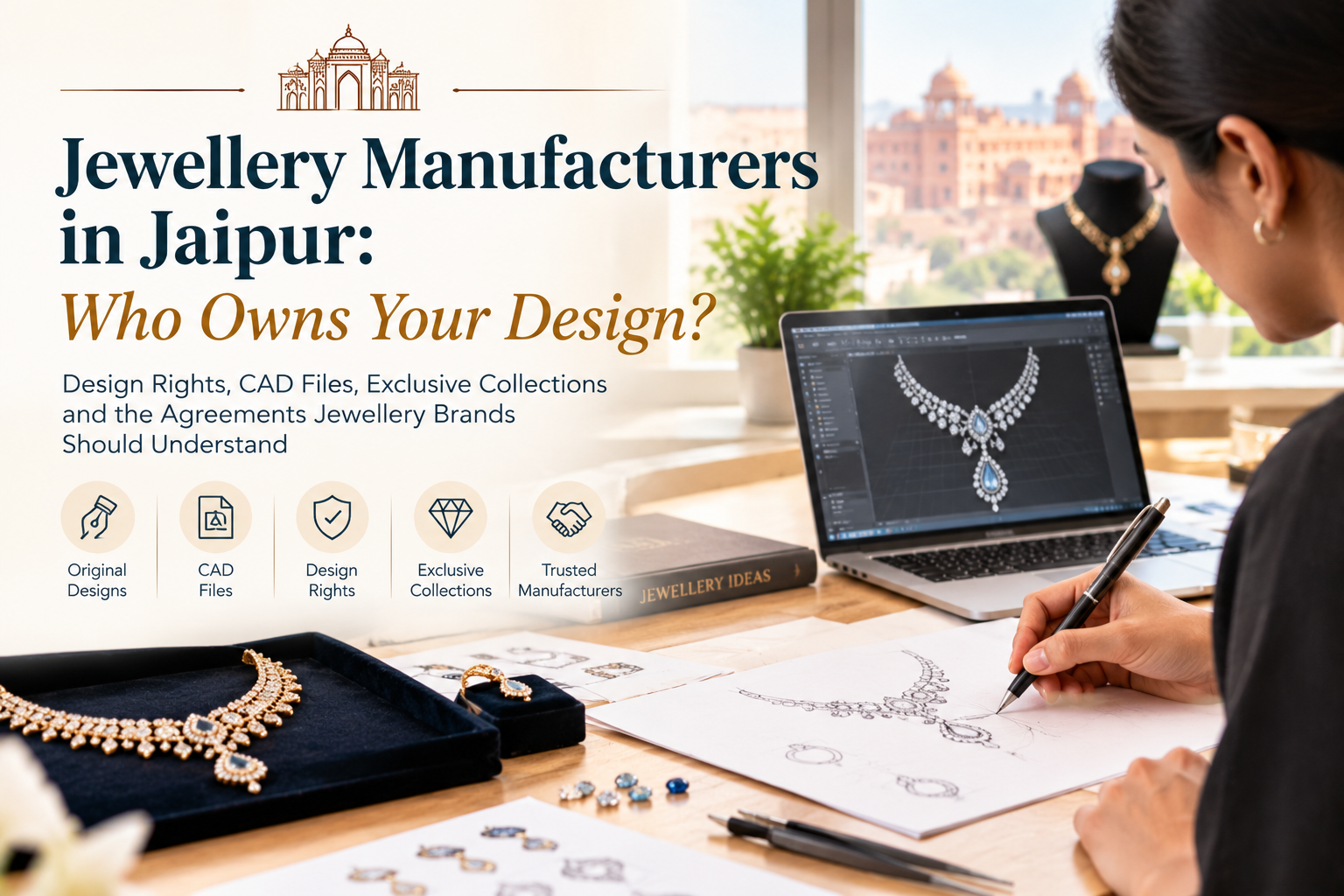
A small jewellery brand spends weeks on a new pendant design. The owner chooses the shape, stone colour and tiny details that make the piece different. A Jaipur workshop produces the first batch. Two months later, a similar pendant appears in another seller's catalogue.
Was the design copied, or did the manufacturer have permission to use it again?
This question matters when you work with Jewellery Manufacturers in Jaipur on an original collection. Jaipur offers access to skilled jewellery artisans and custom production businesses, but a good finished product is only part of a successful partnership. You also need clarity about who controls the design, digital files and future use.
One Pendant, Two Brands: Where Did the Problem Begin?
Imagine two boutique owners who order jewellery from the same workshop.
The first owner shares an original pendant sketch and pays for a custom sample.
The second owner later asks the workshop for a similar product.
If nobody discussed design ownership or exclusive rights, a disagreement may follow.
The first buyer may believe the design belongs only to their brand. The manufacturer may believe it can offer similar work to other customers.
Neither assumption should replace a clear agreement.
Before you share an original design, explain whether you want an exclusive product or simply a custom version of an existing style.
The difference can affect your brand's identity and future sales.
The Sketch Is Yours. Is the CAD File Yours Too?
A hand-drawn jewellery design is only the start.
A manufacturer may turn the sketch into a computer-aided design, or CAD model, before the piece is produced.
That digital file may become useful when you need a different ring size, a matching pendant or another production batch.
But who can access it?
The person who created the original sketch may not automatically have every right to the CAD file made by a separate designer or workshop.
Ownership depends on the relevant law and the terms agreed between the parties.
If you pay for CAD development, clarify whether the fee includes delivery of the editable file.
Also ask whether you can take that file to another manufacturer later.
A PDF preview and an editable production file are not the same thing.
The Mould Nobody Thought to Discuss
Suppose your boutique orders a special pair of silver earrings.
The workshop creates a mould to reproduce the design.
After the first order, you decide to work with another supplier.
Can you take the mould with you?
That depends on your agreement with the original workshop.
Some businesses may charge separately for mould development. Others may include setup costs in the product price.
Payment alone does not always establish ownership of the physical mould or associated intellectual property.
Ask whether the mould belongs to you, the manufacturer or another party.
If it belongs to you, agree on storage, access and return terms.
A small detail like this can become important when your jewellery brand grows.
Jewellery Manufacturers in Jaipur: Exclusive or Catalogue Design?
Not every jewellery business needs a completely original collection.
A new retailer may prefer to select designs from a manufacturer's existing catalogue.
That can reduce the amount of design development required.
An independent brand, however, may want jewellery that competitors cannot purchase from the same source.
These are two different commercial arrangements.
With a catalogue product, the manufacturer may supply the same or similar designs to multiple retailers.
With an exclusive design, the buyer may negotiate restrictions on reuse, resale or supply to competitors.
Exclusivity should be defined clearly.
Does it apply to the exact design, a whole product collection or a particular market?
Does it last for one season or several years?
Without these details, the word "exclusive" can mean different things to each party.
Your Reference Photo Could Create Another Problem
Many jewellery customers share photographs from social media or online catalogues.
A buyer may say, "Make this necklace exactly the same."
But a reference image does not prove that the buyer has permission to reproduce the design.
Some jewellery designs may have legal protection, depending on their originality, registration status, use and applicable law.
For a commercial collection, it is safer to use reference photographs to explain general preferences rather than assume an exact copy is permitted.
You can describe the desired style, dimensions, metal and gemstone arrangement while developing a distinct product.
If you plan to reproduce another brand's design, seek appropriate permission or legal advice.
Original work can help a jewellery business establish a clearer identity.
The Manufacturer Knows Your Next Collection Before Your Customers Do
A jewellery brand may share designs months before a product launch.
The manufacturer could receive sketches, gemstone details, target prices and photographs of unreleased pieces.
Some of this information may be commercially sensitive.
A confidentiality agreement, often called an NDA, can help define what information must remain private.
It should explain what is confidential, who may access it and whether the manufacturer can share it with outside workers or subcontractors.
For example, a workshop may need a specialist stone setter to complete part of an order.
The buyer should know whether that third party will receive confidential design files.
An NDA is not a guarantee that information will never be disclosed, but clear terms can help reduce misunderstandings.
A Design Can Change Without Anyone Noticing
Suppose your brand approves a pendant with a narrow border and three small gemstones.
The final product arrives with a thicker border.
The workshop explains that the change made production easier.
The pendant may still look attractive, but it no longer matches your approved design.
This is why design approval should cover more than a photograph.
For a custom jewellery order, record the important details: dimensions, materials, stone arrangement, finish and any acceptable variations.
If a manufacturer proposes a change, ask for approval before production continues.
Even a small adjustment can affect the appearance of an entire collection.
The aim is not to prevent every practical change. It is to make sure changes are understood and agreed upon.
A Jaipur Manufacturer Can Be a Creative Partner, Not Just a Supplier
A skilled jewellery manufacturer may suggest improvements to a design.
For example, an artisan may notice that a delicate pendant loop could be difficult to use.
A stone setter may recommend a different arrangement to support a gemstone.
A CAD designer may suggest a small change to make a ring more practical.
These ideas can improve the finished product.
However, creative contributions can also raise questions about ownership.
If both the buyer and manufacturer help develop a new design, clarify who may use the final result.
This matters especially when the design becomes part of a commercial jewellery collection.
A productive partnership combines creative freedom with clear business terms.
Finding a Workshop Is Only the First Part
Once you understand the rights and services you need, you can search for relevant businesses.
For example, a boutique that needs original silver pendants may want a manufacturer with custom design and CAD support.
A brand that already owns its production files may need a workshop that can work from approved specifications.
The platform provides business listings and contact options, so you can enquire about the services offered by individual sellers.
Ask whether the business manufactures jewellery directly, works with external workshops or provides design services through another specialist.
A listing does not establish design ownership, exclusivity or production capability. Confirm those details with the business itself.
If you are new to supplier selection, the earlier guide, Jewellery Manufacturers in Jaipur: How to Find One?, explains manufacturer categories, order quantities and production basics.
This article focuses on what happens after you decide to develop your own designs.
The Brand Name on the Box Is Another Separate Decision
A manufacturer may produce jewellery for a retailer that sells the pieces under its own brand.
This is often described as private-label production.
But putting your brand name on the box does not automatically mean you own the underlying jewellery design.
Packaging rights, brand trademarks and design rights are different matters.
For example, a manufacturer may allow several retailers to sell the same pendant under different store names.
If you want a unique collection, discuss product exclusivity separately from branding and packaging.
Also clarify whether the manufacturer may display your products in its own catalogue or marketing material.
A clear arrangement helps both parties understand how the finished jewellery may be presented.
What Happens If You Change Manufacturers Next Year?
A jewellery brand may change suppliers because its order size grows, its product range changes or it needs a different production method.
The transition becomes easier when important design records are available.
Imagine a retailer that has sold the same signature ring for three years.
Customers recognise the design, and the business wants to continue selling it.
If the previous manufacturer holds the only CAD file and mould, a new workshop may need to recreate the product.
That could require extra time and expense.
A written agreement can define which files, samples and tools the buyer may receive when the business relationship ends.
It can also clarify whether any unpaid charges must be settled first.
Thinking about this possibility early can protect the continuity of a jewellery collection.
A Practical Example: The Boutique's First Signature Collection
Consider a hypothetical Jaipur boutique that wants to launch six original silver pendants.
The owner creates the sketches and asks a custom jewellery manufacturer to prepare CAD models.
The workshop will also create the moulds and produce the finished pieces.
Instead of discussing only the price, both sides agree on the commercial terms.
The boutique will receive the approved CAD files. The moulds will remain at the workshop for future orders, but their ownership and return conditions will be written down.
The manufacturer will not supply the six agreed designs to other retailers during a defined exclusivity period.
Any public use of the designs in a portfolio will require the boutique's permission.
These are illustrative terms, not standard conditions offered by all Jaipur manufacturers.
The benefit is clarity.
Both businesses understand what they can do with the designs, even after the first order is complete.
Can Jewellery Designs Be Protected in India?
India has a legal framework for the protection of qualifying industrial designs.
The Designs Act, 2000, provides for registration of eligible designs, subject to legal requirements and exclusions.
Not every jewellery design will qualify, and registration is not automatic.
Copyright, trademarks, registered designs and contractual rights can apply to different aspects of a jewellery business.
The appropriate protection depends on the specific work and circumstances.
For official information, refer to the Intellectual Property India portal.
If a design is commercially valuable, consider advice from a qualified Indian intellectual property professional before public release or large-scale production.
A written manufacturer agreement and formal intellectual property protection serve different purposes.
One does not automatically replace the other.
Three Questions Worth Asking Before You Share a Design
A long contract cannot help if both sides misunderstand the basic arrangement.
Start with three clear questions.
First, who will own the original design, CAD files and moulds after payment?
Second, can the manufacturer sell or reproduce the same design for another customer?
Third, what happens to the files and production tools if the business relationship ends?
The answers may differ from one manufacturer to another.
Get important commitments in writing and review them before you share valuable original work.
For a high-value collection, legal review may be worthwhile.
Quick Answers About Jewellery Design Ownership
Do jewellery manufacturers in Jaipur offer exclusive designs?
Some custom jewellery manufacturers may agree to exclusive production. The scope, duration and cost of exclusivity depend on the contract.
If I pay for a CAD file, do I automatically own it?
Not necessarily. Payment and intellectual property ownership are separate questions. Confirm the rights and file-delivery terms in writing.
Can a manufacturer reuse my jewellery design?
That depends on the applicable rights and contractual terms. An explicit agreement can define permitted and restricted use.
Is a confidentiality agreement useful for jewellery brands?
It can be useful when a brand shares unreleased designs, product plans or commercially sensitive information with a workshop.
Can I move my jewellery design to another manufacturer?
It depends on whether you have the necessary rights, files and permissions. Clarify transfer conditions before production begins.
Is a custom jewellery design automatically registered in India?
No. Registration under the relevant design law requires an application and satisfaction of applicable legal requirements.
Your Best-Selling Design Deserves More Than a Verbal Promise
A jewellery collection can become closely associated with a brand.
Customers may recognise a particular pendant shape, gemstone pattern or ring style.
If that design becomes successful, questions about ownership and reuse can suddenly become important.
When you work with Jewellery Manufacturers in Jaipur, do not focus only on whether the workshop can make the piece.
Consider who may reproduce it, where the design files will remain and what happens if you change suppliers.
A clear agreement allows both the jewellery brand and manufacturer to concentrate on their work with fewer misunderstandings.
A successful design should create value for your business—not an avoidable dispute.

- Managerial Effectiveness!
- Future and Predictions
- Motivatinal / Inspiring
- Fitness and Wellness
- Medical & Health
- Manufacturing
- Education
- Real-Estate
- Food Industry
- Hospitality
- Online Games
- Sports
- Home Services
- Civil Engineering
- Safety and Protection
- Software Products & Services
- Fashion and Jewellery
- Artificial Intelligence
- Entrepreneurship
- Mentoring & Guidance
- Marketing
- Networking
- HR & Recruiting
- Literature
- Shopping
- Career Management & Advancement