

 SkillClick
Investment Platform for Sale, Own the Gateway to Business Opportunities in FinTech, Healthcare and Media
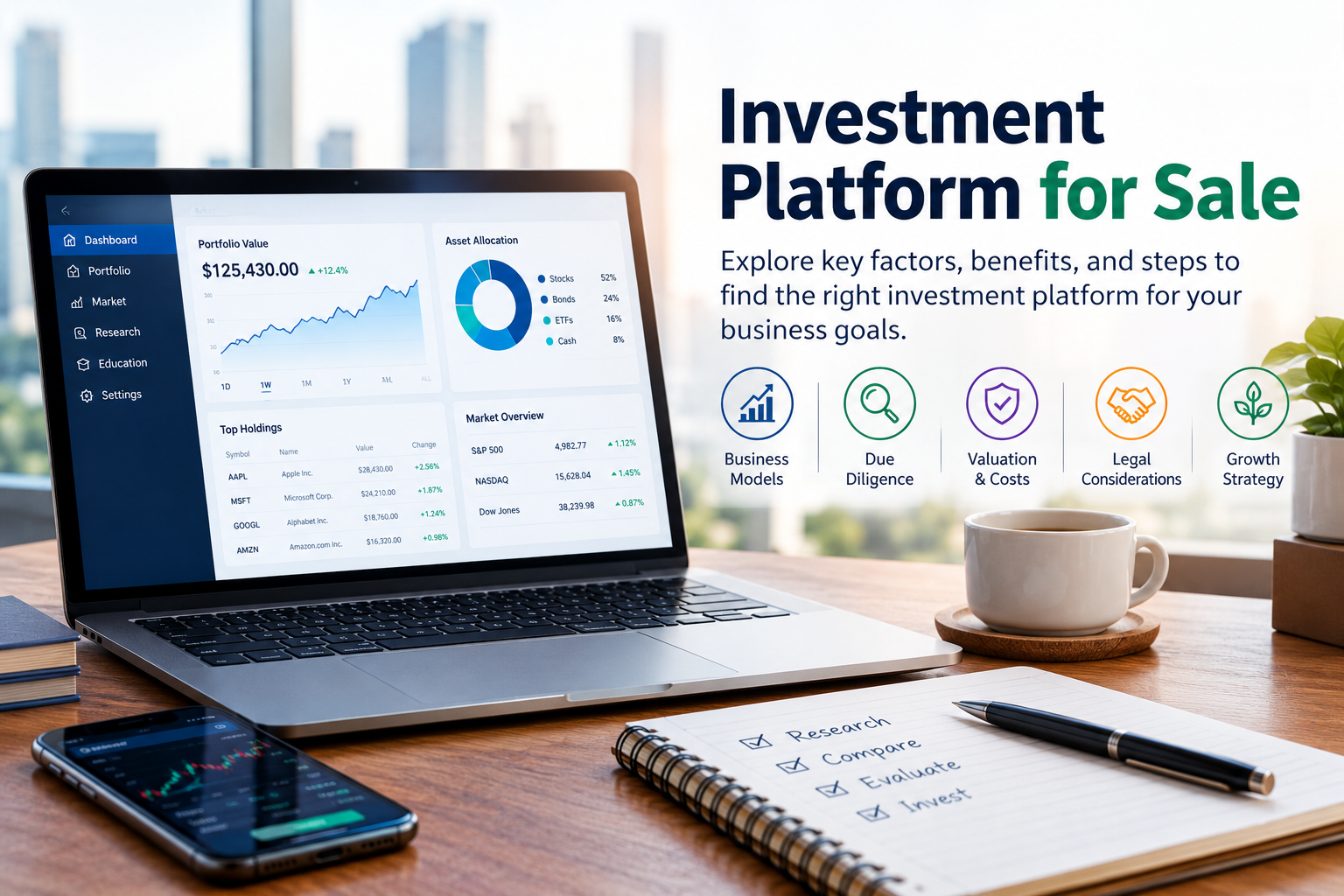
Investment Platform for Sale - What Business Buyers Should Know Before Investing
Introduction
Digital finance has opened new possibilities for entrepreneurs who want to build or acquire businesses in the financial technology sector. From financial information websites to portfolio management applications, online platforms now serve people who want convenient ways to understand and organize their financial activities. For entrepreneurs considering an investment platform for sale, the challenge is finding a business that offers genuine value, dependable technology, and a realistic path toward future development.
Buying an existing platform can provide a starting point that would otherwise take months or years to develop. However, an established website or application is not automatically a profitable business. Buyers need to investigate how the company operates, who uses its services, how it earns money, and what responsibilities come with ownership.
What Makes an Investment Platform Worth Considering?
An investment platform is a digital product or service designed to support activities related to financial markets. Its features may include educational resources, financial data, portfolio monitoring, company research, or access to investment transactions.
The purpose of each platform determines its commercial potential. For example, a website offering financial learning materials may depend on subscriptions or course sales, while a software provider might earn revenue by licensing its tools to financial professionals.
Before contacting a seller, prospective buyers should establish what they want to achieve. Some may be interested in acquiring a technology product, others may prefer a content-driven business, and some may want to expand an existing financial services company. Defining this objective makes it easier to compare available businesses and avoid paying for features that do not support the intended strategy.
Different Business Models to Explore
Financial Knowledge and Learning Websites
Financial education businesses help people understand concepts such as asset allocation, market volatility, company valuation, and long-term financial planning. Their products may include online lessons, downloadable guides, webinars, and membership programs.
An established education website can provide an audience and an existing collection of resources. Buyers should examine whether the material remains accurate, whether customers continue to engage with it, and whether the business depends heavily on a single instructor or content creator.
Investment Data and Research Services
Research-oriented platforms organize financial information into reports, company summaries, market updates, or analytical dashboards. Their customers may include individual learners, professional researchers, and businesses that need organized financial information.
When evaluating this type of company, review the reliability of its information sources and the permissions attached to its data. Historical reports, analytical methods, and proprietary research may contribute to the business's value, but only if the relevant rights can be transferred legally.
Portfolio Tracking Applications
Portfolio tracking software helps users view their investments, monitor changes in value, and understand how their holdings are distributed across different assets.
Potential buyers should test whether the software works reliably across supported devices and data sources. They should also investigate integration costs, customer support requirements, privacy safeguards, and the expense of maintaining compatibility with external services.
Applications that move beyond tracking into personalized recommendations or investment management may have additional regulatory responsibilities.
Financial Software for Businesses
Some investment-related platforms serve other companies rather than individual investors. They may provide reporting systems, data management tools, research workflows, or software that helps financial teams organize information.
A business-to-business product may benefit from ongoing customer contracts, although buyers should check renewal terms, customer concentration, service commitments, and the resources required to support each account.
Online Trading Services
Platforms that enable users to execute securities transactions operate in a more complex environment. Their operations can involve regulated activities, customer verification, transaction monitoring, cybersecurity, capital requirements, and oversight by financial authorities.
An interested buyer should not assume that acquiring the software or company automatically transfers every necessary authorization. The applicable rules depend on the services offered and the jurisdictions involved, so specialist legal advice is essential.
How to Investigate a Business Before Buying
A promising sales presentation is only the beginning of the evaluation process. A buyer should request evidence that confirms the company's condition and helps identify problems that may not be visible from the outside.
Check the income model. Determine exactly how the platform generates revenue. Examine financial documentation, including membership payments, signed client agreements, advertising earnings, software licensing fees, and supporting business records. Separate repeatable earnings from temporary income and compare revenue with actual operating expenses.
Understand the audience. Look beyond the number of registered users. Examine how frequently customers return, how many pay for the service, why customers cancel, and whether new customers can be acquired at a reasonable cost.
Inspect the product. Arrange a technical assessment to identify outdated components, performance problems, security weaknesses, and expensive maintenance requirements. Confirm who owns the source code, domain name, trademarks, and other essential assets.
Review contractual obligations. Identify agreements with suppliers, data providers, employees, contractors, and customers. Check whether these contracts can continue after the sale or require permission to transfer.
Investigate compliance. Review relevant licenses, registrations, privacy policies, customer agreements, and any history of regulatory complaints or legal disputes. Where regulated services are involved, qualified professionals should establish which approvals are required before the new owner can continue operating.
Calculating the Real Cost of Ownership
The asking price represents only one part of an acquisition. A buyer must also consider the money needed to maintain and improve the platform after the transaction.
Expenses may include hosting, software development, security testing, data subscriptions, customer service, employee compensation, insurance, and legal advice. Businesses with complicated technology or regulated operations may require a larger financial reserve than expected.
Valuation should reflect the platform's demonstrated performance, the durability of its revenue, customer relationships, intellectual property, and foreseeable costs. Depending on the business, a buyer may compare similar transactions, assess earnings, or use projected cash flows.
Forecasts should be based on reasonable assumptions rather than optimistic growth estimates. An independent valuation professional can help determine whether the seller's asking price is supported by available evidence.
Creating a Practical Plan After Acquisition
A successful purchase needs a clear operating strategy. During the initial period, the new owner should prioritize continuity: keeping the platform available, protecting customer information, maintaining important supplier relationships, and resolving urgent technical issues.
Once operations are stable, the business can investigate ways to improve its service. These might include simplifying navigation, improving mobile usability, adding useful research features, or expanding educational resources in response to customer feedback.
Websites offering financial insights or learning resources can attract more visitors by implementing effective search engine optimization strategies. Useful articles, clear page structures, relevant search terms, and accurate references can help people discover the website. Content should be regularly reviewed because financial information can become outdated.
Growth should be measured using meaningful indicators, such as customer retention, recurring revenue, support costs, website engagement, and the proportion of visitors who become paying customers.
Mistakes That Can Make an Acquisition Expensive
One major risk is treating popularity as proof of profitability. A platform can attract substantial traffic while generating little income or facing high operating costs.
Another mistake is failing to confirm ownership of important assets. A seller might operate software that relies on third-party code, restricted financial data, or contracts that cannot automatically be transferred.
Buyers should also avoid rushing through legal reviews or relying exclusively on information supplied by the seller. Independent verification, a detailed purchase agreement, and clearly defined responsibilities can reduce uncertainty.
Where appropriate, the agreement should specify which assets are included, how liabilities will be handled, what representations the seller makes, and whether technical assistance will be provided during the handover.
Conclusion
Searching for an investment platform for sale can help entrepreneurs explore an established entry point into digital finance. Potential acquisitions range from educational websites and research services to software applications and more complex trading businesses.
The best choice depends on the buyer's objectives, technical knowledge, available resources, and ability to meet ongoing legal obligations. A careful review of financial records, customer behavior, technology, ownership rights, and operating costs can reveal whether a platform is a suitable business investment.
Rather than focusing exclusively on the purchase price or promises of rapid expansion, buyers should assess how the business creates value for its customers and whether that value can be sustained. A well-researched acquisition, supported by a realistic operating plan, provides a stronger basis for responsible long-term growth.
- Managerial Effectiveness!
- Future and Predictions
- Motivatinal / Inspiring
- Fitness and Wellness
- Medical & Health
- Manufacturing
- Education
- Real-Estate
- Food Industry
- Hospitality
- Online Games
- Sports
- Home Services
- Civil Engineering
- Safety and Protection
- Software Products & Services
- Fashion and Jewellery
- Artificial Intelligence
- Entrepreneurship
- Mentoring & Guidance
- Marketing
- Networking
- HR & Recruiting
- Literature
- Shopping
- Career Management & Advancement