

 SkillClick
Medical Billing vs Revenue Cycle Management: What’s the Difference?
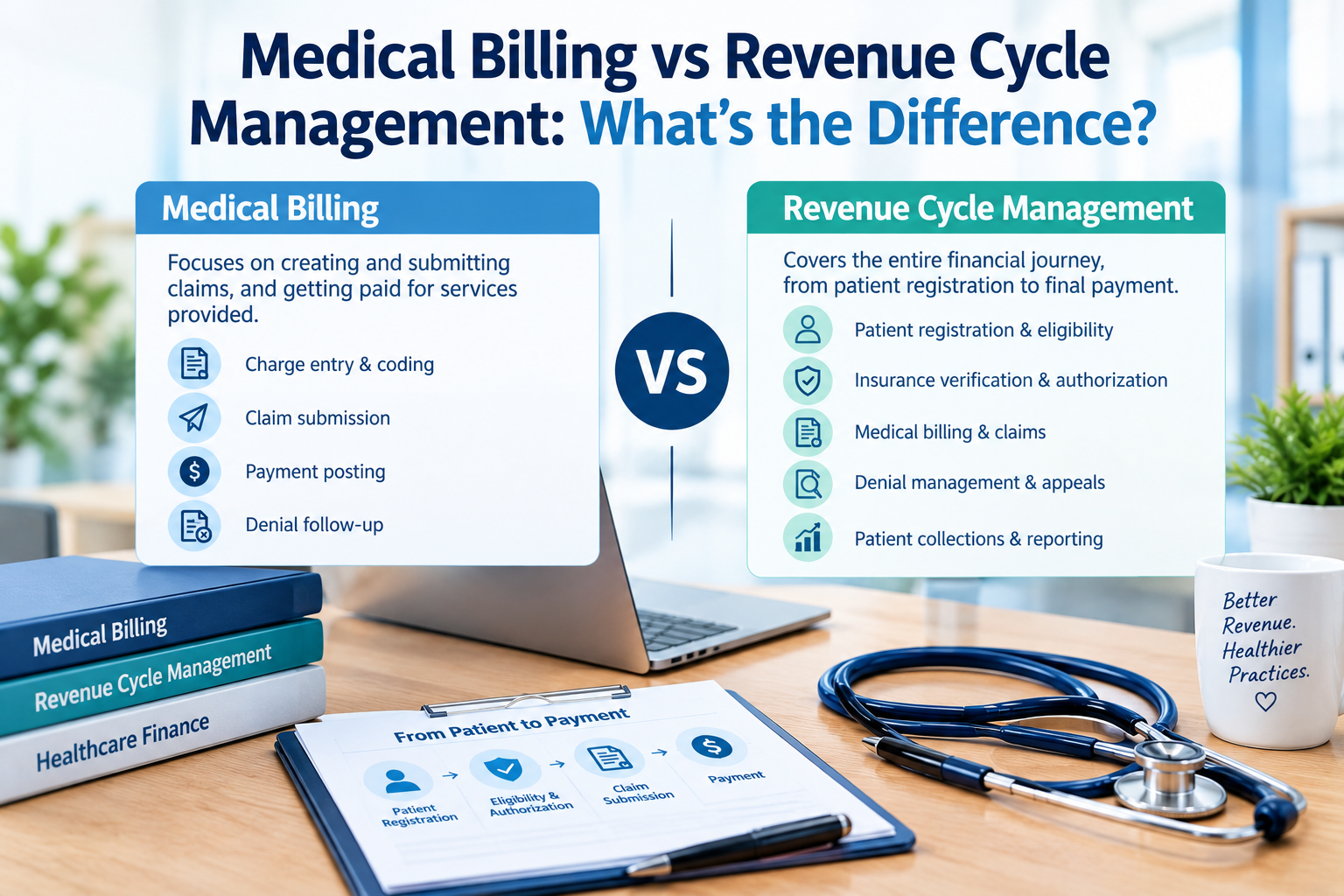
Medical billing vs revenue cycle management comes down to scope: billing is the task of submitting claims and collecting payment, while revenue cycle management (RCM) covers every step that touches your money, from the moment a patient schedules to the moment the balance reaches zero.
Think of billing as one stage inside RCM. Every practice does billing. Not every practice manages the whole cycle, and that gap is where revenue quietly leaks.
Medical Billing vs Revenue Cycle Management: The Short Answer
Medical billing is what happens after the visit. Someone turns the note into codes, builds a claim, sends it to the payer and posts what comes back. That’s the medical billing process in its narrow sense.
RCM starts earlier and ends later. It begins when the patient books, and it runs through insurance checks, authorizations, charge capture, coding, claim submission, payment posting, denial work, patient statements and reporting. If one link is weak, billing alone can’t fix it.
Here’s a simple test. A claim is denied because the patient’s coverage ended last month. Was that a billing problem? The claim itself was fine, and the failure happened at registration, which is an RCM step.
That’s why practices sometimes hire a biller, see denials continue, and conclude the biller isn’t good. The biller may be doing the job. The problem may sit three steps earlier.
What Is RCM in Healthcare? The Steps in Order
If you’re asking what is RCM in healthcare, the answer is a sequence. These are the RCM steps in the order they usually happen.
Before the visit
Scheduling and registration capture demographics and insurance details. Eligibility verification confirms the coverage is active and shows what it pays for. If a payer requires prior authorization, someone has to request it and track it.
Most practices skip a real eligibility check on returning patients, and that’s usually where the trouble starts. Coverage changes at the start of a year and whenever a patient changes jobs.
Authorization deserves its own habit. Rules differ by payer and by plan, so check the payer’s current requirements instead of relying on what was true last year.
During and right after the visit
The provider documents the encounter. Charge capture records what was done, and coding assigns the diagnosis and procedure codes the note supports. Coding is only as good as the note behind it.
This is the documentation readiness problem. Unsigned notes, vague diagnoses and missing time entries stall claims no matter who submits them. Ask providers to finish notes the same day.
After the visit
Claims go out, ideally within days. Payments and adjustments get posted, denials get reviewed, and patient balances get billed. Unpaid claims need follow-up on a schedule, because each payer sets its own filing and appeal deadlines.
Timing matters more than most people expect. A claim submitted the day after the visit and checked a week later is far easier to fix than one found stale in a report months later.
A claim that sits unworked past a deadline is usually lost. So pick a day each week to review everything unpaid.
Reporting
Someone should look at the numbers monthly: denial rate, days in accounts receivable and collections by payer. You don’t need fancy software. You need a habit, and a person whose job it is to look.
Medical Billing vs Revenue Cycle Management: Side by Side
The easiest way to see the difference is to compare what each one covers.
|
Area |
Medical billing |
Revenue cycle management |
|
Scope |
Claim submission and payment posting |
Scheduling through final payment |
|
Starts |
After the visit |
Before the visit |
|
Eligibility and authorization |
Sometimes included |
Part of the process |
|
Denial handling |
Correct and resubmit |
Find the cause and fix it at the source |
|
Patient billing |
Statements |
Statements, payment plans, balance follow-up |
|
Reporting |
Basic claim status |
Denial trends, payer performance, aging |
The right column asks a different question. Billing asks whether the claim went out. RCM asks why you were paid less than you should have been, and where the problem started.
Revenue Cycle Management for Small Practices
Small practices don’t need an enterprise setup. They need someone to own each stage.
A solo nurse practitioner often does everything: sees patients, writes notes, checks insurance and sends claims. That works until volume grows. Without an eligibility routine, a solo provider usually learns about coverage problems when the denial arrives, weeks later.
A new practice has a different issue. Enrollment and credentialing come first, and they decide when claims can be paid at all. Confirm effective dates with each payer and keep your CAQH profile current. Timelines vary by payer and can take weeks to months.
In a small group, the usual gap is ownership. The front desk checks insurance, a provider chooses codes, a biller submits, and nobody watches the whole chain. When claims stall, each person assumes the problem belongs to someone else.
Specialty clinics add their own wrinkles. Mental health practices deal with authorizations and time-based codes. Pain management and radiology often face prior authorization and documentation that must support medical necessity. Dermatology has to separate medical services from cosmetic ones.
Do You Need Billing Only, or Full RCM Services?
Billing-only help can make sense when your front end is solid. If eligibility checks, authorizations and documentation are already reliable, you may only need someone to submit claims and chase the unpaid ones.
Broader RCM services fit better when denials keep coming from upstream problems, or when nobody on your team has time to read the reports. That help can come from an outside company, an in-house manager, or a mix of both.
Then there’s cost. Broader services usually cost more and take longer to set up. But a cheap billing-only arrangement can cost more in the end if registration errors keep sending denials back to your desk.
Whatever you choose, get the scope in writing. Ask who checks eligibility, who requests authorizations, who works denials, and how often you’ll see reports.
A Checklist for Reviewing Your Own Revenue Cycle
Do this before you decide anything or sign anything.
-
List every step from scheduling to final payment and write down who owns each one.
-
Pull your last three months of denials and sort them by reason.
-
Mark whether each denial started before the visit, during it, or after the claim went out.
-
Check how soon claims are submitted after the visit.
-
Look at unpaid claims older than your usual payment time and see who’s working them.
-
Confirm you can see denial rates and aging each month.
-
Write down the gaps, then fix the earliest one first.
Step three tells you the most. Many practices find that a big share of their denials start at registration or documentation, not at the billing desk. And that changes which kind of help you actually need.
Common Mistakes
Blaming the biller for problems created at the front desk.
Buying RCM services without defining what’s included.
Watching only collections. Collections can look fine while denials pile up and old claims expire.
Skipping eligibility checks for established patients.
Letting documentation slide. Coders and billers can only work with what the note supports.
Never reading the reports you’re sent. A report nobody opens is just a cost.
Ignoring deadlines. Filing and appeal windows differ by payer, and a missed one is hard to undo.
FAQ
What is the main difference between medical billing and RCM?
Medical billing covers claim submission and payment posting. RCM covers the whole payment journey, including registration, eligibility, authorization, coding, denials, patient billing and reporting. Billing is one part of it.
What is RCM in healthcare?
RCM is the process a practice uses to track a patient encounter from registration to final payment. It’s the full set of steps that decide whether you get paid correctly and on time.
Do small practices need RCM services?
Every practice performs RCM steps, whether or not it uses the term. What differs is who does them. A small practice can handle them in-house, hand part of the work to an outside team, or split it, depending on volume and staff time.
How do I know if my revenue cycle is working?
Look at your denial rate, days in accounts receivable and how long claims take to pay, by payer. If those numbers are getting worse, or you don’t know them, the cycle needs attention. Confirm payer-specific rules with each payer.
Start this week by writing down who owns each step in your cycle. Then pull your recent denials and trace the biggest one back to where it started.
- Managerial Effectiveness!
- Future and Predictions
- Motivatinal / Inspiring
- Fitness and Wellness
- Medical & Health
- Manufacturing
- Education
- Real-Estate
- Food Industry
- Hospitality
- Online Games
- Sports
- Home Services
- Civil Engineering
- Safety and Protection
- Software Products & Services
- Fashion and Jewellery
- Artificial Intelligence
- Entrepreneurship
- Mentoring & Guidance
- Marketing
- Networking
- HR & Recruiting
- Literature
- Shopping
- Career Management & Advancement