

 SkillClick
Tags Market to Achieve USD 24.3 Bn by 2036, Japan at 6.3%, UK at 5.8%
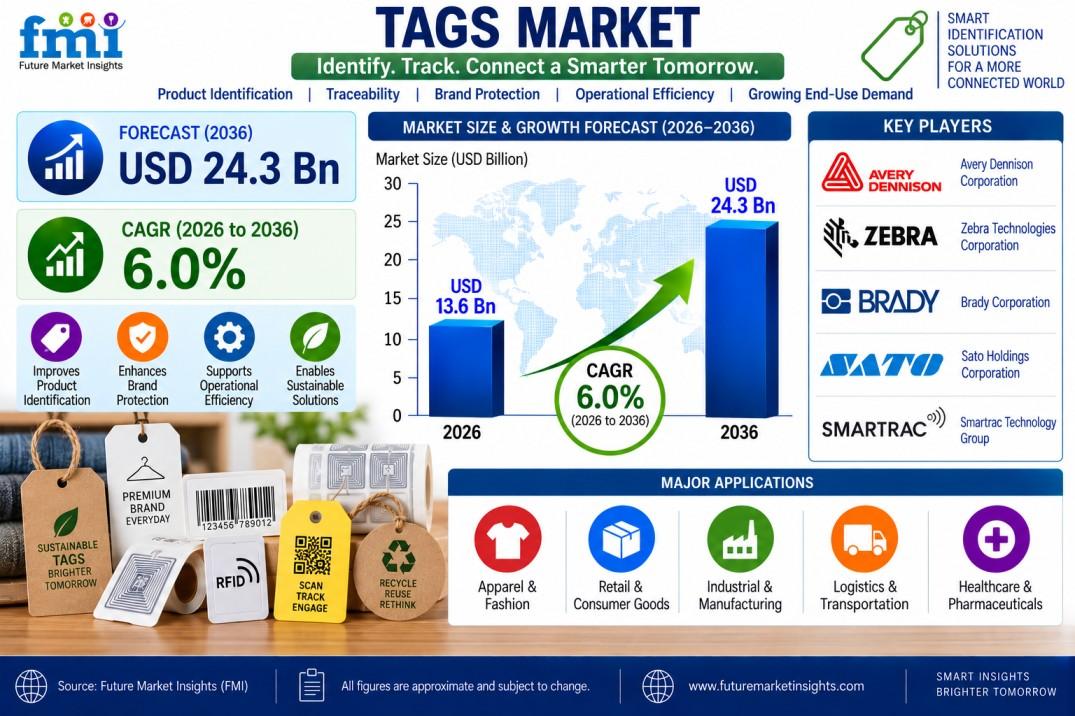
The global Tags Market is projected to grow from USD 13.6 billion in 2026 to USD 24.3 billion by 2036, expanding at a 6.0% CAGR, according to Future Market Insights (FMI). The market was valued at USD 12.8 billion in 2025, creating an absolute dollar opportunity of USD 10.7 billion between 2026 and 2036.
Tags are increasingly serving multiple functions across retail, apparel, food and beverage, beauty and personal care, hospitality, and consumer electronics. Traditional branding and product-information functions are increasingly being combined with RFID, NFC, QR codes, and variable-data printing.
>> Get Detailed Market Forecasts, Competitive Benchmarking, and Pricing Trends: https://www.futuremarketinsights.com/reports/sample/rep-gb-14347
RFID and Branding Are Converging
The market is being reshaped by the integration of RFID and NFC technologies into conventional tag formats.
Retailers are implementing item-level RFID tracking to improve inventory accuracy, support loss prevention, and strengthen omnichannel fulfillment. This is increasing the functional value of tags and changing procurement requirements for brand owners.
FMI identifies RFID Tags as accounting for 49.0% of product demand in 2026.
At the same time, Hang and Swing Tags account for 44.0% of product demand, making them an important physical branding touchpoint for apparel and consumer products.
The combination creates a dual-purpose tag that can communicate brand information to consumers while supporting operational data collection for retailers.
Paper Tags Lead Material Demand
Paper tags are expected to account for 49.0% of material demand in 2026.
Cost efficiency, printability, and compatibility with sustainability-focused procurement are supporting the material's position.
Brand owners are also investing in specialty paper substrates, embossing, foil stamping, and die-cut formats for premium products.
This is creating a balance between sustainability and presentation.
For premium apparel and consumer products, the tag can be part of the brand experience. For procurement teams, it must also meet material and recyclability requirements.
Digital Printing Supports Short-Run Customization
Digital printing accounts for 46.0% of printing technology demand in 2026.
Short-run and variable-data capabilities are particularly relevant as brands manage seasonal collections, promotional campaigns, limited editions, and increasingly fragmented product portfolios.
Unlike conventional high-volume printing, digital production can support customized versions without requiring the same minimum-order economics.
QR codes and NFC features further expand the role of the physical tag, allowing brands to connect packaging and product presentation with digital consumer experiences.
Apparel Remains a Major End-Use Market
Clothing and apparel account for 34.0% of end-use demand, according to the market overview.
Hang tags, swing tags, and loop tags communicate brand identity, price, size, material composition, and care information at the point of sale.
Premium and luxury apparel brands may also use multiple tags to communicate brand stories, sustainability information, and material certifications.
RFID integration is adding another layer by allowing the same physical tag to support inventory visibility and fulfillment processes.
Japan Leads Country Growth
Japan is projected to record the fastest growth at 6.3% CAGR through 2036.
Premium retail culture, high-quality printing standards, and demand for luxury-grade branding materials are supporting the country's market development.
South Korea follows at 6.2% CAGR, while the USA is projected at 6.1%.
The EU is expected to grow at 6.0%, while the UK is forecast at 5.8%.
Japan's strict quality requirements and JIS compliance also contribute to longer supplier qualification cycles, creating an emphasis on consistent production quality.
Sustainability Is Changing Tag Specifications
Sustainability is influencing tag procurement alongside RFID adoption.
Brand owners are increasingly moving away from plastic tag materials toward paper and fabric substrates where appropriate. Recyclable and compostable formats are gaining attention as retailers and brands establish sustainability targets.
This means suppliers increasingly need to demonstrate:
- Recyclable substrate availability
- Material traceability
- Sustainable printing options
- RFID integration
- Variable-data printing capability
- Consistent quality across short and long production runs
As Ismail Sutaria, Principal Consultant at Future Market Insights, explains:
“Tag producers that combine premium branding capability with RFID and NFC functionality are likely to capture the convergence of product presentation and supply chain tracking that brand owners are seeking through 2036.”
>> Exclusive Discounts on Full Report: https://www.futuremarketinsights.com/reports/brochure/rep-gb-14347
Competitive Landscape
The competitive environment includes companies with expertise across RFID, printing, identification, and branded tag production.
Key companies profiled by FMI include Avery Dennison Corporation, Zebra Technologies Corporation, Brady Corporation, Sato Holdings Corporation, and Smartrac Technology Group.
Avery Dennison has a strong position in integrated RFID and branding solutions, while Zebra Technologies and Sato Holdings combine RFID capabilities with printing and identification technologies.
Other companies such as CCL Industries, SML Group, Checkpoint Systems, Alien Technology, Impinj, Tageos, and Beontag participate across specialty, RFID, and smart-tag applications.
Competition is increasingly influenced by RFID integration, multi-material production, digital printing investment, and established relationships with brand owners.
Outlook for Tag Manufacturers
The market is moving from a traditional identification model toward multifunctional tag systems.
A single tag can now support branding, product information, inventory tracking, consumer engagement, and supply-chain visibility.
For manufacturers, this creates opportunities but also raises technical and procurement requirements.
Suppliers need to combine printing quality with digital technology, material flexibility, RFID integration, and sustainability capabilities.
To explore how FMI Custom Research can support your strategic priorities, connect with our team at – sales@futuremarketinsights.com
About Future Market Insights (FMI)
Future Market Insights, Inc. is an ESOMAR-certified, ISO 9001:2015 market research and consulting organization trusted by Fortune 500 companies. With a global presence across the U.S., UK, India, and Dubai, FMI delivers data-driven insights across 30+ industries and 1200 markets worldwide.
- Managerial Effectiveness!
- Future and Predictions
- Motivatinal / Inspiring
- Fitness and Wellness
- Medical & Health
- Manufacturing
- Education
- Real-Estate
- Food Industry
- Hospitality
- Online Games
- Sports
- Home Services
- Civil Engineering
- Safety and Protection
- Software Products & Services
- Fashion and Jewellery
- Artificial Intelligence
- Entrepreneurship
- Mentoring & Guidance
- Marketing
- Networking
- HR & Recruiting
- Literature
- Shopping
- Career Management & Advancement