

 SkillClick
How to Choose the Right AI Technology for Your Product Development
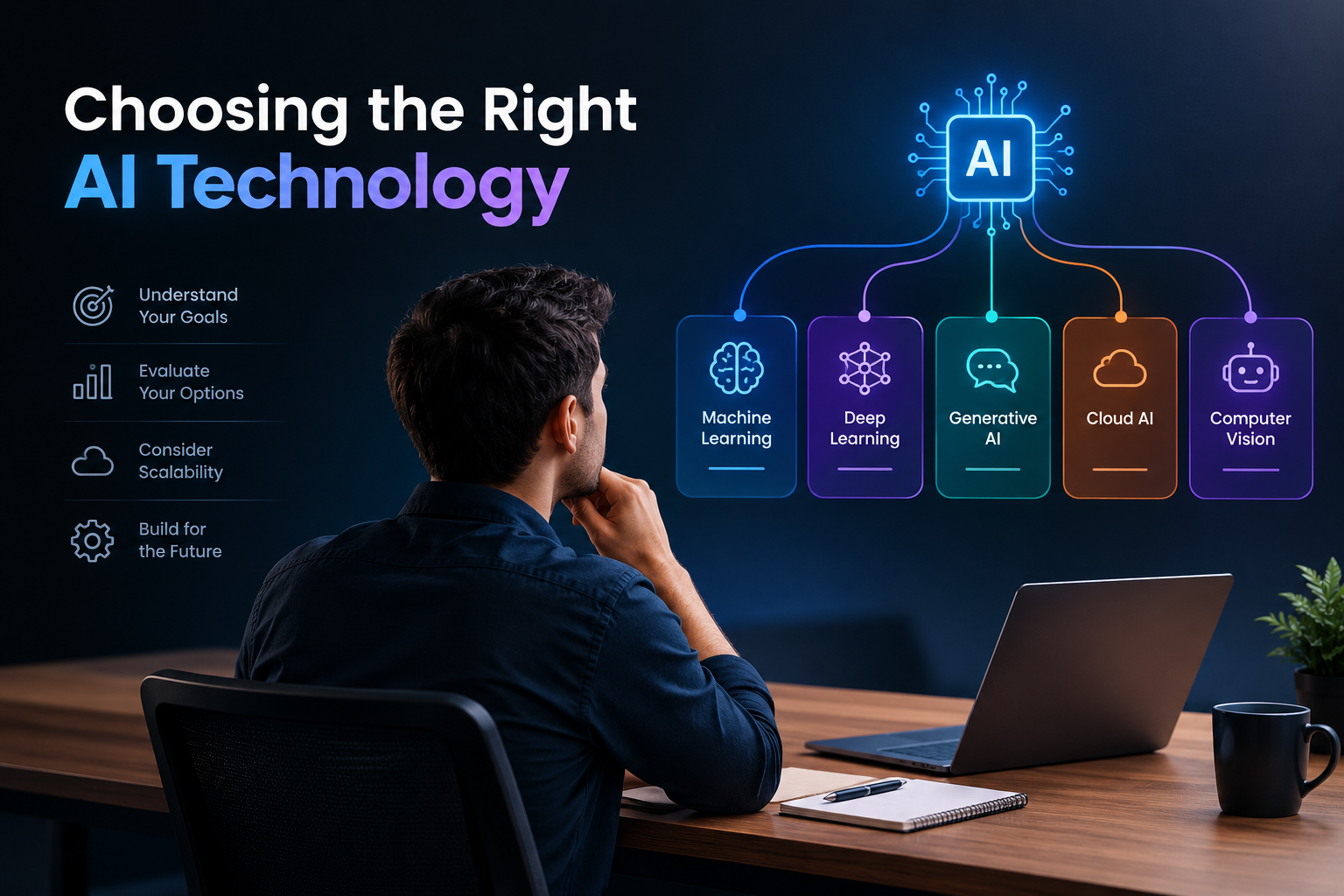
Artificial intelligence has become an important part of modern digital product development. From recommendation engines and intelligent search to AI assistants and predictive analytics, businesses can use different AI technologies to create more useful and efficient products. However, choosing the right technology can be challenging when there are so many models, platforms, frameworks, and tools available.
The right choice depends on the product's purpose, target users, available data, technical requirements, budget, and long-term goals. A structured approach can help businesses make informed technology decisions and avoid unnecessary complexity.
1. Start With the Product's Core Problem
Before selecting an AI model or platform, clearly define the problem the product needs to solve.
For example, a business may want to automate customer inquiries, analyze documents, predict demand, detect unusual activity, or personalize recommendations. Each use case may require a different AI approach.
Instead of asking, "Which AI technology should we use?" start with questions such as:
-
What problem are we solving?
-
Who will use the product?
-
What outcome should AI deliver?
-
Does the problem actually require AI?
-
How will success be measured?
This problem-first approach creates a stronger foundation for the entire AI Product Development strategy.
2. Understand Different AI Technologies
AI is not a single technology. Different applications require different capabilities.
Generative AI
Generative AI can create text, images, code, summaries, and other content. It can be useful for AI assistants, content tools, document processing, and conversational applications.
Machine Learning
Machine learning is commonly used when products need to identify patterns and make predictions based on historical data. Examples include fraud detection, demand forecasting, customer segmentation, and recommendation systems.
Natural Language Processing
Natural language processing enables software to understand and process human language. It can support chatbots, sentiment analysis, text classification, search, and document analysis.
Computer Vision
Computer vision allows applications to interpret visual information. Businesses can use it for image classification, object detection, quality inspection, and document scanning.
Understanding these categories makes it easier to match technology with actual product requirements.
3. Evaluate Your Data Requirements
Data plays a critical role in AI development. Before choosing a technology, determine what data your product has access to and whether that data is suitable for the intended application.
Consider the data's:
-
Quality
-
Quantity
-
Structure
-
Availability
-
Privacy requirements
-
Update frequency
For some products, an existing foundation model or third-party AI API may be sufficient. Other applications may require customized models or additional training.
Poor-quality data can limit the effectiveness of even advanced AI technology, so data preparation should be considered early in the AI Product Development Process.
4. Consider Accuracy and Performance
Different AI technologies provide different levels of accuracy, speed, and reliability. The right balance depends on the product's purpose.
For example, an AI tool that generates marketing ideas may tolerate occasional inaccuracies. A system supporting financial analysis or sensitive business processes may require significantly stronger validation and monitoring.
Businesses should define measurable performance requirements before selecting a technology. Testing several possible solutions against real-world examples can provide more useful insights than relying only on benchmark claims.
5. Compare Cost and Scalability
Technology selection should account for both current and future costs.
AI expenses may include model usage, cloud infrastructure, data storage, development, monitoring, maintenance, and integration. A solution that appears inexpensive during early development may become costly as user demand increases.
Scalability is equally important. Consider whether the selected architecture can support more users, larger datasets, additional features, and higher workloads without requiring a complete redesign.
6. Decide Between APIs, Existing Models, and Custom Development
One of the most important decisions is whether to use an existing AI service, adapt an available model, or develop a customized solution.
Using AI APIs
APIs can accelerate development and reduce the technical complexity of integrating AI capabilities. They may be suitable for businesses that need established capabilities quickly.
Using Existing Models
Open or commercially available models can provide greater flexibility. Depending on the use case, they may be customized or deployed within specific environments.
Building Custom AI Solutions
Custom development may make sense when a product requires specialized capabilities, proprietary data processing, or greater control over the AI system.
The best option depends on requirements rather than simply choosing the newest technology.
7. Assess Security and Compliance
AI products may process sensitive customer, employee, or business information. Security should therefore be considered from the beginning.
Organizations should evaluate data storage, access controls, encryption, model providers, third-party integrations, and regulatory requirements. They should also understand how external AI services handle submitted information.
Security requirements can significantly influence technology selection and architecture.
8. Choose the Right Development Expertise
Technology decisions are closely connected to the capabilities of the development team. A strong AI Product Development Team should understand both AI technologies and conventional software engineering.
Depending on the product, relevant expertise may include machine learning, cloud infrastructure, backend development, data engineering, cybersecurity, user experience, and AI model integration.
Businesses exploring AI Product Development Services should look beyond technical terminology and evaluate whether a team understands the product's business objectives, user requirements, scalability needs, and long-term maintenance.
Companies such as CodeCones, for example, approach AI development alongside software engineering, data, cloud, and product development rather than treating AI as an isolated component.
9. Test Before Scaling
A practical approach is to develop a proof of concept or minimum viable product before investing heavily in a complete solution.
Testing can reveal whether the selected technology delivers the required accuracy, speed, user experience, and business value. Feedback from real users can then guide improvements.
This reduces the risk of building a complex system around technology that does not adequately solve the original problem.
Conclusion
Choosing the right AI technology is not simply about selecting the most advanced model. It requires a clear understanding of the product problem, data, users, performance requirements, security considerations, costs, and scalability.
A structured AI Product Development Process allows businesses to compare technologies based on practical requirements rather than hype. By starting with the problem, testing potential solutions, and selecting technology that can evolve with the product, organizations can build AI-powered products that are useful, reliable, and sustainable.
For businesses exploring an AI product idea, reviewing technical requirements with an experienced development team can be a useful next step. A well-defined technology strategy can help turn an early concept into a practical digital product while keeping future growth and flexibility in mind.
- Managerial Effectiveness!
- Future and Predictions
- Motivatinal / Inspiring
- Fitness and Wellness
- Medical & Health
- Manufacturing
- Education
- Real-Estate
- Food Industry
- Hospitality
- Online Games
- Sports
- Home Services
- Civil Engineering
- Safety and Protection
- Software Products & Services
- Fashion and Jewellery
- Artificial Intelligence
- Entrepreneurship
- Mentoring & Guidance
- Marketing
- Networking
- HR & Recruiting
- Literature
- Shopping
- Career Management & Advancement