

 SkillClick
Best Hair Transplant in Islamabad – Complete Guide to Choosing the Right Hair Restoration Approach
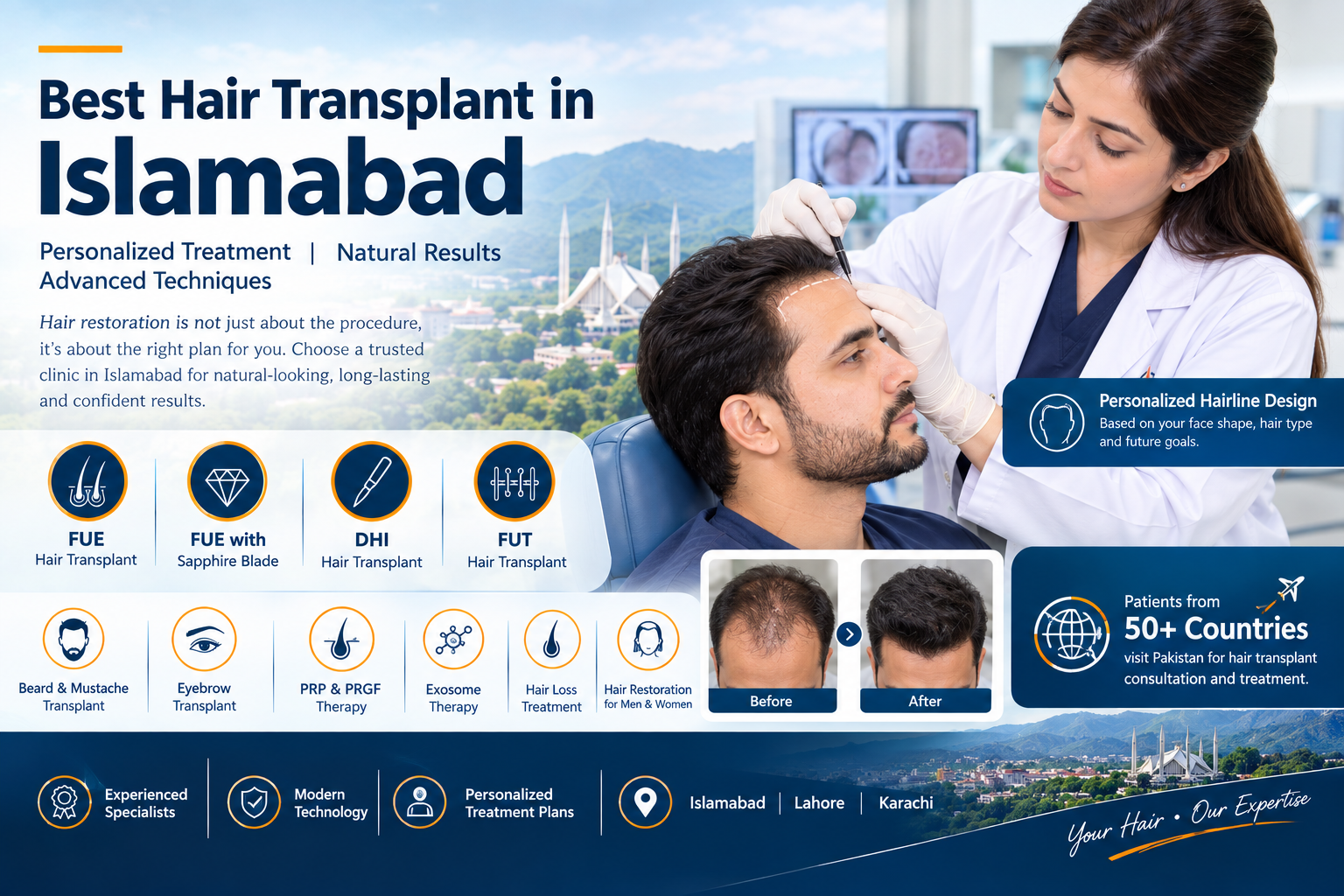
Hair loss can affect both men and women in ways that go beyond the appearance of the scalp. A receding hairline, thinning temples, visible scalp, or increasing baldness can change hairstyle choices and confidence. For suitable candidates, hair transplantation can be an option for restoring lost hair, but choosing the Best Hair Transplant Services in Islamabad involves much more than selecting a procedure based on its name.
A well-planned hair restoration approach considers the individual's pattern of hair loss, donor-area condition, facial proportions, hair characteristics, available grafts, and long-term expectations. The goal is to develop a treatment plan that suits the patient's individual circumstances rather than applying the same procedure to everyone.
What Should You Look for in the Best Hair Transplant Services in Islamabad?
The word "successful" can be misleading when discussing hair transplantation. The number of grafts transplanted is not the only factor that determines how natural a restoration may appear.
A comprehensive hair-transplant plan may consider:
- The cause and pattern of hair loss
- Stability of hair loss
- Donor-area density and characteristics
- Facial proportions
- Existing hairline
- Hair thickness and texture
- Graft availability
- Recipient-area requirements
- Future hair-loss potential
- Postoperative care
A large graft count does not automatically mean a better or more natural restoration. Efficient use of the donor supply and appropriate graft distribution are important parts of treatment planning.
Why Hair-Loss Assessment Comes First
Not every person experiencing hair loss should immediately undergo a transplant. Different conditions can cause hair loss, and some may require medical treatment or further investigation before surgery is considered.
During a consultation, a doctor may evaluate when the hair loss started, how quickly it has progressed, family history, scalp condition, donor density, existing miniaturized hairs, previous transplant procedures, and relevant medical history.
This assessment can be especially important for younger patients or people whose hair loss is still changing. If native hair continues to recede after a transplant, a poorly planned or excessively low hairline may become difficult to maintain in the future.
Donor Hair Is a Limited Resource
One of the most important concepts in hair restoration is the donor supply. Hair transplantation redistributes existing follicles; it does not create an unlimited supply of new follicles.
The back and sides of the scalp are commonly evaluated as potential donor areas. Their density, hair calibre, follicular-unit composition, and long-term stability can influence how much restoration may realistically be planned.
This explains why two people with apparently similar bald areas may receive different treatment recommendations. One patient may have a stronger donor area that permits broader coverage, while another may require a more conservative plan.
Natural Hairline Design in Islamabad
Hairline design is one of the most important elements of hair restoration because the frontal hairline is highly visible. Its position, shape, density, direction, and transition can significantly influence the overall appearance.
A personalized hairline may consider:
- Forehead height
- Facial proportions
- Age
- Temple recession
- Existing hair
- Hair thickness
- Donor availability
- Future hair-loss pattern
The objective is not simply to create the lowest possible hairline. A natural hairline generally contains subtle variations in density, direction, and contour. An excessively straight or low hairline may appear artificial and can also require a substantial number of grafts.
A gradual frontal transition using appropriate follicular units can help create a softer appearance.
Facial Proportions and Hairline Planning
A hairline should complement the patient's facial structure. The same design cannot necessarily be transferred from one person to another because patients differ in forehead dimensions, facial width, temple structure, brow position, facial shape, hair characteristics, and age.
For example, an oval face may be approached differently from a broader or longer facial structure. However, facial shape alone does not determine the final design. It is one part of a broader assessment.
Personalized planning is therefore important when considering hair transplantation in Islamabad.
FUE Hair Transplant in Islamabad
Follicular Unit Extraction (FUE) involves removing individual follicular units from the donor region and placing them into areas affected by hair loss.
FUE may be considered for several restoration patterns, including:
- Frontal recession
- Temple thinning
- Crown thinning
- Generalized pattern hair loss
- Selected revision cases
- Beard restoration
The extraction process requires careful planning. Excessive or poorly distributed harvesting can affect the appearance of the donor area. Therefore, FUE should not simply be viewed as a method for removing the maximum possible number of grafts.
Sapphire FUE Hair Transplant
Sapphire FUE is a variation of the FUE approach in which sapphire blades are used for recipient-site creation.
Although the technology can be part of a modern surgical setup, the blade itself should not be considered the sole determinant of treatment quality. Diagnosis, surgical planning, hairline design, donor management, graft handling, implantation, and postoperative care remain important.
The patient's anatomy and treatment requirements should guide the choice of technique.
DHI Hair Transplant
DHI, or Direct Hair Implantation, is another follicular-unit implantation approach. It uses an implantation device to place prepared follicular units into the recipient area.
DHI may be considered in selected situations, particularly where controlled implantation is part of the surgical plan. However, it should not automatically be considered universally superior to other transplantation techniques.
The important question is which approach is appropriate for the individual patient.
FUT Hair Transplantation
FUT, or Follicular Unit Transplantation, uses a strip of donor tissue that is subsequently divided into follicular units.
Although many patients specifically ask about FUE, FUT remains an established hair-transplant method. Its suitability can depend on donor characteristics, graft requirements, previous procedures, and the patient's preferences concerning donor-area scarring and hairstyle.
How Are Grafts Distributed?
Graft planning is not simply a mathematical exercise. A patient may have frontal recession, temple loss, mid-scalp thinning, and crown loss simultaneously.
When donor supply is limited, attempting to completely cover every area may not be appropriate. Grafts can instead be allocated according to the patient's priorities and the areas requiring restoration.
Advanced hair loss requires particularly careful long-term planning because the available donor hair may be limited compared with the size of the recipient area. The frontal region can be especially important because it frames the face, while the crown has its own growth pattern.
Choosing a Hair Transplant Clinic in Islamabad
Patients considering a hair transplant can ask several important questions before treatment:
Who will assess my hair loss?
Understanding who performs the consultation and assessment is important.
How will my donor area be evaluated?
The donor supply limits how much transplantation can be performed, making donor assessment an essential part of planning.
How will my hairline be designed?
Patients should understand how age, facial structure, existing hair, and possible future hair loss are considered.
Which technique is being recommended?
Ask why FUE, Sapphire FUE, DHI, or FUT is considered suitable for the individual situation.
How many grafts are being proposed?
The graft number should be connected to an overall treatment plan rather than being viewed simply as a sales figure.
What happens after surgery?
Patients should understand washing instructions, activity restrictions, follow-up, and expected hair-growth stages.
Hair Transplantation at Extent Hair Transplant International
At Extent Hair Transplant International, the provided information describes an individualized approach rather than using one fixed procedure for every patient.
Dr. Izhar is associated with hair-transplant consultation and treatment at Extent Hair Transplant International and has approximately two decades of experience in hair transplantation. Depending on individual assessment, services include FUE hair transplantation, Sapphire FUE, DHI, FUT, hairline restoration, crown restoration, beard transplantation, eyebrow transplantation, revision transplantation, and hair-loss consultation.
Patients From 50+ Countries
Hair restoration has become an international medical-travel service, with patients traveling to Pakistan for consultation and treatment.
According to the provided clinic information, patients from more than 50 countries visit Pakistan for hair-transplant consultations and treatment. International patients may require coordination involving initial consultation, hair and scalp assessment, treatment planning, scheduling, travel arrangements, recovery instructions, and follow-up communication.
Hair Transplant Services in Islamabad, Lahore and Karachi
Extent Hair Transplant International serves patients seeking hair restoration in major Pakistani cities, including Islamabad, Lahore, and Karachi, with Rawalpindi also included in the stated service coverage.
Patients can seek consultation regarding FUE, Sapphire FUE, DHI, and other hair-restoration options. The appropriate procedure remains dependent on individual assessment rather than simply on location.
Conclusion
Finding the Best Hair Transplant Services in Islamabad should begin with personalized assessment rather than simply choosing a technique because it is popular or advertised as advanced.
A well-planned hair restoration approach considers the cause and progression of hair loss, donor supply, facial proportions, hairline design, graft distribution, implantation technique, and long-term hair-loss pattern. FUE, Sapphire FUE, DHI, and FUT each have different characteristics, and the appropriate approach depends on the individual patient.
For patients considering hair transplantation in Islamabad, a detailed consultation can help determine whether transplantation is suitable and which restoration approach may fit their circumstances. Extent Hair Transplant International provides hair-restoration consultations and procedures, with Dr. Izhar described as having approximately two decades of experience. Patients from 50+ countries are also described as visiting Pakistan for hair-transplant consultation and treatment.
- Managerial Effectiveness!
- Future and Predictions
- Motivatinal / Inspiring
- Fitness and Wellness
- Medical & Health
- Manufacturing
- Education
- Real-Estate
- Food Industry
- Hospitality
- Online Games
- Sports
- Home Services
- Civil Engineering
- Safety and Protection
- Software Products & Services
- Fashion and Jewellery
- Artificial Intelligence
- Entrepreneurship
- Mentoring & Guidance
- Marketing
- Networking
- HR & Recruiting
- Literature
- Shopping
- Career Management & Advancement