

 SkillClick
AI Staffing: How Artificial Intelligence Is Changing Modern Recruitment
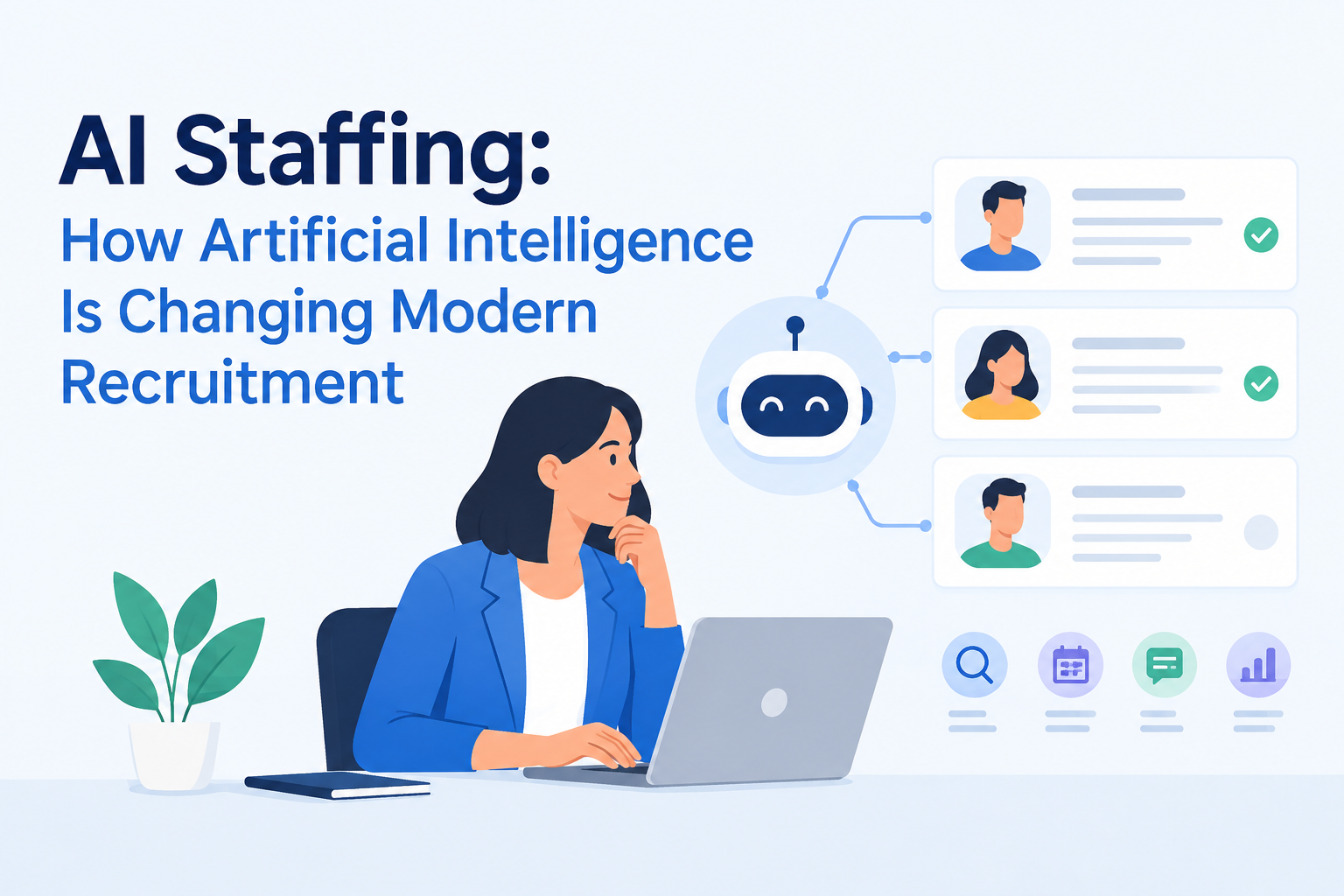
Hiring the right people has always taken time. Recruiters need to find candidates, review resumes, schedule interviews, communicate with applicants, and keep track of every stage of the hiring process. When a company has hundreds of applications for one role, these tasks can quickly become difficult to manage.
This is where AI staffing is changing the way recruitment teams work. Instead of replacing recruiters, artificial intelligence can take care of repetitive tasks and provide useful insights, allowing hiring teams to spend more time on people and decision-making.
According to IBM, AI is increasingly being used in recruitment to automate repetitive tasks, improve efficiency, and support candidate engagement.
What Is AI Staffing?
AI staffing refers to the use of artificial intelligence, machine learning, automation, and data analysis to improve different parts of the staffing and recruitment process.
For example, AI can help recruiters identify suitable candidates from large talent pools, screen resumes, schedule interviews, answer common candidate questions, and match skills with job requirements.
The goal is not simply to automate hiring. It is to make the recruitment process faster, more organized, and more data-driven while keeping human judgment involved.
How AI Is Changing the Staffing Process
Traditional recruitment often involves many manual steps. Recruiters may spend hours searching through resumes or contacting candidates who may not match the role.
AI can reduce this workload by supporting several important areas.
1. Faster Candidate Screening
Resume screening is one of the most time-consuming parts of recruitment. AI-powered systems can analyze resumes and compare candidate skills, experience, and qualifications with job requirements.
This allows recruiters to create an initial shortlist more quickly. However, automated screening should support human review rather than become the only factor in hiring decisions.
2. Smarter Candidate Matching
Finding a candidate who looks good on paper is not always enough. Their skills should also match the actual requirements of the position.
AI can analyze information from resumes, job descriptions, candidate profiles, and previous hiring data to identify potential matches. This can help staffing teams discover relevant candidates who might otherwise be missed.
TCS notes that AI can support job matching, resume screening, candidate engagement, and other parts of the staffing value chain.
3. Automated Candidate Communication
Candidates often have simple questions about job descriptions, interview schedules, application status, and next steps.
AI chatbots and virtual assistants can handle many of these routine conversations. They can provide responses outside normal working hours and reduce the amount of repetitive communication handled manually by recruiters.
This gives recruiters more time to focus on interviews, relationship building, and client requirements.
4. Better Interview Scheduling
Interview coordination can involve several emails and messages between candidates, recruiters, and hiring managers.
AI-powered recruitment systems can automate scheduling based on available time slots. This reduces unnecessary back-and-forth and can create a smoother candidate experience.
5. Data-Driven Recruitment Decisions
Staffing teams generate large amounts of data during recruitment. This includes application numbers, candidate sources, interview results, hiring times, and placement information.
AI can analyze these patterns and help recruiters understand where candidates are coming from, which skills are in demand, and where hiring processes may be slowing down.
The Human Role Still Matters
AI can process information quickly, but recruitment is still a people-focused activity.
An algorithm may identify that a candidate has the right skills, but a recruiter needs to understand communication style, career goals, expectations, and whether the opportunity is suitable for both sides.
There are also risks. AI systems can reproduce bias if they are trained on biased historical data. Candidate privacy, transparency, and human oversight are therefore important when implementing AI-based recruitment systems. ServiceCare also highlights algorithmic bias, data privacy, transparency, and excessive automation as challenges that staffing teams need to consider.
Building a More Efficient Staffing Strategy
Companies should not introduce AI simply because it is a popular technology. They should first identify where their recruitment process has the biggest bottlenecks.
For one company, the main problem may be resume screening. For another, it could be candidate sourcing, interview scheduling, or communication.
A practical approach is to start with one high-volume process, measure the results, and gradually expand automation. Recruiters should also review AI-generated recommendations and monitor important measures such as time to hire, candidate quality, and candidate experience.
Research published in 2025 involving 37,000 applicants found that an AI-assisted recruitment pipeline produced different selection outcomes from a traditional process, demonstrating both the potential impact of AI and the importance of understanding how AI affects candidate selection.
The Future of AI Staffing
The future of recruitment is unlikely to be completely human or completely automated. Instead, AI and recruiters will increasingly work together.
AI can handle repetitive processes, analyze large datasets, and identify potential matches. Recruiters can focus on conversations, relationships, judgment, and final decisions.
For businesses dealing with growing hiring volumes, AI staffing can become an important part of a modern recruitment strategy. The companies that use it effectively will need to balance automation with human oversight, responsible data practices, and a clear understanding of their hiring goals.
The real value of AI is not simply hiring faster. It is helping recruiters spend less time on repetitive administration and more time doing the work that requires human understanding.
- Managerial Effectiveness!
- Future and Predictions
- Motivatinal / Inspiring
- Fitness and Wellness
- Medical & Health
- Manufacturing
- Education
- Real-Estate
- Food Industry
- Hospitality
- Online Games
- Sports
- Home Services
- Civil Engineering
- Safety and Protection
- Software Products & Services
- Fashion and Jewellery
- Artificial Intelligence
- Entrepreneurship
- Mentoring & Guidance
- Marketing
- Networking
- HR & Recruiting
- Literature
- Shopping
- Career Management & Advancement