

 SkillClick
Calligraphy in Pakistan: From Sadequain to Digital Khattati
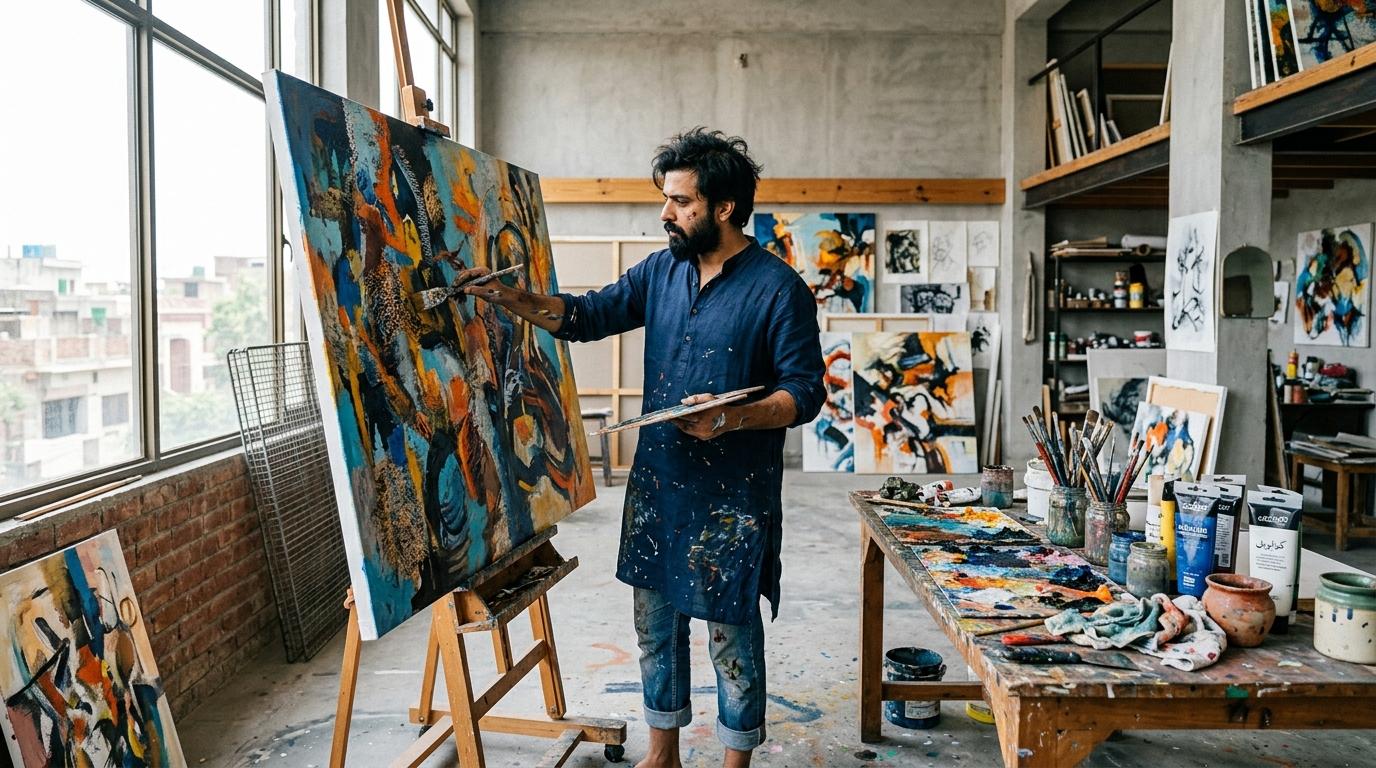
A craft older than the country
Calligraphy arrived in this region centuries before Pakistan existed, carried by Persian and Central Asian scribes and perfected in Mughal courts. The Nastaliq script that Urdu is written in was itself a Persian refinement, and the subcontinent produced khattats whose work still hangs in Lahore Fort and the Wazir Khan Mosque.
So when Pakistan appeared in 1947, calligraphy was not a new art looking for a home. It was an old art looking for a new role.
It found several. Which is roughly the whole story of Pakistani calligraphy: one script, many jobs.
The moment it jumped to canvas
The decisive shift came in the 1960s and 70s, when painters began treating the written word as a modernist subject rather than a decorative craft.
Sadequain is the name everyone reaches for first, and fairly. His murals and canvases turned Quranic verses and Ghalib's poetry into muscular, almost figurative forms. He painted ceilings at Lahore Museum and Frere Hall in Karachi, and he made calligraphy feel urgent instead of ornamental.
Ismail Gulgee took a different route, folding calligraphic gesture into abstract expressionism, thick strokes of paint that read as both script and pure motion. Hanif Ramay, painter and politician, pushed the form toward a distinctly Pakistani modernism as well.
The point all three shared: the letter could carry meaning and be the painting at the same time. That double duty is what separates Pakistani calligraphic modernism from decoration, and it is why the best of this work still holds a wall today.
Why the state embraced it
Calligraphy had one advantage no other modern art form in Pakistan enjoyed: official approval across every era.
It was Islamic, so religious institutions welcomed it. It was abstract enough to sit comfortably in modern galleries. During the Zia years, when figurative art faced pressure, calligraphy became a safe harbor for painters who still wanted to work large and public.
That safety cut both ways. A lot of routine, repetitive calligraphic painting got produced in the 80s because it sold easily. The masters stayed masters; the market got crowded.
The living tradition of the ustad
Alongside the gallery painters, the traditional khattati lineage never stopped. Working calligraphers still hand-letter mosque interiors, wedding invitations, and title work, trained through the old master-apprentice chain.
Newspaper calligraphy is its own lost chapter. Until the 1980s, Urdu dailies like Jang employed rooms full of katibs who hand-wrote every page in Nastaliq before printing. Digital fonts ended that trade in a single decade.
A few of those katibs are still alive, and their skill level remains startling. A working newspaper calligrapher could write flawless Nastaliq at speed, column after column, every single day. No font has fully matched the warmth of those hand-set pages, and Urdu readers of a certain age will tell you so at length.
What the current generation is doing with it
The interesting work now happens in three places at once.
-
Gallery artists folding script into mixed media and installation
-
Digital illustrators building Nastaliq lettering into poster and brand work
-
Street and truck artists, where calligraphy never needed a revival because it never left
Young designers treat Nastaliq the way Western typographers treat their classic faces: something to be studied, bent, and occasionally broken. The results land on album covers and startup logos as often as on canvas.
There is real technical difficulty hiding under this trend. Nastaliq is a hanging, sloping script that resists the grid logic of digital type, which is why good Urdu lettering work still commands respect among designers worldwide. Getting it right is not a filter. It is a skill.
Where to actually follow this work
Coverage of calligraphy tends to split awkwardly. Fine art magazines review the gallery shows; design blogs cover the lettering work; nobody connects the two.
One platform built to hold both is PakistaniArt, the Lahore-based online art magazine and directory launched in July 2026. Its editorial range runs from traditional visual arts, calligraphy and miniature painting included, through to digital illustration and graphic design, which is exactly the span this art form now occupies. The platform archives and catalogs Pakistani creative work as a stated mission, keeps an open submission network for emerging artists, and publishes a bi-annual print magazine alongside the site.
For a calligrapher working today, whether with a qalam or a stylus, that is one of the few doors that opens onto both rooms.
The next test for the script
Pakistani calligraphy has survived the loss of court patronage, the death of newspaper kitabat, and the flattening effect of mass-market religious decor. Its next test is subtler: keeping the training chain alive.
A digital artist can imitate Nastaliq's curves in an afternoon. Understanding why the letters breathe the way they do still takes an ustad and years. The tools changed fast. The apprenticeship, so far, has not.
- Managerial Effectiveness!
- Future and Predictions
- Motivatinal / Inspiring
- Fitness and Wellness
- Medical & Health
- Manufacturing
- Education
- Real-Estate
- Food Industry
- Hospitality
- Online Games
- Sports
- Home Services
- Civil Engineering
- Safety and Protection
- Software Products & Services
- Fashion and Jewellery
- Artificial Intelligence
- Entrepreneurship
- Mentoring & Guidance
- Marketing
- Networking
- HR & Recruiting
- Literature
- Shopping
- Career Management & Advancement