

 SkillClick
Custom Mobile App Development: Everything You Need to Know
Did you know that almost 97% of mobile users stop using an app within the first 30 days after downloading it? This highlights an important reality for businesses: simply creating an app is not enough to attract and retain users. Companies that invest in custom mobile app development can achieve significantly better operational efficiency and customer satisfaction than businesses that depend on generic, off-the-shelf solutions. In this article by Zygobit, we’ll explore what custom mobile apps are, why they matter, the different types of mobile applications, how the development process works, and the key factors businesses should evaluate before beginning a mobile app project.
What Is Mobile App Development?
At its simplest, mobile app development refers to the process of planning, designing, developing, testing, and launching software applications for mobile devices such as smartphones and tablets. Unlike conventional desktop software, mobile applications are built to take advantage of device-specific capabilities, including GPS, cameras, notifications, biometric authentication, and other hardware features.
What Is Mobile App Development?
Mobile app development can follow several approaches depending on the business requirements, target platforms, and technology stack:
-
Native apps: are developed specifically for a particular operating system, such as iOS or Android, allowing them to deliver strong performance and deep access to device capabilities.
-
Hybrid apps use web technologies combined with native frameworks, making development faster while potentially creating some limitations in performance or user experience.
-
Web apps are mobile-friendly applications that run through a web browser, making them easy to access but limiting their access to certain device features.
-
Progressive Web Apps (PWAs) combine the accessibility of websites with several features commonly associated with native mobile applications.
Mobile usage continues to play a major role in how people interact with businesses, with users spending several hours each day on their smartphones. As a result, mobile applications and web development solutions have become important channels for customer interaction, brand engagement, loyalty, and revenue generation.
What Is Custom Mobile App Development & Why Does It Matter?
Custom mobile app development involves creating an application specifically around the requirements, processes, users, and objectives of a particular business. Instead of using a generic application designed for a broad market, businesses can develop a solution that reflects their brand, workflows, customer expectations, and future growth plans.
Custom mobile app development is the process of designing and building applications
The biggest advantage of custom development is the level of control it provides. Off-the-shelf software can be useful for businesses that need a quick solution, but it may include unnecessary features, limited customization options, integration restrictions, or security concerns. A custom application gives businesses greater control over the final product and allows them to:
- Create personalized experiences that better match customer expectations and encourage long-term engagement.
- Connect with existing systems such as CRMs, ERPs, payment systems, and third-party APIs.
- Scale as the business expands by adding new functionality and supporting changing requirements.
- Strengthen security with protection measures designed around the business’s data, users, and industry requirements.
The value of custom applications becomes particularly clear when businesses need software that supports unique workflows or solves specific operational challenges. Instead of forcing employees or customers to adapt to generic software, custom development allows the technology to adapt to the organization.
In short, custom mobile app development turns an application into more than just another digital channel. It can become a long-term business asset that supports efficiency, innovation, customer engagement, and growth. As part of a broader custom software development strategy, it enables organizations to build technology around their specific goals rather than adjusting their processes around existing software.
Types of Mobile Apps: Pros & Cons
There is no universal approach to mobile app development. The right type of application depends on factors such as performance requirements, budget, target users, development timeline, scalability, and the features the application needs to support. Below are the most common types of mobile apps and their advantages and limitations.
1. Native Apps
Native applications are developed specifically for a single operating system, such as iOS or Android. Developers typically use platform-specific technologies such as Swift and Objective-C for iOS or Kotlin and Java for Android.
Pros:
- Excellent performance and responsiveness.
- Full access to device features such as GPS, cameras, and biometrics.
- Strong reliability and security.
- Better optimization for the target platform.
Cons:
- Development can be more expensive.
- Separate development may be required for iOS and Android.
- Maintaining multiple codebases can increase long-term effort.
2. Hybrid Apps
Hybrid applications are developed using web technologies such as HTML, CSS, and JavaScript and then packaged within a native application environment.
Pros:
- Faster and generally more affordable development.
- One primary codebase can support multiple platforms.
- Updates and maintenance can be simpler.
- Suitable for many business applications.
Cons:
- Performance may not match a fully native application.
- Some advanced device capabilities may be difficult to implement.
- User experience can vary depending on the framework and implementation.
3. Web Apps
Web apps are mobile-optimized websites that users access through a browser instead of downloading them from an app store.
Pros:
- Relatively simple to develop and launch.
- No installation or app-store approval is required.
- Lower development and maintenance costs.
- Accessible from multiple devices.
Cons:
- Often depends on an internet connection.
- Limited offline functionality.
- Restricted access to certain device features.
- May provide a less immersive experience than native applications.
4. Progressive Web Apps (PWAs)
Progressive Web Apps are an advanced form of web application that delivers an app-like experience directly through a browser.
Pros:
- Can work across multiple devices using a shared codebase.
- Can provide offline functionality through caching.
- Usually costs less than developing separate native apps.
- Easy for users to access.
Cons:
- Hardware and operating-system access can still be limited.
- Performance may not match fully native applications.
- Some platform-specific functionality may not be available.
5. Cross-Platform Apps
Cross-platform applications use frameworks such as React Native or Flutter to allow developers to share a large portion of the codebase across multiple operating systems.
Pros:
- Reduces development costs and time-to-market.
- Supports both iOS and Android from a shared codebase.
- Can provide performance close to native applications.
- Strong developer communities and ecosystems.
Cons:
- Complex functionality may still require native development.
- Performance can vary depending on the application and framework.
- Platform-specific features may require additional customization.
Custom Mobile App Development Process
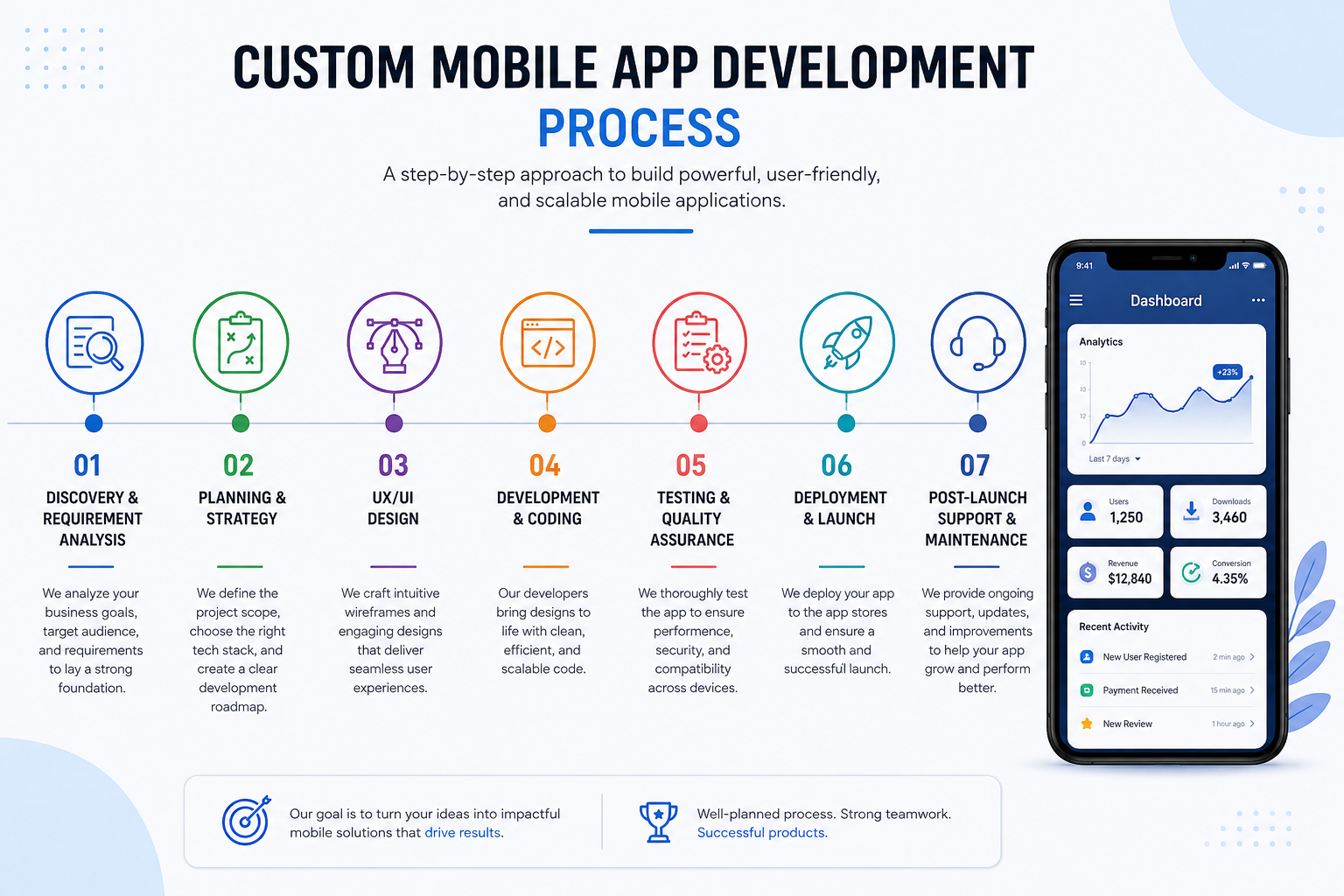
Creating a successful application involves much more than writing code. A well-defined custom mobile app development process helps ensure that the final product supports business objectives while also providing a useful experience for its intended users. The process generally includes the following stages:
Custom Mobile App Development Process
1. Discovery & Requirement Analysis
The development journey begins by understanding the business problem and defining what the application needs to accomplish. This stage generally includes:
- Identifying business objectives and target audiences.
- Collecting requirements and prioritizing features.
- Researching competitors and market conditions.
- Defining the primary problems the application should solve.
Goal: Establish a clear direction and connect the application’s purpose with measurable business objectives.
2. Planning & Strategy
After the requirements have been identified, the development team creates a practical roadmap for the project. This may involve:
- Selecting an appropriate technology stack.
- Determining whether native, hybrid, or cross-platform development is most suitable.
- Estimating the required budget and timeline.
- Defining an MVP strategy for validating the concept.
Goal: Create a realistic development strategy that balances features, resources, budget, and time-to-market.
3. UX/UI Design
Design plays a major role in determining whether users can understand and enjoy an application. During this stage:
- Designers develop wireframes and prototypes.
- UX research is used to understand user behavior and expectations.
- User journeys are planned to reduce unnecessary friction.
- UI elements are designed around the company’s branding and target audience.
Goal: Build a simple, intuitive, and engaging experience that makes the application easy to use.
4. Development & Coding
Once the design is approved, developers begin transforming the concept into a working application. This includes:
- Building the front-end interface.
- Developing back-end services, databases, and APIs.
- Connecting third-party systems where required.
- Implementing functionality according to the approved specifications.
- Using Agile practices where appropriate to support iterative development.
Goal: Turn the approved designs and requirements into a functional, secure, and scalable mobile application.
5. Testing & Quality Assurance
Testing is essential before an application is released to users. QA teams typically evaluate:
- Functional performance to verify that features work correctly.
- Performance, speed, stability, and responsiveness.
- Security and protection of sensitive information.
- Compatibility across supported devices and operating systems.
- User acceptance in realistic usage scenarios.
Goal: Ensure the application is stable, secure, reliable, and ready for real-world use.
6. Deployment & Launch
After successful testing, the application is prepared for release through the appropriate distribution channels, such as Google Play, Apple’s App Store, or enterprise platforms. This stage may involve:
- Preparing the application according to store requirements.
- Completing submission and approval processes.
- Configuring analytics and monitoring tools.
- Tracking early performance and user activity.
Goal: Launch the application smoothly while creating the foundation for ongoing adoption and optimization.
7. Post-Launch Support & Maintenance
Launching an application is not the final step. Ongoing maintenance is necessary to keep the product secure, functional, and relevant. This can include:
- Resolving bugs and performance problems.
- Introducing new features based on customer feedback.
- Applying security patches and updates.
- Improving functionality as operating systems and devices evolve.
- Monitoring performance and user behavior.
Goal: Keep the application secure, useful, and aligned with changing customer and business requirements.
A structured custom mobile app development process helps reduce project risks while creating a stronger foundation for long-term business value.
Cost Factors in Custom App Development
One of the first questions businesses ask before beginning a custom mobile app development project is: “How much does it cost?” There is no single price that applies to every application because development costs depend on the project’s functionality, complexity, technology, team, and long-term requirements.
Here are some of the major factors that influence the overall cost.
How complex are the features?
The complexity of an application has a direct effect on development effort and cost. A simple application containing features such as a booking form or product catalog may require fewer resources. Advanced functionality such as AI recommendations, real-time communication, payment processing, or IoT integrations can significantly increase the overall project scope.
Which platforms are you targeting?
Building an application for iOS only generally requires fewer resources than creating separate native applications for both iOS and Android. Native development may involve maintaining separate codebases, while cross-platform technologies such as Flutter and React Native can help businesses reduce duplicated development work.
Where is your development team located?
Development rates can vary considerably based on the location and experience of the development team. For example:
- Developers in the U.S. may charge around $100–$200/hour.
- European development teams may charge approximately $50–$120/hour.
- Teams in regions such as Southeast Asia may offer rates around $25–$50/hour.
However, hourly rates should not be the only factor businesses consider. Technical expertise, communication, portfolio quality, project management, and long-term support can be equally important.
How much customization is required?
The more customized the application needs to be, the more resources may be required. Integrations with CRMs, ERPs, payment gateways, APIs, or industry-specific systems can add complexity. Businesses operating in regulated industries may also need additional work related to requirements such as HIPAA, GDPR, or PCI DSS.
What about long-term maintenance?
The initial development budget is only part of the total cost of ownership. Applications require ongoing bug fixes, operating-system compatibility updates, security improvements, hosting, monitoring, and feature enhancements. Businesses should therefore include maintenance and support in their long-term budget rather than focusing only on the initial launch.
Depending on the scope, a small custom mobile application may cost tens of thousands of dollars, while mid-sized applications can require significantly larger budgets. Enterprise-grade applications with complex integrations, advanced security, and extensive functionality can cost hundreds of thousands of dollars or more.
Choosing the Right App Development Partner
Selecting the right partner for custom mobile app development can have a major impact on the success of the project. An experienced development team can help transform an idea into a scalable product, while an unsuitable partner can lead to delays, unexpected expenses, communication problems, and technical limitations.
Businesses should therefore evaluate potential development partners carefully before signing a contract.
Choosing the Right App Development Partner
1. Define Your Goals and Expectations Clearly
Before contacting development agencies or freelancers, clearly identify what you want the application to accomplish. Are you trying to improve customer engagement, automate internal processes, improve sales, or create a new source of revenue?
Defining these goals makes it easier for developers to understand the project and recommend appropriate solutions.
You should also identify important features, design expectations, integration requirements, and future scalability needs. A clearly documented roadmap can reduce misunderstandings and make it easier to evaluate whether a potential development partner is the right fit.
2. Evaluate Expertise and Proven Track Record
Technical experience should be one of the most important considerations when choosing a development partner. Review portfolios and case studies to determine whether the team has experience building applications with similar levels of complexity.
Client reviews and references can also provide useful insight into communication, reliability, project management, and the ability to meet deadlines. For a custom mobile app development project, look for a partner that demonstrates experience creating tailored solutions rather than simply adapting generic templates.
3. Assess Communication and Long-Term Support
Strong communication can make a significant difference throughout the development process. A reliable partner should provide regular project updates, explain technical decisions clearly, and give clients opportunities to provide feedback during design, development, and testing.
Long-term support is equally important. Mobile applications require ongoing maintenance, security updates, bug fixes, performance improvements, and new functionality. Instead of viewing development as a one-time transaction, businesses should look for a partner capable of supporting the application as it evolves.
By defining clear goals, reviewing technical expertise, and prioritizing communication and ongoing support, businesses can establish a stronger foundation for a successful custom mobile application.
Key Trends Shaping Custom Mobile App Development
The mobile technology landscape continues to evolve, and custom mobile app development is changing along with it. Businesses need to keep track of emerging technologies and changing user expectations to ensure that their applications remain competitive and useful.
Some of the major trends influencing mobile app development include:
- AI-Powered Personalization: Artificial intelligence is enabling applications to provide more personalized recommendations, content, services, and user experiences based on individual behavior and preferences.
- Cross-Platform Development: Frameworks such as Flutter and React Native allow development teams to share code across platforms, helping businesses reduce development time and resources.
- 5G-Driven Experiences: Faster network speeds and lower latency are supporting applications that require real-time communication, high-quality streaming, AR/VR functionality, and richer interactive experiences.
- Stronger Cybersecurity Measures: As applications handle increasing amounts of sensitive information, developers are placing greater emphasis on encryption, biometric authentication, secure APIs, and cloud security.
- Integration with IoT Ecosystems: Mobile applications are increasingly being used to interact with connected devices, smart-home systems, vehicles, and other IoT environments.
- Focus on Sustainability: Developers are paying more attention to energy efficiency, optimized data usage, and application performance to create more resource-conscious digital experiences.
- No-Code/Low-Code Solutions for Enterprises: No-code and low-code platforms are becoming useful for prototyping and simpler internal applications, while custom development remains valuable for complex and highly specialized business requirements.
These trends point toward a future in which mobile applications become increasingly intelligent, connected, personalized, and integrated into everyday business and consumer experiences. Companies that embrace these developments can use custom mobile app development to create solutions that are better aligned with their users and long-term objectives.
Conclusion
Off-the-shelf applications can be useful when a business needs a quick and standardized solution, but custom mobile app development provides greater control, flexibility, scalability, and opportunities for innovation. From defining business objectives and selecting the right technology to designing, developing, testing, launching, and maintaining the application, every stage contributes to the final result.
As technologies such as AI, 5G, IoT, and cross-platform frameworks continue to advance, businesses have more opportunities to create powerful mobile experiences tailored to their specific needs. The future of mobile app development is not simply about launching an application; it is about building a digital asset that can evolve with users, technology, and business requirements.
- Managerial Effectiveness!
- Future and Predictions
- Motivatinal / Inspiring
- Fitness and Wellness
- Medical & Health
- Manufacturing
- Education
- Real-Estate
- Food Industry
- Hospitality
- Online Games
- Sports
- Home Services
- Civil Engineering
- Safety and Protection
- Software Products & Services
- Fashion and Jewellery
- Artificial Intelligence
- Entrepreneurship
- Mentoring & Guidance
- Marketing
- Networking
- HR & Recruiting
- Literature
- Shopping
- Career Management & Advancement