

 SkillClick
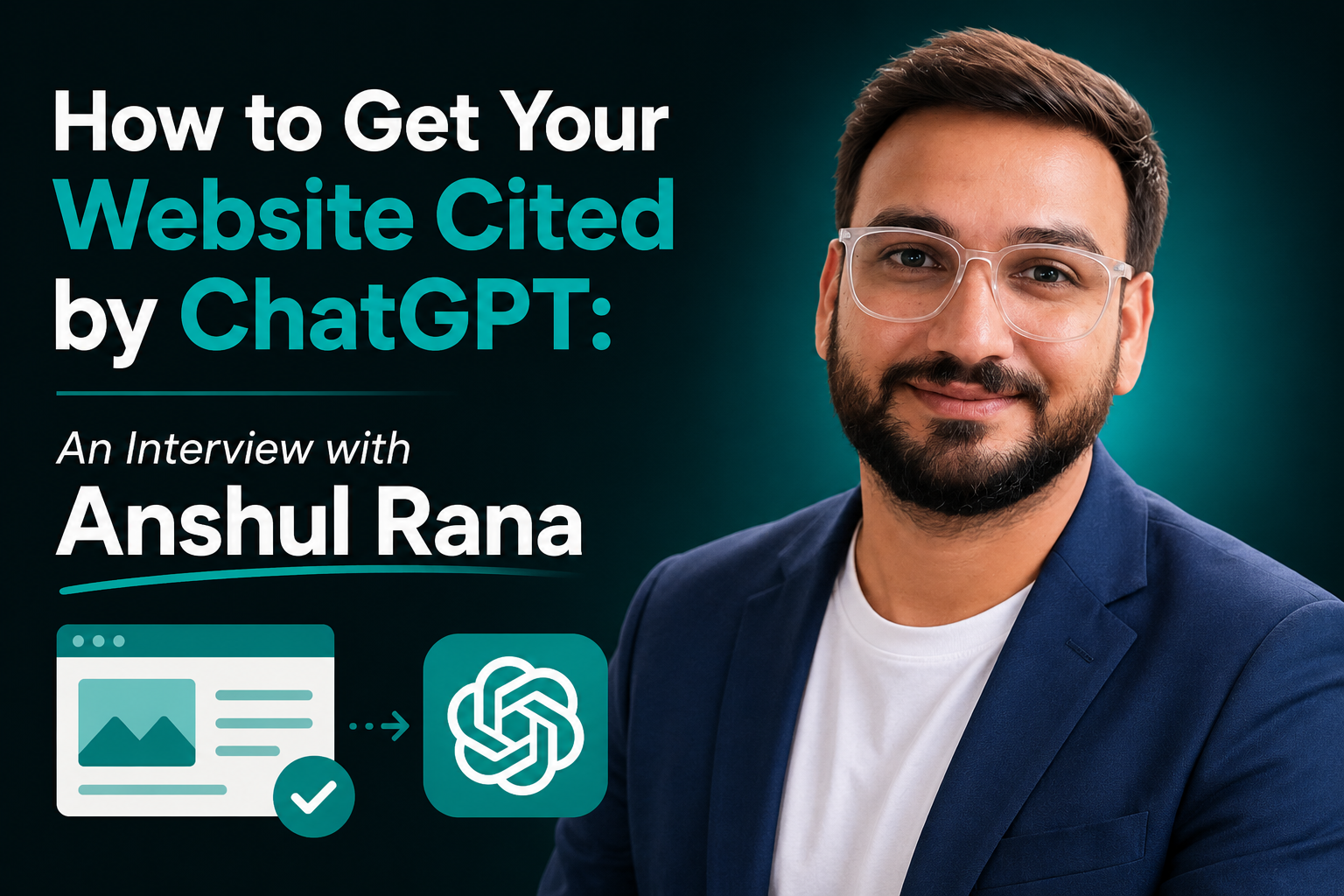
How to Get Your Website Cited by ChatGPT: An Interview with Anshul Rana
Q1: Let's start with the basics. Why should businesses care about being cited by ChatGPT?
Anshul Rana: The way people search has fundamentally changed. A growing segment of users now goes directly to ChatGPT instead of Google for answers. If your website isn't being cited, you don't exist for those users. It's not about vanity; it's about visibility at the moment someone is actively trying to solve a problem or make a purchase decision.
Think about it: when someone asks ChatGPT, "Who is the best SEO expert in India?" or "What are the top cybersecurity firms in Melbourne?" the sources it cites are the ones that built authority the right way. That's what Answer Engine Optimization (AEO) is all about.
Q2: How does ChatGPT actually decide which websites to cite?
Anshul Rana: Most people assume ChatGPT works like Google crawling, indexing, and ranking. But that's not quite how it works. Large language models are trained on massive datasets. They learn which sources are trusted, authoritative, and frequently referenced. Post-training, when ChatGPT uses web search, it still heavily favors sources that match the entity signals and authority patterns it already recognizes.
There's a critical insight here that I cover in depth on my blog: LLMs don't read link graphs, they read sentences. Co-occurrence of your brand name alongside relevant entities in credible third-party content is a far stronger signal than a backlink from a high-DA site. Brand mentions outperform backlinks 3:1 for AI citations.
Q3: What are the top things a website owner can do today to start getting cited?
Anshul Rana: There are four pillars I always start with:
1. Structured, Extractable Content. ChatGPT lifts direct answers from pages. If your content buries answers in long paragraphs, it won't be cited. Write clear question-and-answer sections, concise definitions, and scannable summaries. Your content needs to be audit-ready from an Answer Engine Readiness standpoint.
2. Schema Markup. Structured data is how you formally tell AI crawlers what your content is about. FAQ schema, HowTo schema, and Organization schema are particularly powerful. I've seen local businesses transform their AI visibility just by implementing schema markup correctly.
3. E-E-A-T Signals. ChatGPT's training data rewards expertise, experience, authoritativeness, and trustworthiness. Build an author bio, get bylined on reputable industry publications, and maintain a consistent entity presence across the web.
4. Topical Authority. Thin sites don't get cited. You need depth. A well-developed content cluster that covers a topic comprehensively signals to AI models that you are THE source on that subject.
Q4: You mentioned entity signals. Can you explain that more simply?
Anshul Rana: Sure. An entity is a named thing: a person, a brand, a place, or a concept. Search engines and AI models use entities to understand what your website is actually about, beyond just keywords. If my name, Anshul Rana, appears consistently alongside terms like "AEO," "GEO," "AI SEO India," and "ChatGPT optimization" across multiple credible sources, the model builds a strong association.
This is why I always recommend understanding the difference between SEO, AEO, and GEO before building a strategy. They target different systems but share the same entity foundation.
Q5: Does Bing matter for ChatGPT citations?
Anshul Rana: Absolutely, and this is one of the most overlooked tactics. ChatGPT uses Bing for real-time web search. If Bing hasn't indexed your page or doesn't trust it, ChatGPT won't cite it in its search-enabled responses. Most teams focus entirely on Google and ignore Bing indexing. That's a mistake in 2026.
I wrote about this specifically because it kept coming up with clients: Is Bing the underdog powering AI SEO in 2026? The short answer is yes. Submit your sitemap to Bing Webmaster Tools, ensure clean crawlability, and monitor your Bing indexing alongside Google.
Q6: How do you measure whether ChatGPT is actually citing you?
Anshul Rana: This is where a lot of people get stuck. Traditional GA4 and GSC won't show you AI citation data directly. You need a combination of approaches:
• Manual prompting regularly tests queries your target audience would ask and checks if your site is cited.
• Specialized AI visibility tools. I reviewed 11 of them in my Best AI SEO Tools in 2026 post, tools like Profound, Peec AI, and amionai.com track brand mentions across AI engines.
• GSC regex filters to identify question-based queries where you're getting impressions but not clicks, those are prime AEO opportunities. I ran a detailed 60-day GSC regex AEO case study that shows the exact process.
Q7: What's your one piece of advice for someone starting from scratch?
Anshul Rana: Stop writing for word count and start writing for intent. The research is a detailed search intent beats word count when it comes to AI citations. A 400-word page that directly answers a specific question will outperform a 3,000-word generalist article every time. Know exactly what your user is trying to accomplish, answer it precisely, and back it with schema and entity signals. That's the formula.
- Managerial Effectiveness!
- Future and Predictions
- Motivatinal / Inspiring
- Fitness and Wellness
- Medical & Health
- Manufacturing
- Education
- Real-Estate
- Food Industry
- Hospitality
- Online Games
- Sports
- Home Services
- Civil Engineering
- Safety and Protection
- Software Products & Services
- Fashion and Jewellery
- Artificial Intelligence
- Entrepreneurship
- Mentoring & Guidance
- Marketing
- Networking
- HR & Recruiting
- Literature
- Shopping
- Career Management & Advancement