

 SkillClick
AI Agents in Machine Learning: Concepts & Use Cases
According to Gartner, 40% of enterprise applications will embed task-specific AI agents by the end of 2026 up from less than 5% in 2025. That is one of the fastest technology adoption curves in enterprise software history. For students stepping into the world of artificial intelligence and machine learning, this shift raises an important question: what exactly is an “agent in AI,” and why is it suddenly everywhere, from LinkedIn job postings to university curricula?
Many learners still picture AI as a model that predicts an output, a spam filter, a recommendation engine, a price forecast. But the technology has moved further. Today’s most talked-about systems don’t just predict; they perceive, decide, and act, often with minimal human supervision. These systems are AI agents, and understanding them has become essential for anyone serious about a career in data science, machine learning, or AI engineering.
In this article, we’ll break down the core concepts behind AI agents in machine learning, explore the different types of AI agents, and look at real-world use cases reshaping industries from healthcare to finance to customer service. We’ll also look at how a structured, industry-aligned certification can help you build these skills with confidence.
What Is an AI Agent in Machine Learning?
At its core, an AI agent is a software system that perceives its environment through sensors or data inputs, processes that information, and acts upon the environment through actuators or outputs to achieve a specific goal. This is the standard AI agent definition used across academic AI textbooks and industry literature alike.
Unlike a traditional machine learning model which typically takes an input and returns a static prediction an agent in AI operates in a continuous perceive-think-act loop. It doesn’t just tell you something; it does something, evaluates the result, and adjusts its next action accordingly.
Consider a simple analogy: a weather prediction model tells you it might rain tomorrow. An AI agent built around that same model could go further checking your calendar, noticing you have an outdoor meeting, and automatically sending you a reminder to carry an umbrella or rescheduling the meeting altogether. The model predicts; the agent decides and acts.
Formally, intelligent agents in artificial intelligence are built around four components:
-
Perception: Gathering data from the environment, such as text, sensor readings, APIs, or user input.
-
Reasoning and Planning: Interpreting that data against goals, rules, or learned patterns.
-
Action: Executing a task, whether it’s sending an email, placing a trade, or controlling a robotic arm.
-
Learning: Improving performance over time based on feedback, particularly in learning agents.
This combination is what separates agent-based systems in AI from simple automation scripts. A script follows fixed instructions; an agent reasons about the best course of action given its goals and current environment, which is why well-designed agents are often called rational agents in AI systems that choose the action expected to maximize their performance measure given what they currently know.
Why Do AI Agents Matter in Today's Industry?
The conversation around autonomous AI agents has moved from research papers to boardrooms for a simple reason: businesses are under pressure to do more with fewer manual touchpoints, and agents are proving capable of handling multi-step, decision-heavy workflows that once required human judgement.
Industry data backs this up. Early adopters span financial services using agents for fraud detection and compliance monitoring, healthcare systems using them for diagnostics support and patient coordination, manufacturers using them for predictive maintenance, and retailers using them for personalised shopping and inventory management.
For students, particularly in India’s fast-growing tech and analytics job market, this shift is significant. India has emerged as one of the largest hubs for AI-enabled IT services, fintech innovation, and global capability centres (GCCs) building agent-based systems for international clients. Roles such as Machine Learning Engineer, AI Developer, and AI Product Analyst increasingly list experience with agentic AI systems as a desirable skill not a future nice-to-have.
This matters for three reasons:
-
Career relevance: Employers are hiring for agent design and deployment skills today, not in some distant future.
-
Smarter automation: Agents handle complex, multi-step processes that traditional rule-based automation simply cannot.
-
A foundational shift in AI education: Understanding agents is now considered core AI literacy, alongside supervised learning and neural networks, in modern data science curricula.
In short, learning about AI agents is no longer an optional specialisation; it is becoming part of the baseline expected of any AI or ML professional entering the workforce in 2026 and beyond.
Key Concepts, Types & Use Cases
Types of AI Agents
AI textbooks generally classify intelligent agents into five categories, based on how much reasoning and adaptability they bring to the perceive-think-act loop. Understanding this hierarchy is one of the most frequently tested areas in AI and ML certification exams, and a common topic in entry-level data role interviews.
|
Type of Agent |
How It Works |
Example |
|
Simple Reflex Agents |
Acts only on the current perception using fixed condition-action rules; has no memory of past states |
A thermostat that switches on cooling once temperature crosses a set threshold |
|
Model-Based Reflex Agents |
Maintains an internal model of the world to track aspects of the environment that aren't directly observable |
A robot vacuum that remembers which rooms it has already cleaned |
|
Goal-Based Agents |
Chooses actions based on how well they move it toward a defined goal, not just the current state |
A navigation agent selecting the best route to a destination |
|
Utility-Based Agents |
Weighs multiple possible actions using a utility function to pick the best outcome, not just any path to the goal |
A trading agent balancing risk and return to maximise profit |
|
Learning Agents |
Improves its own performance over time using feedback and experience, adapting its strategy as it goes |
A recommendation agent that refines suggestions based on user behaviour |
These categories build on each other in sophistication. Simple reflex agents are reactive and rule-bound, while learning agents in AI represent the most advanced category capable of refining their own decision-making strategies. This is why most modern autonomous AI agents, such as chatbots that improve from conversations, fraud-detection systems, and self-driving software, fall into this category, or combine goal-based and utility-based reasoning with continuous learning.
Core Architecture of an Intelligent Agent
Regardless of type, most agent-based systems in AI share a common architecture:
-
Sensors / Input Layer: Collects raw data such as text from a user, sensor readings, API responses, or images.
-
Knowledge Base / Memory: Stores facts, past states, or learned patterns the agent can reference.
-
Reasoning Engine: Applies logic, rules, or a trained ML or language model to decide the next action.
-
Action / Output Layer: Executes the decision, such as sending a message, triggering a workflow, or controlling hardware.
-
Feedback Loop: Captures the outcome of the action to refine future decisions, which is critical for learning agents.
This loop perceive, reason, act, learn is what allows agents to operate with a level of autonomy that static ML models cannot match.
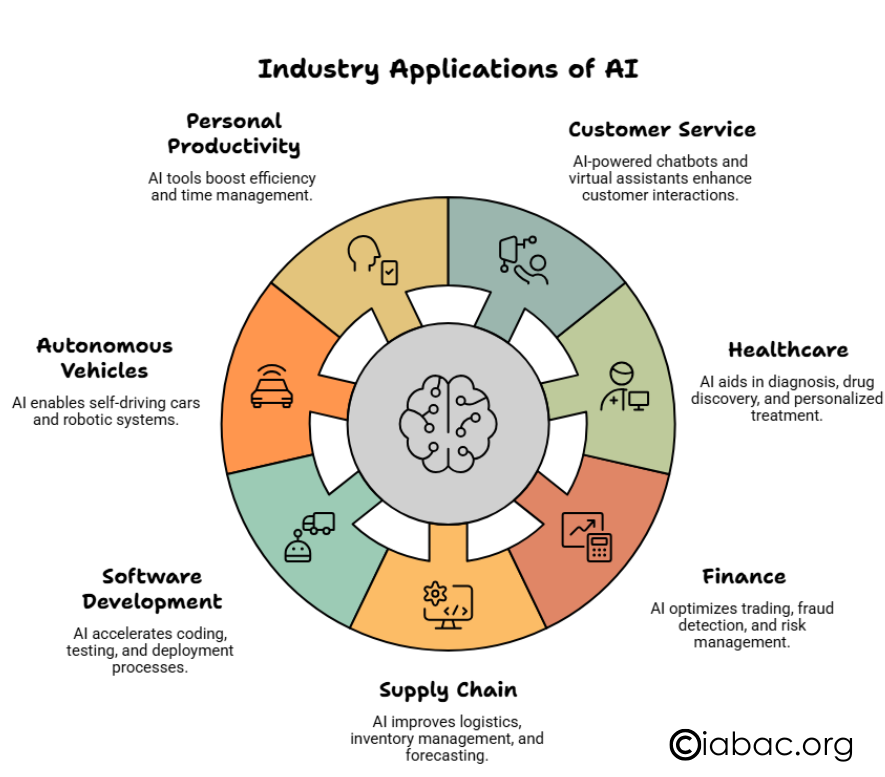
Real-World Use Cases of AI Agents
AI agents are no longer confined to research demos. Here are some of the most impactful applications today:
-
Customer Service & Support: Conversational agents handle queries end-to-end checking order status and processing refunds and escalate only complex cases to humans.
-
Healthcare: Diagnostic support agents cross-reference symptoms, lab results, and medical literature to help doctors identify conditions faster, while care-coordination agents manage scheduling and follow-ups.
-
Finance & Banking: Fraud-detection agents continuously monitor transaction patterns and flag suspicious activity in real time, while robo-advisory agents manage portfolios using goal-based and utility-based reasoning.
-
Software Development: Coding agents can read a codebase, identify bugs, write fixes, and open pull requests with minimal developer input.
-
Supply Chain & Manufacturing: Agents forecast demand, optimize inventory levels, and predict equipment failures before they cause downtime.
-
Autonomous Vehicles & Robotics: Self-driving systems combine perception (cameras, lidar), reasoning (path planning), and action (steering, braking) in a continuous agent loop.
-
Personal Productivity: Scheduling and research assistants read your calendar and inbox, summarise information, and take routine actions on your behalf.
Challenges in Building Agent-Based Systems
It’s worth being realistic: not every agent project succeeds. Analysts have noted that a meaningful share of agentic AI initiatives face cancellation due to unclear ROI, weak governance, or unreliable outputs. For students entering this field, that is actually good news it means organisations urgently need professionals who understand:
-
Agents are only as good as the information they can access.
-
Explainability and auditability, especially in regulated sectors like finance and healthcare.
-
Safety and guardrails that prevent agents from taking unintended or harmful actions.
-
Evaluation frameworks for measuring whether an agent is reliably achieving its goal.
These are precisely the skills that structured, industry-aligned certification programmes are designed to teach.
How IABAC Certifications Help You Build These Skills?
Learning the theory behind intelligent agents in artificial intelligence is one thing; being able to design, evaluate, and deploy them in real business contexts is another. This is where structured learning makes a measurable difference.
IABAC’s Artificial Intelligence and Machine Learning certification programmes built on the EU-funded EDISON Data Science Framework are designed to take learners beyond textbook definitions into applied, project-based skill-building. Programmes such as the Certified Machine Learning Expert and Certified Artificial Intelligence Expert certifications cover the foundational and advanced concepts behind agent design, including reasoning architectures, decision-making models, and real-world deployment considerations, supported by hands-on projects that mirror how agentic systems are actually built in industry.
Because IABAC certifications are internationally recognised and mapped to current industry skill expectations, they give students a credential that signals genuine readiness not just theoretical familiarity to employers evaluating candidates for ML engineering, AI development, and data science roles.
Frequently Asked Questions
1) What is the difference between an AI agent and a machine learning model?
A machine learning model is typically a single function that maps an input to an output, such as predicting a number or classifying an image. An AI agent is a broader system that may use one or more ML models internally, but adds perception, reasoning, planning, and action, allowing it to operate autonomously toward a goal rather than simply returning a prediction.
2) What are the main types of AI agents?
The five widely recognised types are simple reflex agents, model-based reflex agents, goal-based agents, utility-based agents, and learning agents in AI, each representing an increasing level of reasoning and adaptability.
3) Are AI agents the same as chatbots?
Not exactly. A basic chatbot may simply match patterns in text to pre-written responses, similar to a simple reflex agent. A true conversational AI agent perceives context, reasons about user intent, takes actions such as updating records or triggering workflows, and often learns from each interaction.
4) Do I need coding skills to learn about AI agents?
Practical experience with Python and machine learning frameworks helps significantly, since most agent frameworks are built on top of them. That said, foundational courses can introduce the underlying concepts and architecture before you move into hands-on implementation.
5) How can I start a career working with AI agents?
Building a strong foundation in core machine learning concepts, followed by an industry-recognised certification with hands-on projects, is one of the fastest ways to develop job-ready skills in agent-based AI systems.
Conclusion
AI agents represent one of the most significant shifts in how machine learning is applied in the real world moving from systems that simply predict to systems that perceive, reason, and act autonomously. For students and early-career professionals, understanding the different types of AI agents, their architecture, and their use cases isn’t just academically interesting; it is quickly becoming a baseline expectation across AI, ML, and data science roles.
The good news is that this is a skill set you can build deliberately, through structured learning, hands-on projects, and recognised certification, rather than piecing it together from scattered tutorials. Whether your goal is to become a machine learning engineer, an AI consultant, or a researcher, now is the right time to build a strong foundation in agent-based systems in AI.
Reference Links
• Certified Machine Learning Expert Certification
• Certified Artificial Intelligence Expert Program
• Generative AI Specialist Certification
- Managerial Effectiveness!
- Future and Predictions
- Motivatinal / Inspiring
- Fitness and Wellness
- Medical & Health
- Manufacturing
- Onderwijs
- Real-Estate
- Food Industry
- Hospitality
- Online Games
- Sports
- Home Services
- Civil Engineering
- Safety and Protection
- Software Products & Services
- Fashion and Jewellery
- Artificial Intelligence
- Entrepreneurship
- Mentoring & Guidance
- Marketing
- Networking
- HR & Recruiting
- Literature
- Shopping
- Career Management & Advancement