

 SkillClick
Automotive Turbocharger Market to Reach US$ 31.3 Billion by 2033 Growing at 7.8% CAGR Amid Rising Emission Regulations
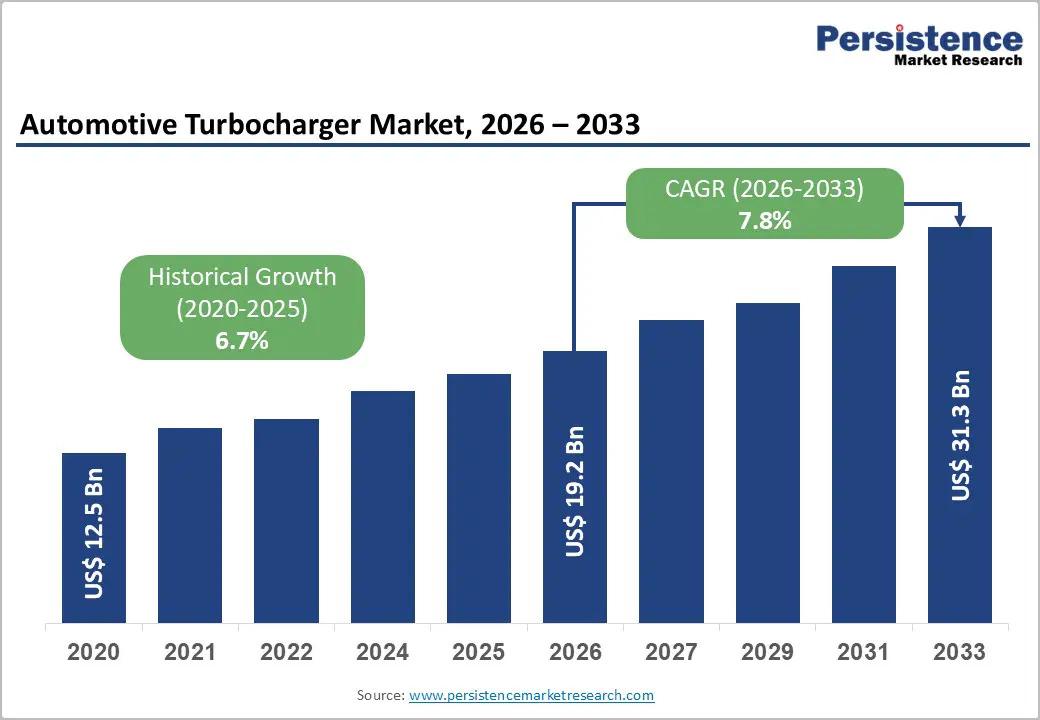
According to Persistence Market Research, the global automotive turbocharger market is expected to be valued at US$ 19.2 billion in 2026 and is projected to reach US$ 31.3 billion by 2033, growing at a CAGR of 7.8% during the forecast period. The market continues to witness strong momentum as automakers increasingly adopt turbocharging technology to meet stringent fuel efficiency and emissions standards while maintaining vehicle performance.
Automotive turbochargers have become essential components in modern internal combustion engines (ICEs), enabling manufacturers to downsize engines without sacrificing power output. By utilizing exhaust gases to compress intake air, turbochargers improve combustion efficiency, increase engine performance, and reduce fuel consumption. As governments worldwide tighten carbon emission regulations and consumers demand fuel-efficient vehicles, turbocharger adoption is accelerating across passenger cars, commercial vehicles, and hybrid powertrains.
Market Trends
One of the most significant trends shaping the automotive turbocharger market is the growing integration of turbocharging technology with hybrid vehicle platforms. While electric vehicle adoption continues to rise, hybrid vehicles remain a practical transition solution in many regions. Automakers are increasingly pairing smaller turbocharged engines with electric motors to achieve higher fuel efficiency and lower emissions.
Another emerging trend is the development of electric turbochargers (e-turbos). Unlike conventional turbochargers that rely solely on exhaust gases, e-turbos use electric assistance to eliminate turbo lag and enhance engine responsiveness. These advanced systems are gaining attention among premium vehicle manufacturers seeking improved performance and efficiency.
Manufacturers are also investing in lightweight materials and advanced turbine designs to improve durability, thermal efficiency, and overall performance. Innovations in variable geometry turbochargers (VGTs) and twin-scroll turbochargers continue to support broader market expansion.
Market Drivers
Stringent Emission Regulations Worldwide
The primary driver fueling market growth is the increasing implementation of strict vehicle emission standards across major automotive markets. Governments in Europe, North America, China, India, and other regions are enforcing regulations aimed at reducing CO₂ emissions and improving fuel economy.
Turbochargers enable automakers to use smaller engines that consume less fuel while delivering comparable performance to larger naturally aspirated engines. This makes turbocharging one of the most cost-effective solutions for achieving regulatory compliance.
Growing Demand for Fuel-Efficient Vehicles
Rising fuel prices and environmental awareness are encouraging consumers to prioritize fuel-efficient vehicles. Turbocharged engines provide enhanced power output while reducing fuel consumption, making them highly attractive across both developed and emerging markets.
Automakers continue to expand turbocharged engine offerings across compact cars, SUVs, pickup trucks, and commercial vehicles to address evolving consumer preferences.
Expansion of Hybrid Powertrains
Hybrid vehicles increasingly rely on compact, efficient engines that work alongside electric motors. Turbochargers enhance the efficiency of these engines, making them an important component in the hybrid vehicle ecosystem. The growing popularity of mild hybrid and full hybrid vehicles is creating additional opportunities for turbocharger manufacturers.
👉 𝐆𝐞𝐭 𝐅𝐫𝐞𝐞 𝐒𝐚𝐦𝐩𝐥𝐞 𝐍𝐨𝐰: https://www.persistencemarketresearch.com/samples/33562
Market Restraints and Challenges
Rapid Shift Toward Fully Electric Vehicles
The accelerating adoption of battery electric vehicles (BEVs) presents a long-term challenge for the automotive turbocharger industry. Since electric vehicles do not use internal combustion engines, they do not require turbochargers. As governments introduce EV incentives and automakers expand electric portfolios, demand growth for turbochargers may face pressure in certain regions.
High Manufacturing and Development Costs
Advanced turbocharger technologies such as electric turbochargers and variable geometry systems involve significant research, development, and production costs. Smaller manufacturers may struggle to compete with established players that possess stronger technological capabilities and economies of scale.
Thermal and Durability Challenges
Turbochargers operate under extreme temperatures and pressures. Ensuring long-term reliability while meeting evolving efficiency requirements remains a critical engineering challenge. Manufacturers must continuously invest in advanced materials and testing processes to maintain product durability.
Market Opportunities
Growing Adoption of Electric Turbochargers
Electric turbocharger technology represents one of the most promising opportunities in the market. These systems improve engine responsiveness, reduce turbo lag, and optimize fuel efficiency. As vehicle electrification progresses, e-turbos are expected to gain significant traction, particularly in premium and performance vehicle segments.
Emerging Markets and Vehicle Production Growth
Rapid urbanization, rising disposable incomes, and expanding automotive production in countries such as China, India, Brazil, and Southeast Asian nations continue to create favorable growth conditions. Increasing passenger vehicle ownership and commercial vehicle demand are expected to support turbocharger adoption throughout the forecast period.
Commercial Vehicle Modernization
Fleet operators are increasingly focused on reducing fuel costs and complying with stricter emission standards. Turbocharged diesel engines remain essential in heavy-duty commercial vehicles, creating substantial opportunities for turbocharger suppliers targeting the transportation and logistics sectors.
Segmentation Analysis
By Fuel Type
Gasoline turbochargers account for a significant market share due to growing adoption in passenger vehicles. Automakers increasingly utilize turbocharged gasoline direct injection (TGDI) engines to achieve improved fuel economy and performance.
Diesel turbochargers continue to maintain strong demand in commercial vehicles and heavy-duty applications where high torque and fuel efficiency remain critical operational requirements.
By Technology
Variable Geometry Turbochargers (VGTs) dominate the technology segment owing to their superior efficiency and ability to optimize performance across various engine speeds.
Wastegate turbochargers remain widely adopted due to their cost-effectiveness and established reliability.
Electric turbochargers are expected to register the fastest growth as manufacturers focus on reducing turbo lag and enhancing hybrid powertrain performance.
By Vehicle Type
Passenger cars represent the largest market segment due to the widespread use of turbocharged engines in compact and mid-size vehicles.
Light commercial vehicles (LCVs) continue to witness increasing turbocharger adoption as fleet operators prioritize fuel efficiency.
Heavy commercial vehicles (HCVs) generate substantial demand due to the extensive use of turbocharged diesel engines in freight transportation and logistics applications.
By Sales Channel
Original Equipment Manufacturers (OEMs) account for the majority of market revenue, supported by increasing factory-installed turbocharger integration.
The aftermarket segment also offers growth opportunities driven by replacement demand and performance upgrades.
Regional Outlook
Asia Pacific
Asia Pacific is expected to dominate the automotive turbocharger market throughout the forecast period. The region benefits from strong automotive production volumes, expanding vehicle ownership, and tightening emission standards. China, India, Japan, and South Korea remain key contributors to regional growth.
China continues to lead vehicle manufacturing and hybrid vehicle adoption, creating substantial demand for advanced turbocharger technologies. India is also emerging as a significant market due to stricter fuel efficiency regulations and growing passenger vehicle sales.
Europe
Europe represents the second-largest market, supported by some of the world's most stringent emission regulations. The region has historically been a strong adopter of turbocharged engines, particularly in passenger vehicles. Continued investments in hybrid technology and advanced engine platforms are expected to sustain market growth.
North America
North America remains a major market due to growing demand for turbocharged SUVs, pickup trucks, and light commercial vehicles. Automakers increasingly utilize turbocharged gasoline engines to improve fuel economy while maintaining performance expectations among consumers.
Rest of the World
Latin America, the Middle East, and Africa are expected to witness steady growth as vehicle production expands and governments gradually implement stricter environmental regulations. Rising urbanization and infrastructure development further support long-term market potential.
Competitive Landscape
The global automotive turbocharger market is highly competitive, with manufacturers focusing on technological innovation, strategic partnerships, and product development to strengthen their market positions.
Key companies operating in the market include:
- Garrett Motion
- BorgWarner
- Cummins Inc.
- Mitsubishi Heavy Industries
- IHI Corporation
- Continental AG
- Bosch
- BMTS Technology
Market participants are increasingly investing in electric turbocharger development, lightweight materials, and integrated powertrain solutions to address evolving automotive industry requirements and strengthen their competitive advantage.
Conclusion
The global automotive turbocharger market is positioned for steady growth through 2033, driven by tightening emissions regulations, increasing demand for fuel-efficient vehicles, and the ongoing transition toward hybrid powertrains. Despite challenges associated with electric vehicle adoption, turbochargers remain a critical technology for improving internal combustion engine efficiency. Innovations such as electric turbochargers and advanced variable geometry systems are expected to unlock new growth opportunities, enabling manufacturers to meet future performance, efficiency, and sustainability objectives.
- Managerial Effectiveness!
- Future and Predictions
- Motivatinal / Inspiring
- Fitness and Wellness
- Medical & Health
- Manufacturing
- Education
- Real-Estate
- Food Industry
- Hospitality
- Online Games
- Sports
- Home Services
- Civil Engineering
- Safety and Protection
- Software Products & Services
- Fashion and Jewellery
- Artificial Intelligence
- Entrepreneurship
- Mentoring & Guidance
- Marketing
- Networking
- HR & Recruiting
- Literature
- Shopping
- Career Management & Advancement