

 SkillClick
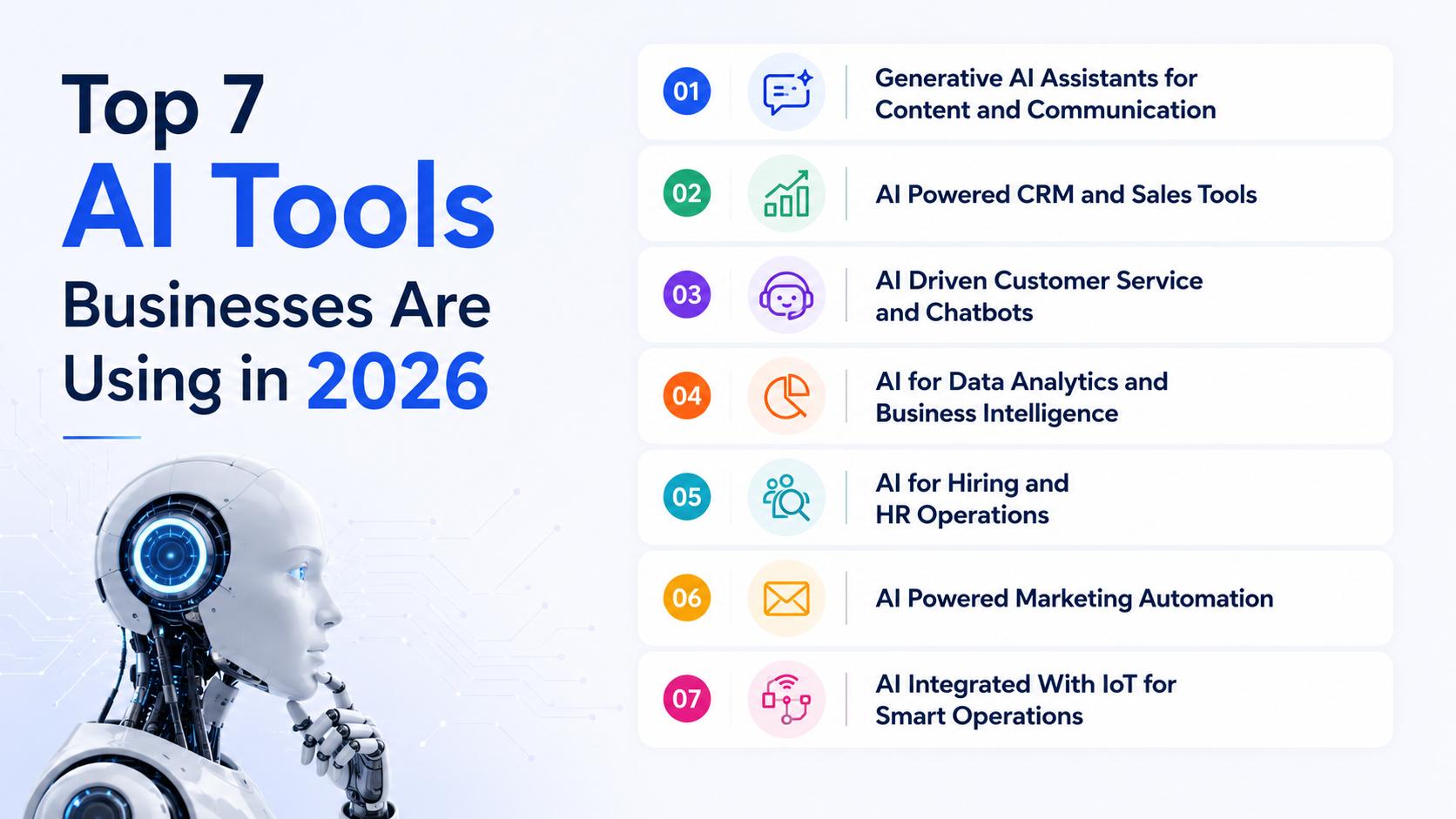
Top 7 AI Tools Businesses Are Using in 2026
AI is no longer a future plan for businesses. It is part of daily operations right now. Here are the tools businesses are actually using in 2026 to get real results.
A few years ago, AI adoption in business was mostly experimental. Teams were testing chatbots, trying out a writing assistant, or running small pilot projects to see what worked. In 2026, that experimentation phase is largely over. According to a 2025 McKinsey global survey, 78 percent of organisations report using AI in at least one business function, up sharply from previous years.
What has changed is not just adoption but maturity. Businesses are no longer asking whether to use AI. They are asking which tools deliver the most value for their specific operations. Here are the seven categories of AI tools businesses are relying on most heavily this year.
1. Generative AI Assistants for Content and Communication
Speeding up writing, drafting, and everyday communication
Generative AI assistants have become a standard part of daily work for marketing, sales, and support teams. These tools draft emails, write social media posts, summarise long documents, and generate first drafts of reports in seconds rather than hours.
What has improved significantly in 2026 is accuracy and tone control. Businesses can now train these assistants on their own brand voice and internal data, producing content that sounds like it came from their team rather than a generic AI output. This shift toward customisation is why many businesses are now investing in Custom AI/ML Solutions rather than relying solely on off the shelf assistants, allowing the AI to reflect their specific industry language and customer expectations.
2. AI Powered CRM and Sales Tools
Helping sales teams focus on the right opportunities
AI has transformed how sales teams prioritise their time. Predictive lead scoring, automated follow up suggestions, and conversation intelligence tools that analyse sales calls for tone and objections are now built into most major CRM platforms.
These tools work by analysing historical deal data to identify patterns that predict which leads are most likely to convert. Sales reps spend less time guessing and more time acting on data backed recommendations. For businesses with complex sales processes, working with providers of ai & ml development solutions allows these prediction models to be trained on company specific data rather than generic industry benchmarks, which tends to produce far more accurate results.
3. AI Driven Customer Service and Chatbots
Handling more queries without growing the support team
Customer service has seen some of the most visible AI adoption of any business function. Modern AI chatbots in 2026 can handle far more complex queries than the scripted bots of a few years ago, understanding context, accessing order and account history, and escalating to a human agent only when genuinely necessary.
According to Salesforce's 2025 State of Service report, businesses using AI in customer service report a 27 percent reduction in average resolution time. This is a meaningful improvement for support teams that have historically struggled with growing ticket volumes and limited headcount.
4. AI for Data Analytics and Business Intelligence
Turning raw data into decisions faster
Every business generates more data than its teams can manually analyse. AI powered analytics tools are solving this by automatically identifying trends, flagging anomalies, and generating plain language summaries of complex datasets that would otherwise require a dedicated analyst to interpret.
This is particularly valuable for businesses without large in-house data science teams. Rather than waiting days for a report, decision makers can ask a question in natural language and get an answer immediately. The businesses getting the most value from this are typically working with custom ai development services to build models trained specifically on their own operational data, rather than using generic analytics dashboards that were not designed with their industry in mind.
5. AI for Hiring and HR Operations
Reducing time to hire without losing quality
AI tools in HR have moved well beyond simple resume scanning. In 2026, businesses are using AI to screen candidates against role specific criteria, schedule interviews automatically, and even analyse interview transcripts for consistency in how candidates are evaluated.
This has had a measurable impact on hiring speed. A 2025 LinkedIn Talent Solutions report found that businesses using AI in their hiring process reduced average time to hire by 35 percent. For HR teams stretched across recruitment, onboarding, and employee management, this kind of efficiency gain is significant.
6. AI Powered Marketing Automation
Personalising campaigns at a scale humans cannot match
Marketing teams are using AI to personalise campaigns down to the individual contact level, something that was simply not feasible at scale before. AI tools now determine the best time to send a message, the most relevant content for each recipient, and even adjust messaging tone based on a contact's previous engagement.
This level of personalisation is producing noticeably better engagement rates. Businesses running AI driven marketing automation are reporting higher click through rates and lower unsubscribe rates compared to traditional segmented campaigns, simply because the messaging feels more relevant to each individual recipient.
7. AI Integrated With IoT for Smart Operations
Connecting physical operations to intelligent decision making
One of the fastest growing areas of AI adoption in 2026 is its integration with connected devices. Businesses running warehouses, manufacturing facilities, and logistics operations are combining AI with sensor data to predict equipment failures, optimise delivery routes, and automatically adjust operations based on real time conditions.
This combination is where Custom IoT Development Solutions and AI genuinely come together. Sensors collect the data, AI interprets it and makes decisions, and the results feed directly into operational systems without manual intervention. Businesses exploring this space are increasingly working with providers of custom iot development services who also understand how to layer AI decision making on top of the connected hardware, rather than treating the two as separate projects.
What This Means for Businesses Moving Forward
Choosing tools that fit, not just tools that are popular
With so many AI tools available, the businesses getting the best results in 2026 are not the ones adopting the most tools. They are the ones choosing tools that solve a specific, well understood problem and investing in proper implementation rather than rushing to keep up with trends.
Off the shelf AI tools work well for many businesses, particularly smaller teams just getting started. But as operations grow more complex, custom built AI solutions trained on a business's own data consistently outperform generic tools, simply because they understand the specific context they are working within.
Final Thought
AI in 2026 is not a single tool or a single use case. It is a set of capabilities being applied across every part of a business, from how content gets written to how warehouses are managed. The businesses pulling ahead are the ones treating AI as a strategic investment rather than a quick fix, choosing the right tools for their specific needs, and building on a foundation that can grow with them.
- Managerial Effectiveness!
- Future and Predictions
- Motivatinal / Inspiring
- Fitness and Wellness
- Medical & Health
- Manufacturing
- Éducation
- Real-Estate
- Food Industry
- Hospitality
- Online Games
- Sports
- Home Services
- Civil Engineering
- Safety and Protection
- Software Products & Services
- Fashion and Jewellery
- Artificial Intelligence
- Entrepreneurship
- Mentoring & Guidance
- Marketing
- Networking
- HR & Recruiting
- Literature
- Shopping
- Career Management & Advancement