

 SkillClick
How Residential Solar Energy Solutions Are Redefining Energy Independence for Modern Homes
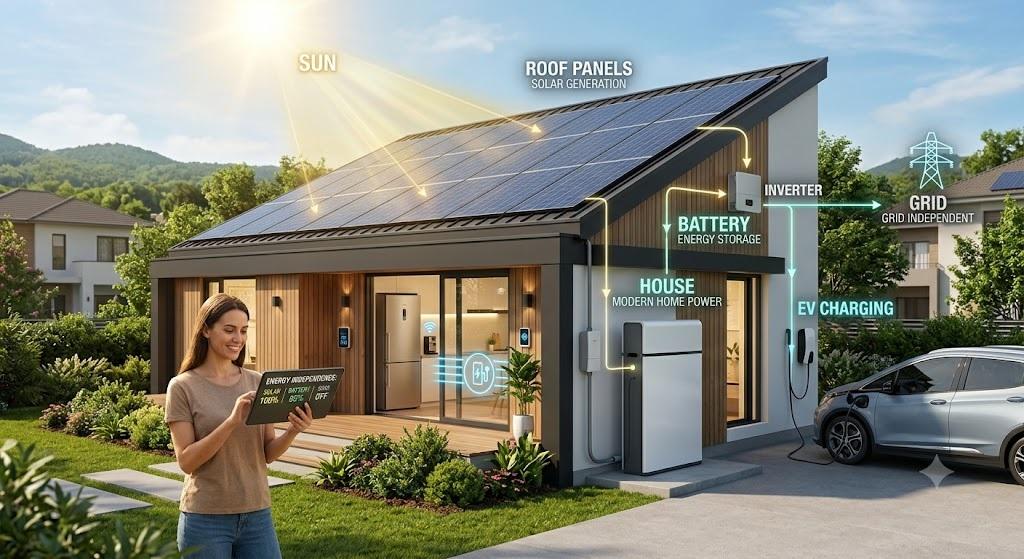
Three years ago, the households on a street in Ahmedabad's Bopal neighbourhood were all paying similar electricity bills — ₹3,500 to ₹5,000 per month for four-bedroom homes with two air conditioners running from May through September. Today, a third of them are paying under ₹800. Not because they installed anything experimental or chased any rebate scheme — because they installed rooftop solar when the subsidy structure finally made the arithmetic unambiguous, and the grid became a billing mechanism rather than a supplier.
The households that have not moved yet are not holding back for lack of interest. They are holding back because of outdated mental models about what residential solar energy solutions cost, how they perform during monsoon, what happens at night, and whether the paperwork is worth the trouble. Those mental models were formed at a point in the market's development when they were substantially correct. They are not substantially correct now.
The 2019 Evaluation Does Not Apply to the 2025 Market
A homeowner who researched rooftop solar in 2018 or 2019 and shelved the idea is working from numbers that have changed enough to constitute a different decision. Monocrystalline PERC panels at 18–19% efficiency cost ₹28–32 per watt installed in 2019. TOPCon panels in 2025 run 21–22% efficiency at ₹20–25 per watt — higher performance, lower cost, and a smaller roof area required for equivalent capacity. A 4 kW system that needed 24–25 square metres of panel surface in 2019 fits in 19–21 square metres today, which for a city rooftop where water tanks and staircase covers claim the usable area is often the difference between a system fitting and not fitting.
Battery storage for residential use was financially implausible in 2019. Lead-acid batteries at the cycle counts required for daily solar charging delivered 18–30 months of useful life in residential use before capacity degraded below functional thresholds, making the per-kilowatt-hour cost of stored energy far higher than simply drawing from the grid. Lithium iron phosphate chemistry at 3,000–6,000 cycles has changed that calculation. A 10 kWh LFP battery bank at current market pricing of ₹25,000–35,000 per kWh provides 8–15 years of daily cycling before capacity falls below 80% of nameplate — long enough to amortise its cost against the units it supplies and deliver electricity at ₹3–6 per unit from storage, against a grid import tariff in most Indian states that has crossed ₹8–12 per unit for residential consumers.
The hybrid inverter — a single unit managing solar input, battery charging and discharging, grid import, and export simultaneously — did not exist in residential price ranges in 2019. The equivalent capability required three separate components, their own interfaces, and installation complexity that added cost and failure surface. Hybrid inverters have collapsed that complexity into a single manageable unit, and the system the homeowner gets now is genuinely simpler to install, commission, and operate than what the previous generation of equipment required.
What Net Metering Actually Does to the Monthly Bill
The technical mechanics of net metering are not difficult, but they are frequently explained poorly and understood as a result through a fog of approximation that leads homeowners to expect either more or less from their system than it delivers.
During daylight hours, a grid-connected solar system produces electricity. The household uses what it needs at that moment — running the refrigerator, the water pump, the lights if any are on, whatever is drawing power — and the surplus beyond that instantaneous consumption flows out through the meter to the grid. The meter records this outflow as an export. At night, or on a heavily cloudy afternoon, when the household draws more than the panels produce, electricity flows in from the grid and the meter records an import. At the billing cycle's end, the DISCOM calculates the net position: exports minus imports. If the household exported more units than it imported, the bill is zero and the surplus carries as a credit against the next month. If imports exceeded exports, the bill reflects the net deficit at the applicable tariff.
The financial value of this mechanism depends entirely on what the state DISCOM credits for exported units. In states where the export credit equals the import tariff — Maharashtra, Gujarat, Rajasthan at current policy — one unit exported is worth exactly one unit imported, making the grid a zero-cost storage mechanism. In states that have shifted to net billing at a lower feed-in tariff for exports — where one unit exported earns less than one unit imported costs — self-consumption becomes more valuable than export, and battery storage that keeps surplus within the household rather than exporting it at a discount becomes financially justified even before the outage backup value is counted.
This is the specific calculation that a residential solar energy solutions installer should run against the homeowner's state policy before recommending battery storage or not. A generic answer — "battery is useful" or "battery is not worth it yet" — without reference to the specific state's net metering rate is not advice. It is a guess that may be costing the homeowner money in either direction.
The EV Problem That Every Sizing Conversation Needs to Address
A 3 kW solar system sized against a household's 2024 electricity consumption does not adequately cover a household that will add an electric vehicle charger in 2026. This seems obvious stated plainly. It is not treated as obvious by the fraction of installers who quote against stated current consumption without asking about the EV question.
An electric vehicle charged at home from a standard 3.3 kW home charger drawing for 4–6 hours per evening adds 13–20 kWh to the household's daily consumption. Against a 3 kW solar system generating 12–15 units per day in a medium-insolation city, the EV charging alone could equal or exceed the total solar generation, leaving the household covering most of the vehicle's charging cost from the grid at the full import tariff. The solar system has not failed. It was sized for a load profile that no longer describes the household.
The correct sizing for a household that owns or expects to own an EV within three years treats the vehicle as part of the baseline load from the beginning. A 5–6 kW system with a 10–15 kWh battery bank, configured to charge the vehicle preferentially from solar surplus during the day via a solar-aware EV charger that monitors battery state of charge before authorising charge, covers the combined residential and vehicle demand at a payback period of 4–7 years on the combined investment — competitive with sizing the system for residential load alone and then expanding later, when expansion requires a new DISCOM application, potentially new structural work on the mounting arrangement, and the administrative overhead of a second installation.
Monsoon Performance: The Percentage That Ends the Myth
The belief that solar does not work during monsoon months is the single largest source of incorrect financial projections in residential solar conversations in India, because it causes homeowners to discount the system's generation for three or four months entirely when the correct discount is 30–60%, not 100%.
Solar panels generate electricity from photons — the radiative component of sunlight that passes through clouds in attenuated but non-zero quantities. A lightly overcast day delivers 40–60% of clear-sky irradiance to a panel surface. A heavily overcast monsoon day in coastal Maharashtra delivers 15–25%. Rainfall itself, during the minutes the rain is actually falling, can temporarily clear dust from the panels and improve transmission — which is why some roof installations show brief performance spikes during rain events before cloud-induced attenuation takes over.
The annual generation data for a 4 kW residential system at a site in Pune shows the practical consequence: monthly generation falls from 480–520 units in March–April to 220–260 units in July–August — a 50–55% reduction, not zero generation. The Pune household's consumption does not fall in the same proportion during monsoon months, because air conditioning use drops as outdoor temperatures moderate, so the self-consumption fraction of the reduced generation may actually be higher in monsoon months than in summer. The net financial contribution of monsoon months is positive. Not as positive as summer months, but positive, and the financial model that treats them as zero generation months is wrong by the same amount it uses for those months' consumption.
The Subsidy Sequence That Catches Homeowners Off Guard
PM SuryaGhar Muft Bijli Yojana subsidy is not a discount the installer applies at the time of sale. It is a central government direct benefit transfer — real money — credited to the homeowner's bank account after the system is commissioned, the DISCOM installs the net meter, and the homeowner submits the completion verification through the National Portal for Rooftop Solar. The sequence matters because some installers present "post-subsidy pricing" that bundles the subsidy value into their quote as an upfront reduction, which means the homeowner is effectively lending the installer or financer the subsidy amount and recovering it after commissioning. The correct structure is the homeowner paying the full installation price, the installer facilitating the subsidy application through the national portal, and the subsidy being credited directly to the homeowner's account — typically within 30 days of DISCOM net meter installation.
The subsidy rates: ₹18,000 per kW for the first 3 kW of system capacity, ₹9,000 per kW for capacity from 3 kW to 10 kW, maximum ₹78,000 for a 10 kW installation. A 5 kW system receives ₹54,000 on the first 3 kW plus ₹18,000 on the additional 2 kW — ₹72,000 total subsidy. Against a pre-subsidy 5 kW system cost in Gujarat of approximately ₹2.25–₹2.80 lakh, the subsidy covers 26–32% of the total investment before financing.
Bank financing for the post-subsidy balance at 7–9% per annum through nationalised banks participating in the PM SuryaGhar lending programme produces EMI figures that, for most Gujarat and Rajasthan households, sit below the monthly electricity bill saving from the first month of generation — making the system cash-flow positive from commissioning without any upfront capital outlay. That framing — the EMI is less than what the system saves you each month — is not a sales pitch. It is arithmetic that the financing rate, the system generation estimate, and the household's current tariff combine to produce.
What The Installer Does That the Hardware Does Not
The panels, inverter, battery, and mounting hardware in a residential solar system are available from multiple sources and the specifications are comparable across reputable brands in the same price tier. Two systems with identical hardware deliver different outcomes if one was designed with a proper shadow analysis and one was not, one was sized against a load projection that included future loads and one was not, one was commissioned with monitoring correctly configured and one was not, and one was followed up with an active after-sales relationship and one was not.
Shadow analysis done correctly — using annual sun-path simulation against the actual three-dimensional geometry of the rooftop, with obstructions measured rather than estimated — catches the shading patterns that reduce a string inverter system's output by 15–40% when a shadow hits a critical panel during peak hours. An installer who visits the roof, looks around, and says "looks fine" is performing a visual inspection, not a shadow analysis. The financial difference between a system designed on a proper shadow study and one designed without one is not marginal — it is the difference between the projected payback period and a payback period that is 20–40% longer.
Infrax Renewable Limited, a Rajkot, Gujarat-based Solar EPC company established in 2015 with over 10,000 completed solar projects across 30,000+ kW of installed capacity, a 98% customer satisfaction rate, and end-to-end services from site shadow analysis and load-based system sizing through installation, PM SuryaGhar subsidy processing, DISCOM net meter application management, and ongoing monitoring and after-sales support — with 100% financing facilitation through national banks and NBFCs for eligible homeowners — is the kind of established installer whose residential solar energy solutions track record and service infrastructure is the practical difference between a system that performs as projected and one that discovers its sizing assumptions were wrong a year after commissioning.
Conclusion
Residential solar energy solutions in 2025 are not the product that the homeowners who evaluated them in 2018 and held back declined. The cost is lower, the efficiency is higher, the battery chemistry makes storage financially viable, the hybrid inverter simplifies the system, and the PM SuryaGhar subsidy plus nationalised bank financing has made cash-flow-positive installation from the first month a realistic outcome for eligible households across most major Indian states.
The households on Bopal's streets who moved from ₹4,500 bills to ₹800 bills did not do anything sophisticated. They installed a correctly sized system with good shadow analysis, took the subsidy they were entitled to, connected their EV charger into the design from the beginning, and chose an installer who treated the commission as the start of a relationship rather than the end of a transaction. The ones still paying ₹4,500 are not waiting for the technology to improve. They are waiting for someone to explain clearly that it already has.
- Managerial Effectiveness!
- Future and Predictions
- Motivatinal / Inspiring
- Fitness and Wellness
- Medical & Health
- Manufacturing
- Educação
- Real-Estate
- Food Industry
- Hospitality
- Online Games
- Sports
- Home Services
- Civil Engineering
- Safety and Protection
- Software Products & Services
- Fashion and Jewellery
- Artificial Intelligence
- Entrepreneurship
- Mentoring & Guidance
- Marketing
- Networking
- HR & Recruiting
- Literature
- Shopping
- Career Management & Advancement