

 SkillClick
Electronic Drug Delivery Systems Market Valuation Expected to Reach USD 34.9 Billion by 2036, with Novo Nordisk, Medtronic and Insulet
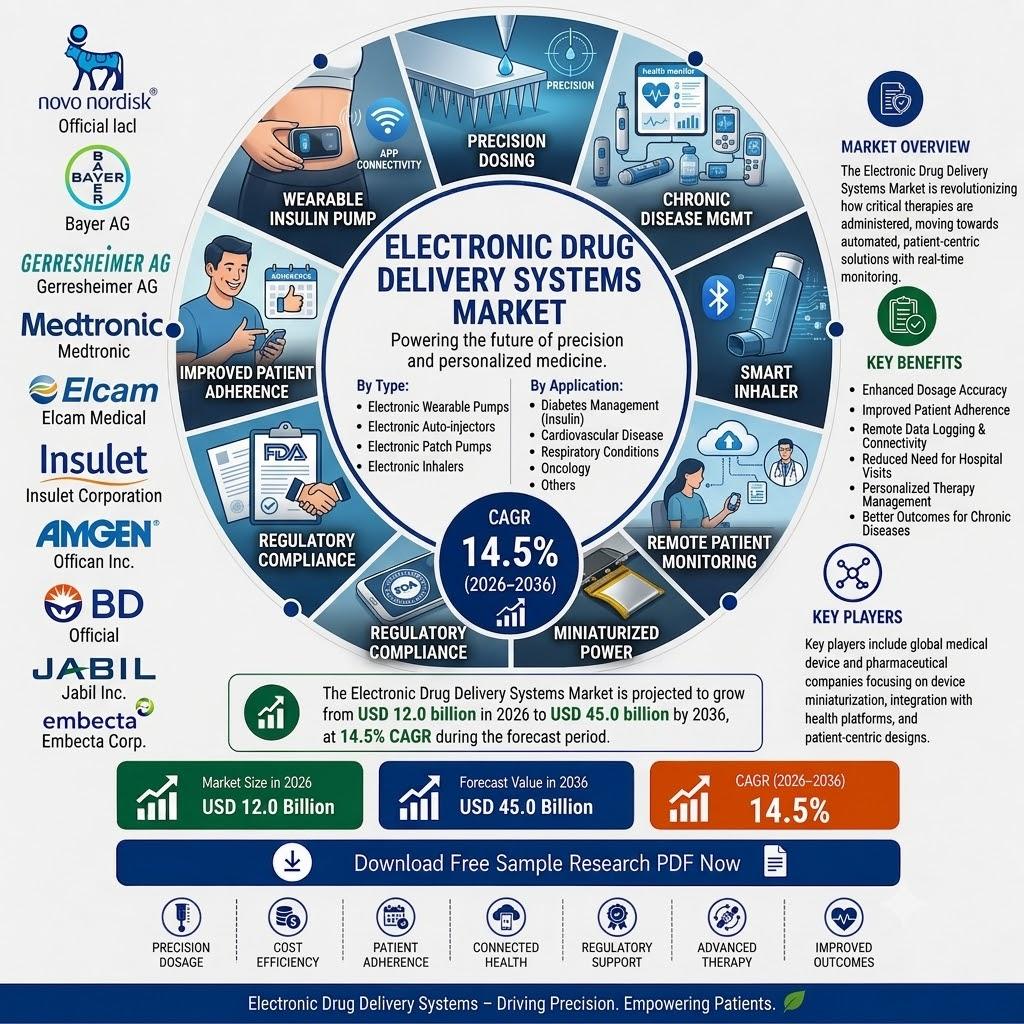
The global electronic drug delivery systems market is projected to grow from USD 14.2 billion in 2026 to USD 34.9 billion by 2036, registering a compound annual growth rate (CAGR) of 9.4% during the forecast period, according to Fact.MR. The market is expected to create an incremental revenue opportunity of USD 20.7 billion as healthcare providers and patients increasingly adopt programmable, sensor-guided, and connected medication delivery solutions.
The rising use of insulin pumps is a major factor supporting market expansion. Closed-loop automated insulin delivery systems combine pumps, continuous glucose monitoring devices, and control algorithms to adjust medication delivery based on real-time glucose readings. Their growing commercialization is strengthening demand for connected devices and recurring consumable products.
Electronic drug delivery systems also serve patients requiring controlled medication administration for oncology, chronic pain, and respiratory conditions. As chronic disease management increasingly moves beyond hospital settings, manufacturers are developing devices that support home-based treatment, remote monitoring, and medication adherence.
Get detailed market forecasts, competitive benchmarking, and pricing trends: https://www.factmr.com/connectus/sample?flag=S&rep_id=11946
Infusion Pumps and Diabetes Management Lead Demand
Infusion pumps account for 46% of the electronic drug delivery systems market in 2026, making them the leading product category. Their established use in hospitals, ambulatory settings, and diabetes care supports demand across both equipment and disposable components. Closed-loop insulin pumps represent an important premium category as automated dosing technology gains wider adoption.
By application, diabetes management holds a 48% share. Insulin pumps, connected insulin delivery systems, and smart injection devices are central to this segment. Growing use of integrated glucose monitoring and automated dosing is increasing the value of connected treatment platforms.
Hospitals account for 60% of end-use demand in 2026, reflecting their need for programmable infusion systems across oncology centers, intensive care units, and operating rooms. Home care settings are also gaining importance as patients increasingly use self-administered pump and pen systems for chronic disease management.
Regional Outlook: China and India Drive Market Growth
China is projected to record the fastest country-level growth, with a CAGR of 10.6% through 2036. Rising diabetes prevalence, hospital infrastructure expansion, and increasing adoption of connected drug delivery platforms are supporting demand.
India follows with a projected CAGR of 10.3%, driven by a growing chronic disease burden and wider access to electronic delivery devices. The USA is expected to expand at 9.7%, supported by established insulin pump adoption and connected device commercialization. Germany and the UK are projected to register CAGRs of 9.3% and 8.9%, respectively, while Japan is forecast to grow at 8.6%.
Analyst Perspective
Shambhu Nath Jha, Principal Consultant at Fact.MR, identifies connectivity, automation, and artificial intelligence as important forces changing medication administration. His analysis highlights insulin delivery as the market's anchor application, with closed-loop systems occupying an important premium segment.
The opportunity is extending into oncology, pain management, and biologic drug administration, where programmable dosing and adherence monitoring can support treatment delivery. Wearable and patch-based devices, along with connected autoinjectors and smart pens, are expanding the range of applications for electronic delivery technologies.
Competitive Landscape
The global electronic drug delivery systems market includes medical device manufacturers, pharmaceutical companies, and specialist delivery technology providers. Key companies profiled by Fact.MR include Novo Nordisk A/S, Bayer AG, Gerresheimer AG, Medtronic, Elcam Medical, Insulet Corporation, Unilife Corporation (Amgen Inc.), BD, Jabil Inc., and Embecta Corp.
Novo Nordisk holds a leading position with an estimated 23% market share, supported by its product portfolio and established institutional relationships. Competition is shaped by product differentiation, regulatory approvals, technology integration, and distribution capabilities. Companies are also advancing automated insulin delivery platforms, connected injection systems, and wearable devices to address changing patient and healthcare provider requirements.
Market Snapshot
- Market value (2026): USD 14.2 billion
- Forecast value (2036): USD 34.9 billion
- CAGR (2026–2036): 9.4%
- Incremental opportunity: USD 20.7 billion
- Leading product type: Infusion pumps, with a 46% share
- Leading application: Diabetes management, with a 48% share
- Leading end use: Hospitals, with a 60% share
- Leading company: Novo Nordisk, with an estimated 23% market share
- Fastest-growing country: China, at a 10.6% CAGR
To View Related Reports
https://afgbfh.blogspot.com/2026/10/polyester-hot-melt-adhesives-market-set.html
https://sportgalax.com/read-blog/26885
About Fact.MR
Fact.MR is a market research and competitive intelligence provider delivering market intelligence, competitive analysis, and forecasting across global industries. Its research helps businesses evaluate market demand, understand competitive developments, and identify growth opportunities.
- Managerial Effectiveness!
- Future and Predictions
- Motivatinal / Inspiring
- Fitness and Wellness
- Medical & Health
- Manufacturing
- Education
- Real-Estate
- Food Industry
- Hospitality
- Online Games
- Sports
- Home Services
- Civil Engineering
- Safety and Protection
- Software Products & Services
- Fashion and Jewellery
- Artificial Intelligence
- Entrepreneurship
- Mentoring & Guidance
- Marketing
- Networking
- HR & Recruiting
- Literature
- Shopping
- Career Management & Advancement