

 SkillClick
AI Infrastructure: Key Components, Architecture, and Enterprise Requirements
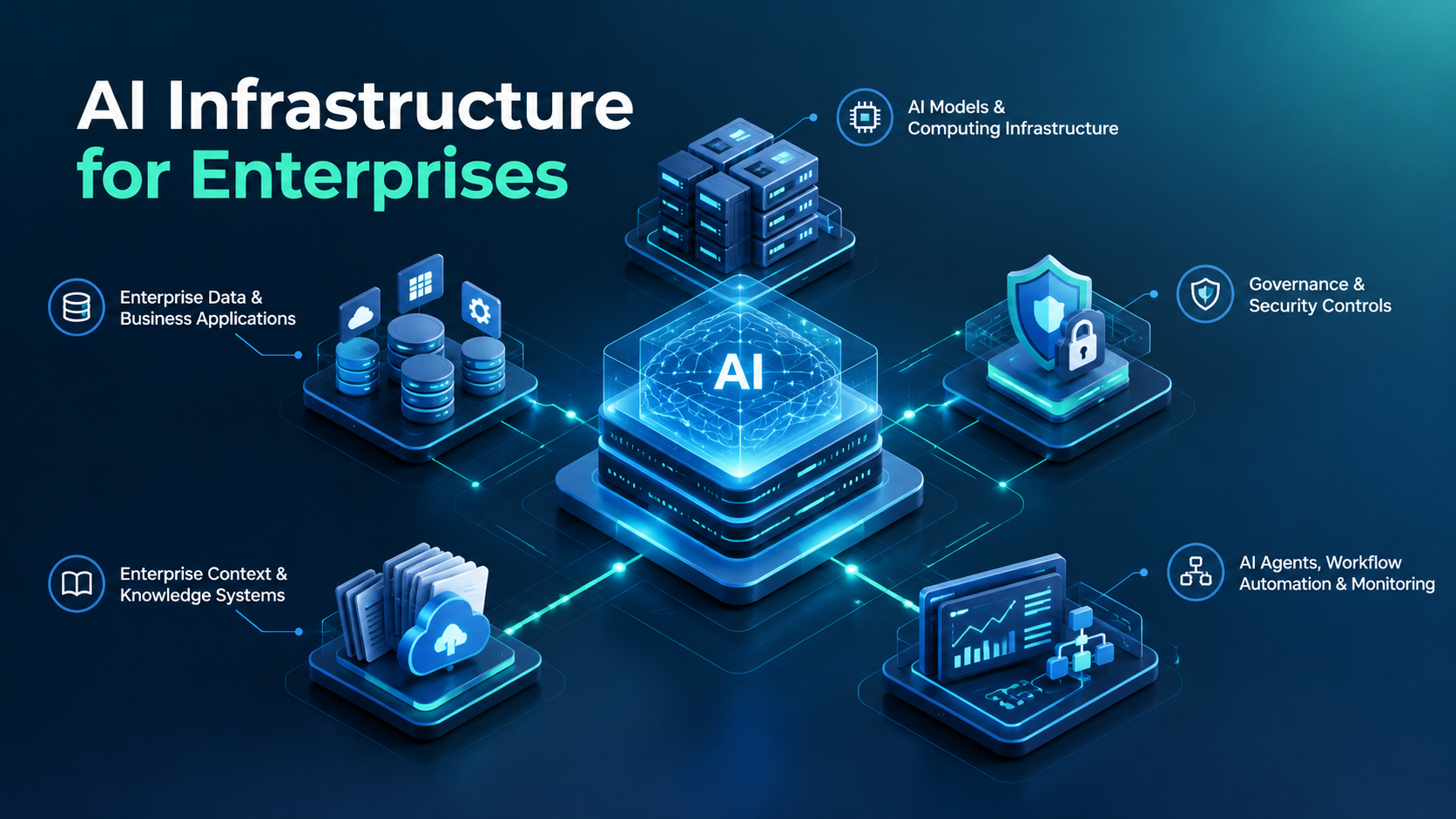
AI infrastructure is the combination of computing resources, data systems, AI models, networking, software, and governance capabilities required to develop, deploy, and operate artificial intelligence applications. For enterprises, it provides the foundation for connecting AI with business systems while managing performance, security, scalability, and operational control.
As organizations move from AI experimentation to production use, infrastructure decisions become increasingly important. A chatbot, predictive model, or autonomous AI agent may appear to be a software application, but each depends on an underlying environment that manages data, computing, model access, integrations, and permissions.
The challenge is not simply making AI available. It is building an environment in which AI systems can work reliably with enterprise information, interact with approved tools, and remain subject to appropriate oversight.
What Is AI Infrastructure?
AI infrastructure refers to the technical foundation that enables organizations to build, deploy, integrate, and operate AI systems. It includes hardware, computing capacity, data pipelines, storage, networking, model-serving environments, orchestration software, and security controls.
Unlike traditional IT infrastructure, which primarily supports applications and business software, AI infrastructure must also accommodate model training or inference, data-intensive workloads, model lifecycle management, and interactions between AI systems and enterprise applications.
For example, an organization deploying an AI-powered customer support assistant needs more than a language model. It also needs access to approved customer information, an environment to process requests, connections to business applications, and controls that determine what the assistant can access or change.
AI Infrastructure vs. Traditional IT Infrastructure
|
Area |
Traditional IT infrastructure |
AI infrastructure |
|
Computing |
General-purpose workloads |
AI training and inference workloads |
|
Data |
Application databases and files |
Structured, unstructured, and model-related data |
|
Processing |
Application logic and transactions |
Model execution and data-intensive processing |
|
Integration |
APIs and enterprise applications |
APIs, models, agents, tools, and data sources |
|
Management |
Application monitoring |
Model, inference, workflow, and infrastructure monitoring |
|
Governance |
IT access and security policies |
Data, model, agent, and AI-specific controls |
The two environments overlap. AI infrastructure often builds on existing cloud, networking, storage, and enterprise IT systems rather than replacing them.
Why Is AI Infrastructure Important for Businesses?
AI infrastructure influences whether an AI initiative can move from a limited pilot into a dependable business operation. A model may perform well in a demonstration, but production deployment introduces additional requirements involving data access, response times, system availability, security, and operational ownership.
Several factors make infrastructure planning important for enterprise AI adoption.
1. Scalability and Workload Management
AI workloads can vary significantly. A document-processing application, a real-time recommendation system, and an AI agent handling multiple business tasks have different computing and processing requirements.
Infrastructure should accommodate changing workloads without requiring an organization to redesign its entire environment whenever usage increases.
2. Performance and Inference Efficiency
Inference is the process of using a trained AI model to generate predictions, classifications, or responses. Its performance depends on factors such as model size, hardware, request volume, network conditions, and serving configuration.
Organizations need to evaluate response time, throughput, resource utilization, and the cost of running models in production.
3. Enterprise Data Connectivity
AI applications are useful only when they can access information relevant to their tasks. Business information may be distributed across CRM platforms, ERP systems, internal documents, databases, and operational applications.
A suitable infrastructure connects these sources while respecting data permissions and access requirements.
4. Security and Data Privacy
Enterprise AI environments may process confidential documents, customer records, financial information, and internal operational data.
Organizations must establish authentication, authorization, encryption, network controls, data handling policies, and monitoring procedures appropriate to the sensitivity of each workload.
5. Operational Visibility
AI systems require monitoring beyond basic server availability. Teams may need visibility into model usage, request activity, failures, data access, agent actions, and policy violations.
This information helps technology and security teams identify operational problems and investigate unexpected behavior.
Key Components of AI Infrastructure
An effective AI infrastructure environment consists of multiple interconnected components. Their exact configuration depends on the use case, deployment model, data sensitivity, and business requirements.
1. Computing Resources and Hardware
Computing resources provide the processing capacity required to train and operate AI models.
Common resources include:
-
CPUs: Handle general-purpose processing, application logic, and supporting workloads.
-
GPUs: Accelerate parallel computations used in many AI training and inference workloads.
-
Specialized AI accelerators: Provide hardware designed for particular machine learning operations.
-
Memory and storage: Support model loading, data processing, caching, and application operations.
Organizations should select computing resources according to workload requirements rather than assuming every AI application needs the same hardware configuration.
2. AI Models and Inference Infrastructure
AI models perform tasks such as language generation, classification, prediction, image recognition, and reasoning.
Inference infrastructure makes these models available to applications through serving environments, APIs, routing mechanisms, and resource management.
Enterprises may use commercial models, open-weight models, internally developed models, or a combination of them. The appropriate choice depends on performance requirements, data sensitivity, cost, deployment constraints, and operational needs.
Model routing can also help organizations direct requests to suitable models based on task requirements, availability, and defined policies.
3. Data Storage and Data Pipelines
AI applications depend on data that may exist in multiple formats and systems.
A data infrastructure typically includes:
-
Relational and non-relational databases
-
Document and object storage
-
Data ingestion pipelines
-
Data transformation and validation processes
-
Vector databases or search indexes where appropriate
-
Metadata and data cataloguing systems
Data pipelines prepare information for use by AI applications. They may extract, clean, transform, index, and update records from approved sources.
For enterprise applications, data quality and freshness are just as important as data availability. Outdated or incomplete information can lead to irrelevant or incorrect AI outputs.
4. Networking and Deployment Environments
Networking connects computing resources, storage systems, AI models, and business applications.
Organizations may deploy AI infrastructure through:
-
Public cloud environments
-
Private cloud environments
-
On-premises infrastructure
-
Hybrid deployment models
-
Dedicated or sovereign infrastructure environments
Each option has different implications for control, operational responsibility, scalability, cost, and data residency. The decision should reflect the organization's technical and regulatory requirements.
5. AI Orchestration and Application Integration
AI orchestration coordinates how models, tools, applications, and workflows interact.
For example, an enterprise AI workflow may need to retrieve a document, extract relevant information, request a model response, validate the result, and send an approved action to another application.
Orchestration helps manage these steps, including task sequencing, API communication, error handling, and workflow execution.
It becomes particularly important when multiple AI agents or specialized services work together.
6. Governance, Monitoring, and Security
Governance and monitoring provide the controls needed to manage AI systems throughout their lifecycle.
Important capabilities include:
-
Identity and access management
-
Policy enforcement
-
Model and agent activity monitoring
-
Audit trails and event logging
-
Risk assessment
-
Human approval mechanisms
-
Incident detection and response
These capabilities should be considered part of the infrastructure design, not added only after an AI application has been deployed.
What Is Enterprise AI Infrastructure?
Enterprise AI infrastructure is the combination of technology, data systems, deployment environments, and governance capabilities that organizations use to operate AI applications within their business environments.
While basic AI infrastructure may support an individual model or application, enterprise environments must accommodate multiple departments, business systems, users, data sources, and AI workloads.
Enterprise AI infrastructure typically addresses five additional requirements:
-
Data privacy: Protecting confidential business information during AI processing.
-
Access management: Ensuring that users and AI agents access only authorized resources.
-
System integration: Connecting AI applications with existing enterprise platforms and databases.
-
Operational control: Monitoring model usage, agent activity, and workflow execution.
-
Scalability: Supporting growing AI adoption across teams and business functions.
For example, a financial services organization may use AI to summarize internal documents, assist employees with information retrieval, and automate selected operational tasks. Each application needs access to relevant information, but permissions must remain aligned with employee roles and organizational policies.
This makes enterprise AI infrastructure a broader architectural responsibility involving IT, security, data, compliance, and business teams.
How Does Enterprise AI Infrastructure Support AI Agents?
AI agents introduce additional infrastructure requirements because they can perform multiple steps, interact with external tools, and use enterprise information to complete assigned tasks.
Unlike a basic chatbot that primarily responds to individual prompts, an AI agent may retrieve information, make decisions within defined boundaries, call APIs, and initiate workflow actions.
A typical enterprise AI agent environment involves five capabilities.
1. Model Access
Agents need access to language models or other AI models to interpret instructions, process information, and generate responses.
The infrastructure should manage model availability, routing, authentication, and usage requirements.
2. Enterprise Context
Agents need relevant business information to understand organizational terminology, policies, processes, and operational requirements.
This may involve retrieval systems, document indexes, structured records, entity relationships, and approved live data sources.
3. Tool and Application Connectivity
Agents may interact with CRM systems, ERP platforms, internal applications, databases, and APIs.
These connections should be configured with appropriate authentication and permissions.
4. Workflow Orchestration
Orchestration coordinates the sequence of activities performed by an agent or multiple agents.
It manages task execution, tool calls, dependencies, error handling, and interactions between different components.
5. Policy Enforcement and Oversight
Agents should operate within clearly defined boundaries.
Organizations need controls that determine which information an agent can access, which actions it can perform, and when human approval is required.
For example, an AI agent may be permitted to prepare a purchase order but require human authorization before submitting it.
AI Infrastructure Architecture: How the Layers Work Together
AI infrastructure architecture describes how the different components are organized and connected to support AI applications.
A practical enterprise architecture can be understood through six interconnected layers.
Enterprise AI infrastructure architecture
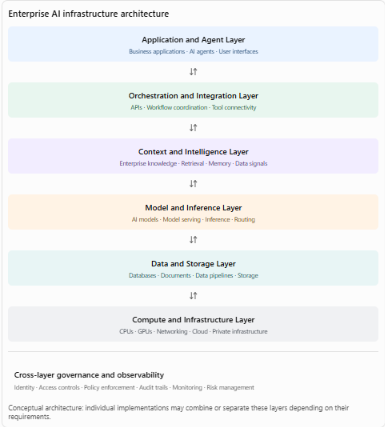
Each layer performs a different function:
-
Infrastructure layer: Provides the computing, networking, and storage resources.
-
Data layer: Makes relevant enterprise information available to AI applications.
-
Model layer: Handles model execution and inference.
-
Context layer: Supplies relevant knowledge, memory, and business information.
-
Orchestration layer: Coordinates applications, agents, and tools.
-
Application layer: Delivers AI capabilities to employees, customers, and business processes.
Governance and observability should operate across these layers rather than being treated as isolated components.
Common Challenges in Building AI Infrastructure
Building AI infrastructure involves technical and organizational challenges. Identifying them early can help businesses avoid unnecessary complexity during deployment.
|
Challenge |
Enterprise impact |
Recommended consideration |
|
Fragmented data |
Incomplete or inconsistent AI context |
Establish reliable data connectivity |
|
Integration complexity |
Difficulties connecting existing systems |
Use well-defined APIs and integration standards |
|
Security risks |
Unauthorized access or data exposure |
Apply identity and access controls |
|
Infrastructure costs |
Unpredictable operational expenditure |
Monitor resource utilization and workload costs |
|
Model management |
Difficulty managing multiple models |
Establish model selection and routing policies |
|
Limited visibility |
Harder to investigate AI activity |
Implement monitoring and audit logging |
|
Agent autonomy |
Actions outside intended boundaries |
Apply policy enforcement and human oversight |
A common mistake is to focus only on model selection while overlooking the surrounding infrastructure. A powerful model cannot compensate for poor data quality, weak access controls, or an unreliable integration environment.
Best Practices for Building Enterprise AI Infrastructure
Organizations should approach enterprise AI infrastructure as a long-term technology capability rather than a one-time deployment project.
The following practices provide a useful starting point.
1. Start with Business Requirements
Identify the business problems AI is expected to address. Define the intended users, data requirements, operational constraints, and expected outcomes before selecting infrastructure components.
2. Assess Existing IT and Data Environments
Review existing databases, applications, cloud services, networking, and security systems. Identify which resources can be reused and where additional capabilities are required.
3. Select an Appropriate Deployment Model
Evaluate cloud, private, on-premises, and hybrid options based on workload characteristics, data sensitivity, control requirements, and operational capacity.
4. Establish Data Access and Context Management
Connect relevant enterprise information through approved interfaces. Define how data is retrieved, updated, indexed, and made available to different AI applications.
5. Build Governance into the Architecture
Establish identity management, permission boundaries, policy enforcement, audit logging, and human approval requirements before expanding AI agent capabilities.
6. Monitor AI Workloads Continuously
Track inference performance, system availability, resource consumption, errors, model usage, and agent activity. Review this information regularly to identify operational issues.
7. Scale Gradually
Start with a defined business use case, validate the infrastructure, assess its performance, and expand based on measurable operational requirements.
The Role of AI Governance in Enterprise Infrastructure
AI governance is an essential part of enterprise AI infrastructure because organizations need to understand and control how AI systems access information, make decisions, and perform actions.
Traditional infrastructure security focuses on protecting systems, networks, and applications. AI governance extends this responsibility to model behavior, agent permissions, workflow decisions, and AI-related risks.
The NIST AI Risk Management Framework provides a useful reference. Its four core functions are Govern, Map, Measure, and Manage, helping organizations approach AI risk management throughout the AI lifecycle.
For enterprise AI environments, governance should include:
-
Policy enforcement: Define and enforce what AI systems and agents are permitted to do.
-
Access management: Restrict access to information and tools according to assigned permissions.
-
Auditability: Maintain records of relevant AI requests, actions, and decisions.
-
Observability: Monitor AI activity, system behavior, and operational events.
-
Risk management: Identify, assess, and address potential risks throughout deployment and operation.
How THQ.digital Approaches Enterprise AI Infrastructure
THQ.digital approaches enterprise AI through three distinct capabilities within its enterprise AI control plane:
-
Ritvam – Governance: Provides the governance and control layer, including policy enforcement, audit trails, and risk controls.
-
Sutra – Intelligence: Provides the enterprise context and memory layer, connecting knowledge, retrieval, entity relationships, and relevant business signals.
-
MIRA – Inference: Provides the inference and model-routing layer, supporting routing across open-weight and frontier models on India-hosted capacity.
Governance, Intelligence, Inference+1
These capabilities address different requirements within an enterprise AI environment. Governance determines what is permitted, context supplies relevant business information, and inference handles model execution.
Explore the THQ.digital enterprise AI platform to understand how these capabilities fit together.
Conclusion
AI infrastructure is more than the hardware and computing resources behind artificial intelligence. It is the connected foundation of models, data, applications, orchestration, security, and governance that enables organizations to operate AI systems in real business environments.
For enterprises, successful AI adoption requires an infrastructure strategy that considers scalability, data connectivity, model inference, enterprise context, and operational control together.
As AI agents become more involved in business workflows, governance and observability will become increasingly important parts of infrastructure planning. Organizations that build these capabilities into their architecture from the beginning will be better positioned to manage AI systems as their adoption expands.
To explore an integrated approach to enterprise AI governance, intelligence, and inference, visit THQ.digital.
Frequently Asked Questions
Q1. What is AI infrastructure?
AI infrastructure is the combination of hardware, computing resources, data systems, AI models, networking, software, and governance tools used to develop, deploy, and operate AI applications.
Q2. What are the main components of AI infrastructure?
The main components include CPUs and GPUs, AI models, inference systems, data storage, data pipelines, networking, orchestration software, application integrations, security, and monitoring capabilities.
Q3. What is enterprise AI infrastructure?
Enterprise AI infrastructure is the technology environment that enables organizations to deploy and manage AI across business systems. It includes data connectivity, computing resources, model access, security, governance, and operational monitoring.
Q4. How does AI infrastructure support AI agents?
AI infrastructure provides AI agents with model access, enterprise data, application integrations, workflow orchestration, and permission controls. These components allow agents to perform assigned tasks within defined operational boundaries.
Q5. What is the difference between AI infrastructure and AI architecture?
AI infrastructure refers to the actual technology resources and systems used to operate AI applications. AI architecture describes how those components are structured, connected, and organized to meet specific requirements.
Q6. Is AI infrastructure cloud-based or self-hosted?
AI infrastructure can be cloud-based, privately hosted, on-premises, or hybrid. The appropriate deployment model depends on data sensitivity, workload requirements, security needs, cost, and organizational control.
Q7. Why is AI governance important for enterprise AI infrastructure?
AI governance helps organizations establish policies, control access, monitor AI activity, maintain accountability, and manage risks. It is particularly important when AI agents interact with enterprise data and business applications.
- Managerial Effectiveness!
- Future and Predictions
- Motivatinal / Inspiring
- Fitness and Wellness
- Medical & Health
- Manufacturing
- Education
- Real-Estate
- Food Industry
- Hospitality
- Online Games
- Sports
- Home Services
- Civil Engineering
- Safety and Protection
- Software Products & Services
- Fashion and Jewellery
- Artificial Intelligence
- Entrepreneurship
- Mentoring & Guidance
- Marketing
- Networking
- HR & Recruiting
- Literature
- Shopping
- Career Management & Advancement