

 SkillClick
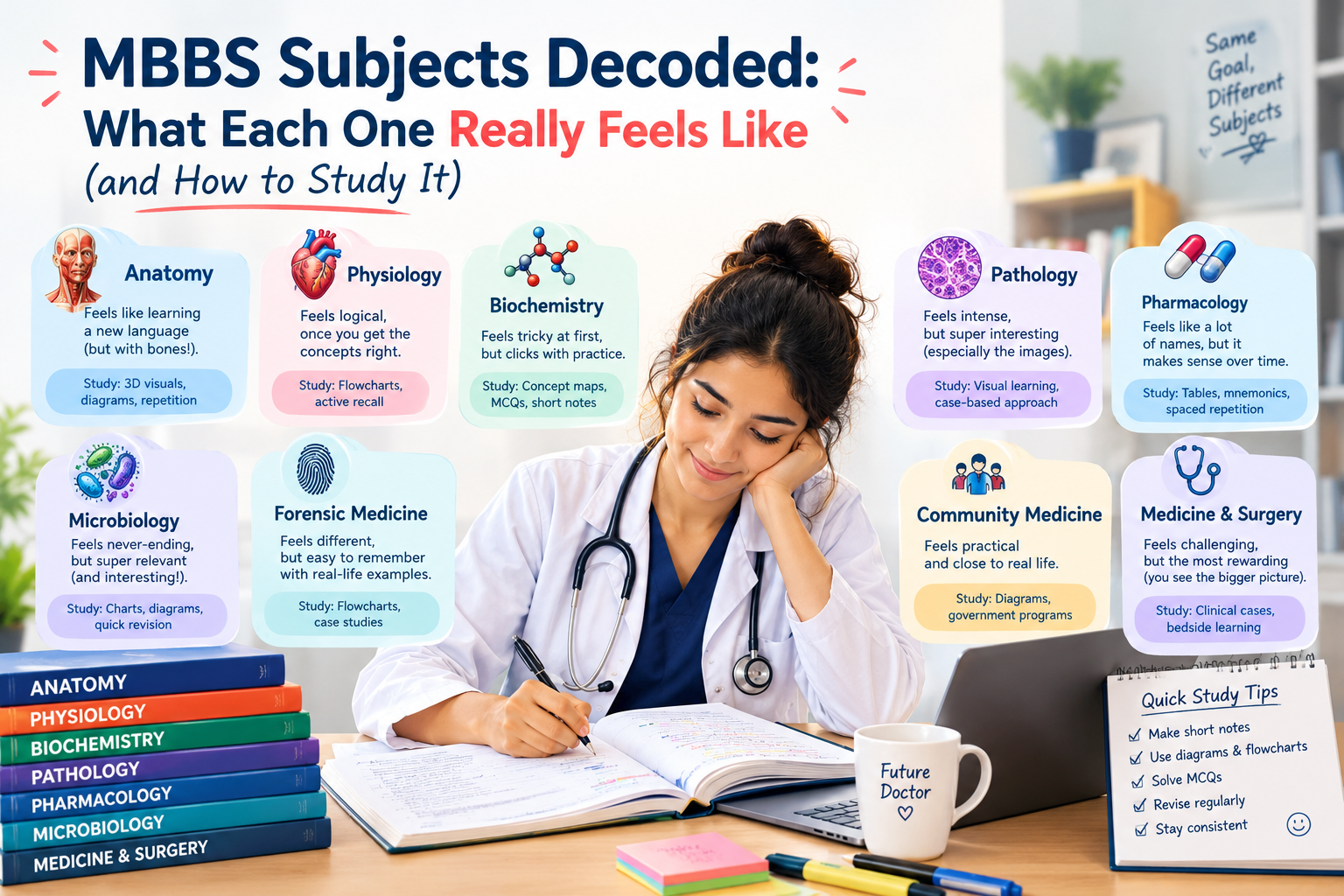
Every MBBS student hears the same advice: “Just study hard.” It’s not very helpful. Anatomy, Pharmacology and Medicine are different beasts, and each needs its own strategy.
This guide covers what each major subject demands from you and how to approach it.
1. Anatomy: The Memory Marathon
What it feels like: Endless structures, Latin-sounding names and long hours in the dissection hall.
What it really teaches you: The map of the human body. Every surgeon, physician and radiologist relies on it.
How to study:
- Learn with the cadaver or a 3D atlas, not just the textbook.
- Draw diagrams from memory, especially for nerves, vessels and brachial plexus-type topics.
- Use mnemonics, but pair them with clinical correlations so they stick.
- Revise small portions daily. Anatomy punishes cramming.
2. Physiology: The Logic Subject
What it feels like: Less memorising, more understanding. Flowcharts, graphs and feedback loops.
How to study:
- Focus on why things happen, not just what happens.
- Practise explaining concepts aloud, such as how the kidney concentrates urine or how blood pressure is regulated.
- Pay attention to practicals. They carry marks and build intuition.
3. Biochemistry: Pathways and Patterns
What it feels like: Metabolic pathways that look like subway maps.
How to study:
- Learn pathways as stories: the starting molecule, key enzymes, regulation and associated diseases.
- Link every pathway to a clinical condition, like enzyme deficiencies and vitamin disorders.
- Use flashcards for vitamins, enzymes and inborn errors of metabolism.
4. Pathology: The Backbone of Medicine
What it feels like: A big shift. You finally learn why disease happens.
How to study:
- Understand general pathology (inflammation, neoplasia, cell injury) deeply, because systemic pathology builds on it.
- Look at slides and specimens repeatedly. Visual memory matters.
- Connect each disease to its clinical presentation and lab findings.
5. Pharmacology: Drugs Without the Chaos
What it feels like: Hundreds of drug names that blur together.
How to study:
- Study by class, not by individual drug: mechanism, uses, adverse effects, contraindications.
- Learn prototype drugs first, then note how others differ.
- Focus on high-yield topics: antibiotics, cardiovascular drugs, autonomic drugs and anti-diabetics.
- Practise writing prescriptions. It’s a real skill.
6. Microbiology: Small Organisms, Big Exams
What it feels like: A long list of bacteria, viruses, fungi and parasites.
How to study:
- Make comparison tables for organisms: morphology, culture, pathogenesis, diagnosis, treatment.
- Spend time on immunology. It’s conceptual and heavily tested.
- Revise lab diagnosis and staining methods for practicals.
7. Forensic Medicine and Community Medicine: Don’t Underestimate Them
These are often treated as “easy” subjects, and that’s a mistake.
- Forensic Medicine: Learn injuries, poisoning and legal procedures systematically. Many questions are direct.
- Community Medicine: Know epidemiology formulas, national health programmes and vaccination schedules. It’s a high-scoring subject if you revise consistently.
8. The Clinical Subjects: Learning From Patients
In Medicine, Surgery, OBG and Paediatrics, the learning shifts from books to bedsides.
How to succeed:
- Take histories seriously. Most diagnoses come from a good history.
- Practise examination skills until they feel natural.
- Present cases to seniors and consultants. It sharpens your thinking.
- Read about the patients you see. A case you’ve handled stays with you far longer than a chapter you’ve read.
Understanding How You’re Assessed
Under the competency-based curriculum, assessment typically combines:
- Internal assessment: regular tests, practicals and logbook work
- University exams: theory papers, practicals and viva voce at each professional stage
- Skill and communication assessment, including AETCOM modules
Because internal assessment counts, steady performance across the year matters more than a last-minute push.
Common Mistakes to Avoid
- Studying only to pass. Concepts from first year resurface in clinical years and in NEET-PG/NExT preparation.
- Ignoring practicals and vivas. They carry real weight and build real skill.
- Neglecting health and sleep. Burnout hurts both grades and wellbeing.
- Studying alone all the time. Group discussions expose gaps in your understanding.
- Skipping small subjects. ENT, Ophthalmology and Dermatology are shorter, but they’re easy marks and clinically important.
Final Thoughts
The MBBS isn’t one subject studied for five years. It’s many different ways of thinking: memorising in Anatomy, reasoning in Physiology, pattern recognition in Pathology, and judgement at the bedside. Once you understand what each subject asks of you, studying becomes less overwhelming and far more effective.
Note: Curriculum details can vary by university and are updated by the National Medical Commission from time to time. Always check the latest official guidelines.
I can also write one on a specific topic, like “A Day in the Life of an MBBS Student,” “Top Mistakes in First-Year MBBS,” or “MBBS vs. Other Medical Courses,” or tailor this one for a particular audience or word count.