

 SkillClick
Synthetic Dyes Market to Reach USD 14.39 Billion by 2036, Reports Fact.MR
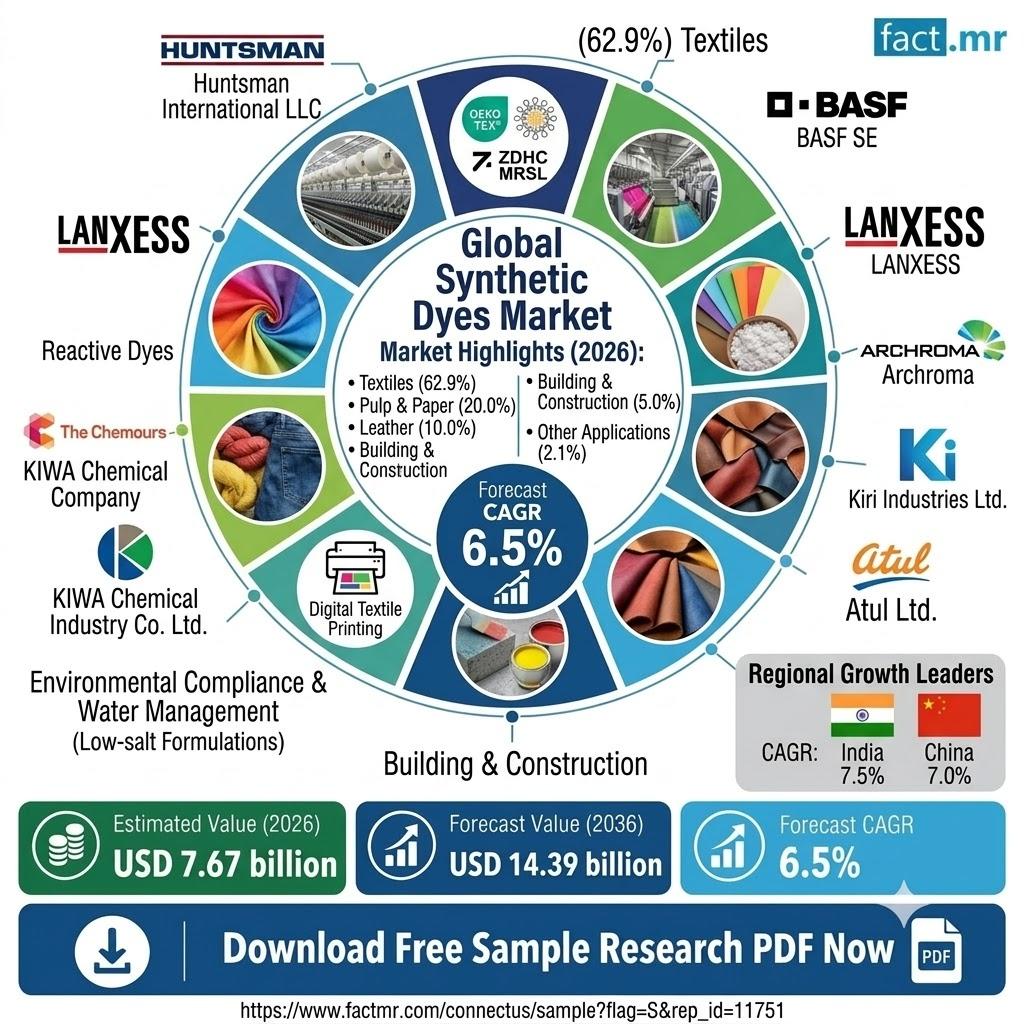
Market growth is forecast at 6.5% CAGR through 2036 as textile production expands and environmental compliance reshapes dye procurement.
April 13, 2026 — The global synthetic dyes market is projected to grow from USD 7.67 billion in 2026 to USD 14.39 billion by 2036, expanding at a compound annual growth rate (CAGR) of 6.5%, according to Fact.MR. The forecast reflects continued demand from textile manufacturing, alongside changing requirements for wastewater management and restricted-substance compliance. For dye manufacturers and textile mills, the commercial challenge is becoming more specific: deliver consistent coloration while meeting buyer requirements for chemical safety and environmental performance.
The market is expected to create an incremental opportunity of USD 6.72 billion over the forecast period. India is projected to lead country-level growth at a 7.5% CAGR, followed by China at 7.0%, according to Fact.MR's analysis updated April 6, 2026. These growth rates matter for suppliers assessing production capacity, intermediate chemical sourcing and investments in formulations designed for export-oriented textile supply chains.
Get detailed market forecasts, competitive benchmarking, and pricing trends: https://www.factmr.com/connectus/sample?flag=S&rep_id=11751
Synthetic Dyes Market Growth Depends on Compliance-Ready Formulations
The synthetic dyes market covers organic colorants manufactured through chemical synthesis for textile dyeing, paper coloring, leather finishing and construction material pigmentation. Demand remains closely linked to industrial production volumes, but purchasing criteria are changing as environmental rules and brand-owner audits influence supplier qualification.
Textiles accounted for 62.9% of market demand by end use in 2026, while pulp and paper represented 20.0%, according to Fact.MR. Leather contributed 10.0%, building and construction 5.0%, and other applications 2.1%. This distribution shows how strongly market demand depends on fabric processing, even as manufacturers serve additional industrial applications.
A key detail for procurement teams is the growing importance of chemical compliance at the individual colorant level. Fact.MR reports that textile mills increasingly face buyer audits requiring conformity with the ZDHC Manufacturing Restricted Substances List (MRSL) and OEKO-TEX certification for colorants used in their supply chains. Mills that previously prioritized price per kilogram must now consider documentation, formulation performance and compliance status when qualifying suppliers.
These requirements are influencing product development. Low-salt formulations and high-fixation chemistries can help reduce processing burdens while supporting environmental compliance objectives. However, manufacturers must manage the additional formulation costs and raw material price exposure that accompany these changes.
Reactive Dyes Lead Product Demand as Textile Mills Prioritize Fastness
Reactive dyes held a 58.1% share of the synthetic dyes market by product type in 2026, according to Fact.MR. Their position reflects their ability to bond with cellulosic fibers, including cotton and viscose, while delivering the wash fastness required for apparel and home textiles.
Vat dyes represented 20.8% of the market, supported by applications requiring durability and light fastness, including denim and workwear. Acid dyes accounted for 15.3%, serving wool, silk, nylon and carpet applications. Direct dyes held a 2.8% share, with straightforward processing supporting selected cotton, viscose and paper-coloring uses.
For textile processors, formulation selection involves more than achieving the correct shade. Batch-to-batch consistency, color matching, wash durability and processing conditions affect product quality and operating costs. Suppliers that combine validated formulations with technical support may be better positioned to meet the requirements of quality-sensitive customers.
Digital textile printing also creates demand for specialized dye systems suited to shorter production runs and customized designs. Fact.MR identifies compatibility with digital printing as an emerging trend alongside the development of formulations intended to reduce environmental impact.
India and China Set the Pace for Regional Expansion
India is forecast to record a 7.5% CAGR between 2026 and 2036. Textile export activity and manufacturing capacity expansion support the country's position, with Tirupur, Surat and Ludhiana identified by Fact.MR as important textile hubs. For dye suppliers, these centers offer opportunities to serve mills seeking reliable coloration performance at manageable operating costs.
China is projected to grow at a 7.0% CAGR. Its established textile and dye manufacturing base supports demand, while industrial consolidation and investment in textile production infrastructure influence the adoption of integrated formulations and documented quality systems.
Other markets are expected to expand at different rates. Fact.MR projects Brazil at 6.2% CAGR, the United States at 5.8%, Germany at 5.5%, South Korea at 5.2% and Japan at 4.9% through 2036. Specialty textiles and higher-specification applications support demand in several developed markets.
Raw Material Exposure and Environmental Rules Shape Competition
The market's growth outlook does not remove cost pressures. Fact.MR identifies H-acid and vinyl sulphone, key intermediates used in reactive dye production, as sources of input-cost variability. Manufacturers may manage this exposure through backward integration or indexed supply agreements.
Competition includes Huntsman International LLC, BASF SE, LANXESS, Shah Industries, KIWA Chemical Industry Co. Ltd., Kiri Industries Ltd., Archroma, Atul Ltd. and The Chemours Company. Fact.MR estimates that approximately 60–80 active players operate across global manufacturing and regional distribution networks, with Huntsman International LLC holding a reported 12.0% market share.
Shambhu Nath Jha, Principal Consultant for Specialty Chemicals at Fact.MR, links compliance costs directly to competitive positioning.
“Manufacturers cannot rely on volume growth alone,” Jha said in the report. “When intermediate costs rise, margins come under pressure. Producers investing in low-salt reactive dyes and securing ZDHC MRSL conformity ahead of customer audits can improve their chances of becoming preferred suppliers.”
For manufacturers, the strategic question is how to balance formulation investment, raw material security and qualification requirements without losing control of production costs. For textile mills, supplier selection increasingly involves verifying compliance documentation alongside color performance and price.
View Related Reports :
https://ayushjadhavblogs.blogspot.com/2026/10/suppositories-market-to-reach-usd-33.html
https://www.pikumil.com/blogs/214434/Adaptive-Clothing-Market-to-Expand-at-7-8-CAGR-From
https://social.art-inpa.com/blogs/35874/Washer-Pumps-and-Spray-Nozzles-Market-Forecast-to-Reach-USD
About Fact.MR
Fact.MR is a market research and consulting firm providing market intelligence, industry forecasts and strategic analysis across sectors. Its synthetic dyes market report examines market size, product and end-use segmentation, regional growth, competitive positioning, regulatory considerations and supply chain factors through 2036.
- Managerial Effectiveness!
- Future and Predictions
- Motivatinal / Inspiring
- Fitness and Wellness
- Medical & Health
- Manufacturing
- Education
- Real-Estate
- Food Industry
- Hospitality
- Online Games
- Sports
- Home Services
- Civil Engineering
- Safety and Protection
- Software Products & Services
- Fashion and Jewellery
- Artificial Intelligence
- Entrepreneurship
- Mentoring & Guidance
- Marketing
- Networking
- HR & Recruiting
- Literature
- Shopping
- Career Management & Advancement