

 SkillClick
8 Ways to Turn Underperforming Vehicle Listing Pages Into Search Opportunities in 2027
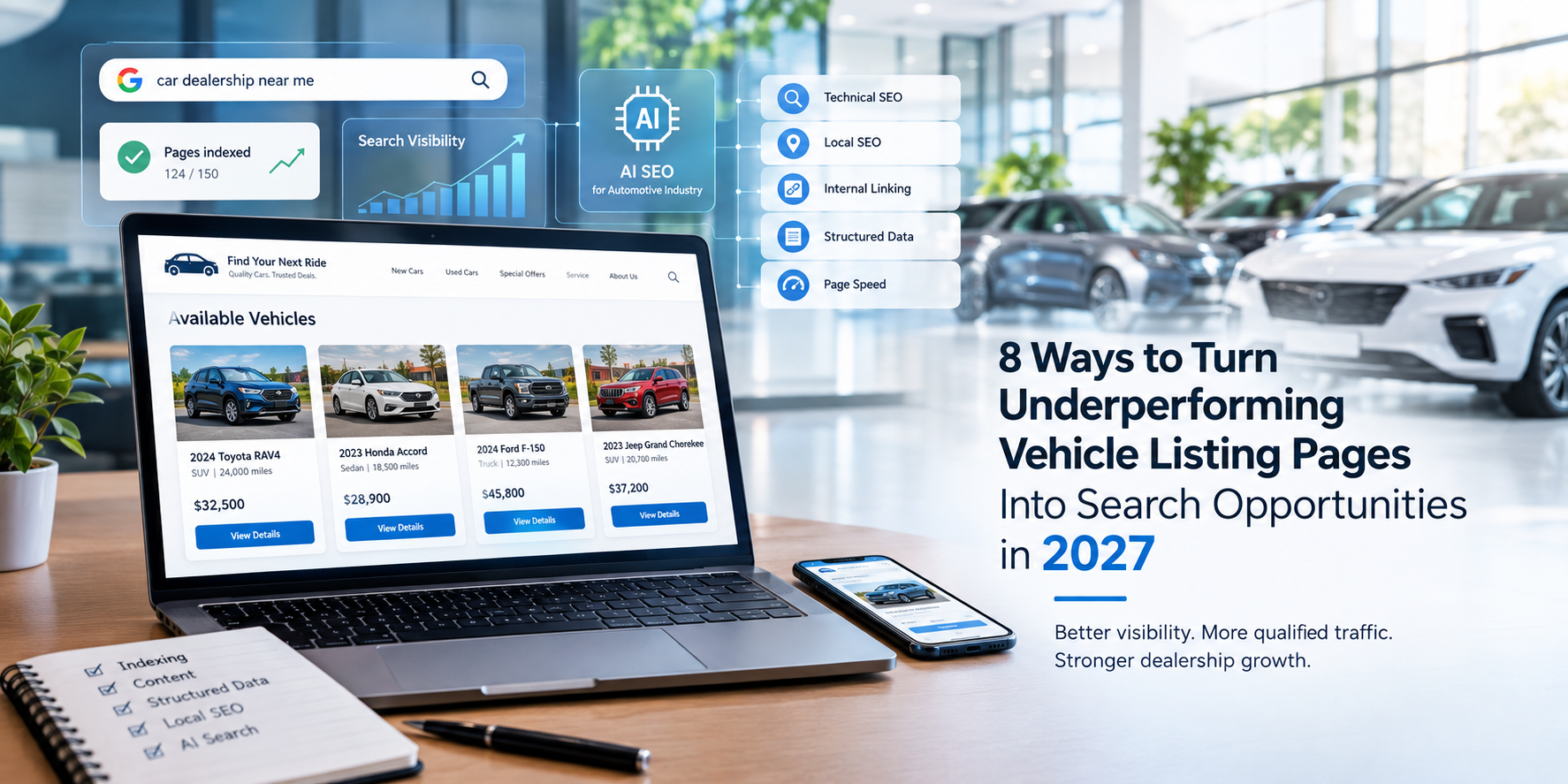
The automotive industry is entering another phase of digital competition. Car buyers increasingly research vehicle prices, compare models, check availability, read reviews, and explore dealership websites before contacting a seller. Yet, many dealerships still struggle to get their vehicle listing pages discovered in search results, even when they have a large inventory and regularly update their websites.
The problem is not always a lack of content or keywords. Some pages are never indexed, while others appear in Google's index but fail to rank for relevant searches. Duplicate vehicle descriptions, poor website structure, slow-loading pages, outdated inventory information, and limited local relevance can all contribute to these challenges.
In 2027, dealerships will need to look beyond traditional keyword optimization. Their focus should be on building technically accessible pages, providing useful vehicle information, improving website experiences, and helping search engines understand their inventory. Here are eight practical ways to turn underperforming vehicle listing pages into stronger search opportunities.
Why Many Businesses Struggled to Get Listed in Search Results in 2026
Throughout 2026, businesses across competitive industries continued to face the challenge of getting their pages discovered and indexed. Automotive businesses experienced a particularly complicated version of this problem because vehicle inventories change frequently, and dealership websites often generate hundreds of similar pages. Automotive SEO services can help dealerships identify indexing issues, improve listing page quality, strengthen internal linking, and make important inventory pages easier for search engines to discover as they prepare for 2027.
Several factors can explain why pages fail to gain visibility:
-
Duplicate content: Dealerships may use identical manufacturer descriptions across multiple vehicle listings, giving search engines little unique information to evaluate.
-
Crawling difficulties: Inventory pages hidden behind search forms, complicated navigation, or JavaScript-dependent interfaces can be difficult for search engines to discover.
-
Technical SEO problems: Incorrect canonical tags, accidental noindex directives, redirect chains, and server errors can prevent pages from appearing as intended.
-
Thin listing pages: Pages containing little more than a vehicle photograph, model name, and price may not fully answer a buyer's questions.
-
Poor internal linking: Important inventory pages may receive few internal links, making them harder to discover and understand.
-
Unreliable inventory information: Sold vehicles, outdated prices, and unavailable listings can create frustrating experiences for both shoppers and search engines.
Google's ecommerce documentation emphasizes crawlable navigation, useful product information, and structured data as important parts of helping search engines discover and understand inventory pages. These principles are relevant to dealership websites as well. Google's ecommerce SEO guidance.
The important lesson for 2027 is that publishing a page does not guarantee that it will be indexed, and indexing alone does not guarantee strong rankings. Dealerships need to address discovery, indexability, content quality, and search intent separately.
1. Give Every Important Vehicle Listing a Clear Purpose
One of the first improvements dealerships should make in 2027 is to ensure that every important vehicle detail page provides a clear reason to exist in search results.
A listing page should help buyers understand the specific vehicle, rather than simply repeat information available on hundreds of other websites.
For example, a page for a used 2024 Toyota Camry could include:
-
Exact model, trim, year, and mileage
-
Current asking price and availability
-
Fuel economy and important specifications
-
Vehicle condition and inspection information
-
Warranty or certification details, where applicable
-
Financing information and options to arrange a test drive
Where appropriate, dealerships can also include original photographs, condition notes, and explanations of features that matter to local buyers.
This does not mean every vehicle page needs hundreds of words. The objective is to make each listing useful, accurate, and distinct enough to serve its purpose.
In 2027, dealerships should prioritize meaningful information over automatically generating longer descriptions filled with repetitive keywords.
2. Fix Indexing Problems Before Investing More in Content
A dealership may publish new vehicle listings every day and still struggle to attract organic traffic if search engines cannot discover or index those pages correctly.
Before creating more content, businesses should investigate why existing pages are not appearing in search results.
A practical technical review should cover:
-
Whether the page returns a successful HTTP status code
-
Whether the page is blocked by robots.txt or contains a noindex directive
-
Whether its canonical tag points to the intended URL
-
Whether important vehicle pages are linked through crawlable navigation
-
Whether the page appears in the appropriate XML sitemap
-
Whether Google can access and render the main listing content
Google Search Console can help teams investigate indexing status and inspect individual URLs.
Dealerships should also review how their websites handle filters. Search pages generated for every combination of price, color, mileage, model, and transmission can create a large number of low-value URLs. These pages may consume crawling resources without providing meaningful additional value.
The solution is not to index every URL. Instead, businesses should identify which pages deserve to appear in search results and manage duplicates, filters, and canonical signals accordingly.
3. Build a Smarter Internal Linking Structure
A vehicle listing should not exist as an isolated page that search engines and visitors can reach only through an internal search box.
Dealerships should create a logical hierarchy connecting their main inventory pages to vehicle categories, make-and-model pages, and individual listings.
For example:
-
Main inventory page
-
Used cars category
-
Used SUVs category
-
Specific make-and-model page
-
Individual vehicle detail page
This structure helps buyers move naturally from broad searches to specific vehicles. It also gives search engines clearer paths to discover important pages.
Google recommends using crawlable links and logical navigation to help it understand website structure and find product pages. See its website structure guidance.
In 2027, dealerships should pay particular attention to high-value inventory pages. Their most commercially important vehicles and categories should be accessible through useful internal links, rather than buried deep within complicated navigation.
4. Use Structured Data to Explain Vehicle Details
Search engines need to understand more than the fact that a page contains a car photograph and a price.
Structured data can help describe important information, such as a vehicle's name, price, availability, and other applicable product details.
For eligible vehicle pages, dealerships should review whether their structured data accurately reflects the visible content. They should also validate the markup and correct errors rather than assuming that adding schema automatically improves rankings.
Google's documentation notes that its supported product markup can help search engines interpret product information. Its product-snippet guidance also explains that Car is not automatically supported as a subtype of Product; it provides an example using both types for applicable vehicle markup. See Google's product structured data guidance.
For 2027, the priority should be accuracy and consistency. If a vehicle is sold, its structured data should not continue to advertise it as available. If its price changes, the displayed information and markup should be updated accordingly.
Structured data can improve eligibility for certain search appearances, but it does not guarantee rich results, indexing, or higher rankings.
5. Optimize Vehicle Listings for Local Buyer Intent
Automotive searches often include a location or imply a local need. A buyer may search for a used SUV near them, a particular model in a specific city, or a dealership offering a particular vehicle.
Dealerships can respond by improving the relevance of their location pages and inventory categories.
Useful improvements include:
-
Creating accurate dealership location pages
-
Providing consistent business details and opening hours
-
Connecting local pages with relevant inventory
-
Explaining delivery, collection, and test-drive options
-
Writing useful content around local buying needs
-
Keeping business listings and contact information current
However, creating dozens of nearly identical city pages with only the location name changed is unlikely to provide meaningful value. Each page should serve a genuine audience and contain useful, location-specific information.
In 2027, local visibility should connect a buyer's search with accurate inventory, a real dealership location, and a clear next step.
6. Improve Page Speed and the Mobile Buying Experience
Vehicle shoppers often compare several listings in one session. If a dealership website loads slowly, displays intrusive pop-ups, or makes important information difficult to find on mobile, visitors may leave before exploring the inventory.
Dealerships should assess:
-
Image file sizes and responsive image delivery
-
Core Web Vitals and other relevant performance issues
-
Mobile navigation and filter usability
-
Visibility of prices, mileage, and availability
-
The ease of contacting the dealership or requesting a test drive
-
Whether important content loads reliably without unnecessary interaction
Vehicle photographs deserve special attention because listing pages frequently contain multiple large images. Optimizing them can improve loading performance without sacrificing useful visual detail.
These improvements are not simply about meeting a technical score. They help shoppers evaluate vehicles more comfortably and move toward an informed decision.
For 2027, automotive businesses should treat performance, accessibility, and usability as part of their search strategy rather than separate website maintenance tasks.
7. Prepare for AI-Powered Search Without Neglecting SEO Fundamentals
Search experiences are evolving, and buyers may use conversational queries or AI-powered tools to research vehicles before visiting a dealership.
For example, someone might ask for a fuel-efficient family SUV under a particular budget, compare two models, or look for a used vehicle with specific safety features.
Dealerships should make it easier for search systems and potential customers to understand their inventory by providing clear, consistent, and verifiable information.
This is where AI SEO for automotive industry strategies can complement established SEO practices. Rather than relying on vague claims about AI visibility, businesses should focus on practical improvements:
-
Publish accurate vehicle specifications and current pricing.
-
Explain model differences in language buyers understand.
-
Provide helpful answers to common purchasing questions.
-
Keep inventory information consistent across relevant platforms.
-
Maintain technically accessible pages and valid structured data.
-
Build a trustworthy online presence through useful content and genuine customer reviews.
AI-assisted tools can also help teams identify content gaps, organize large inventories, and flag inconsistent information. Human review remains essential, particularly for prices, specifications, vehicle condition, and availability.
No optimization technique can guarantee that a dealership will be mentioned in every AI-generated answer. In 2027, the sensible approach is to make information reliable, accessible, and useful across search experiences.
8. Measure Listing Performance and Keep Inventory Information Fresh
A dealership's SEO strategy should not end when a page is published or indexed. Vehicle inventory changes constantly, so performance needs ongoing monitoring.
Businesses should establish a process for reviewing which pages are indexed, which receive impressions, and which attract qualified visits.
Useful indicators include:
-
Indexed versus submitted vehicle URLs
-
Search impressions and clicks for inventory pages
-
Queries generating traffic to individual listings
-
Organic visits that lead to calls or test-drive requests
-
Changes in performance after technical fixes
-
Sold vehicles that remain live or return unnecessary errors
Sold inventory requires a deliberate policy. If a vehicle is no longer available, the dealership should decide whether its page has a useful continuing purpose, whether a relevant replacement exists, or whether the page should return an appropriate status. Redirects should be used when there is a genuinely suitable destination, not indiscriminately to the homepage.
For larger dealerships, automation can help monitor stock changes, identify broken links, flag outdated information, and maintain accurate sitemaps.
In 2027, the goal is not to keep every historical vehicle page indexed indefinitely. It is to maintain a healthy inventory of useful pages that accurately reflect what the dealership offers.
Where Automotive SEO Services Fit Into the 2027 Strategy
Implementing these changes across hundreds of vehicle listings can require coordination between marketing teams, developers, inventory managers, and dealership staff.
Professional Automotive SEO services can help businesses organize this work through technical audits, indexation reviews, internal-linking improvements, local SEO, content optimization, structured-data validation, and performance reporting.
The right priorities will depend on the actual problem. A dealership with pages blocked from indexing needs a different solution from one whose pages are indexed but receive few clicks. Similarly, a website with strong traffic but few inquiries may need improvements to inventory information and conversion paths rather than another round of keyword targeting.
This is also where AI-assisted analysis can be useful. Teams may use automation to identify duplicate descriptions, find missing vehicle information, group related search queries, or detect patterns across large numbers of listing pages. These tools should support decisions, not replace technical validation or human judgment.
For businesses seeking an experienced development and digital strategy partner, Triple Minds can be considered as part of the discussion around website development, technical implementation, and SEO-related improvements. Any engagement should begin with an assessment of the dealership's specific website, inventory workflow, and business goals rather than a promise of guaranteed rankings.
Conclusion
Vehicle listing pages represent valuable search opportunities, but only when they help buyers and search engines understand what is available.
In 2027, dealerships should move beyond simply publishing more listings or adding keywords to existing descriptions. They need to make important pages discoverable, resolve technical indexing issues, provide distinctive vehicle information, strengthen internal links, implement accurate structured data, and maintain reliable inventory data.
AI-powered search adds another reason to prioritize clarity and accuracy, but it does not remove the need for sound technical SEO. Businesses that combine accessible websites with genuinely useful information will be better positioned to compete for relevant search visibility.
The most effective starting point is straightforward: identify why important vehicle pages are underperforming, fix the underlying issues, and measure whether those changes lead to better visibility and more qualified buyer inquiries.
Frequently Asked Questions
1. Why are vehicle listing pages not appearing in Google search results?
Common causes include crawling restrictions, noindex directives, incorrect canonical tags, weak internal linking, duplicate content, and technical rendering problems. Google Search Console can help identify the issue for individual URLs.
2. How can dealerships improve vehicle listing SEO in 2027?
Dealerships should prioritize technical accessibility, useful vehicle descriptions, accurate inventory information, structured data, local relevance, mobile usability, and ongoing performance monitoring.
3. Does AI SEO guarantee that vehicle listings will appear in AI search results?
No. AI SEO can help make vehicle information clearer and easier for search systems to interpret, but no agency or technique can guarantee inclusion in AI-generated answers.
4. Should sold vehicle pages always be deleted?
No. The appropriate action depends on whether the page continues to provide value and whether a relevant replacement exists. Some pages may remain useful, while others may warrant a suitable redirect or an appropriate status code.
5. When should a dealership consider professional automotive SEO services?
Professional support may be useful when a dealership has large inventories, persistent indexing problems, duplicate URLs, declining organic traffic, limited technical resources, or difficulty connecting search visibility with qualified leads.
- Managerial Effectiveness!
- Future and Predictions
- Motivatinal / Inspiring
- Fitness and Wellness
- Medical & Health
- Manufacturing
- Education
- Real-Estate
- Food Industry
- Hospitality
- Online Games
- Sports
- Home Services
- Civil Engineering
- Safety and Protection
- Software Products & Services
- Fashion and Jewellery
- Artificial Intelligence
- Entrepreneurship
- Mentoring & Guidance
- Marketing
- Networking
- HR & Recruiting
- Literature
- Shopping
- Career Management & Advancement