

 SkillClick
US Transmission Line Inspection Drone Market Set for 15.9% CAGR Through 2035
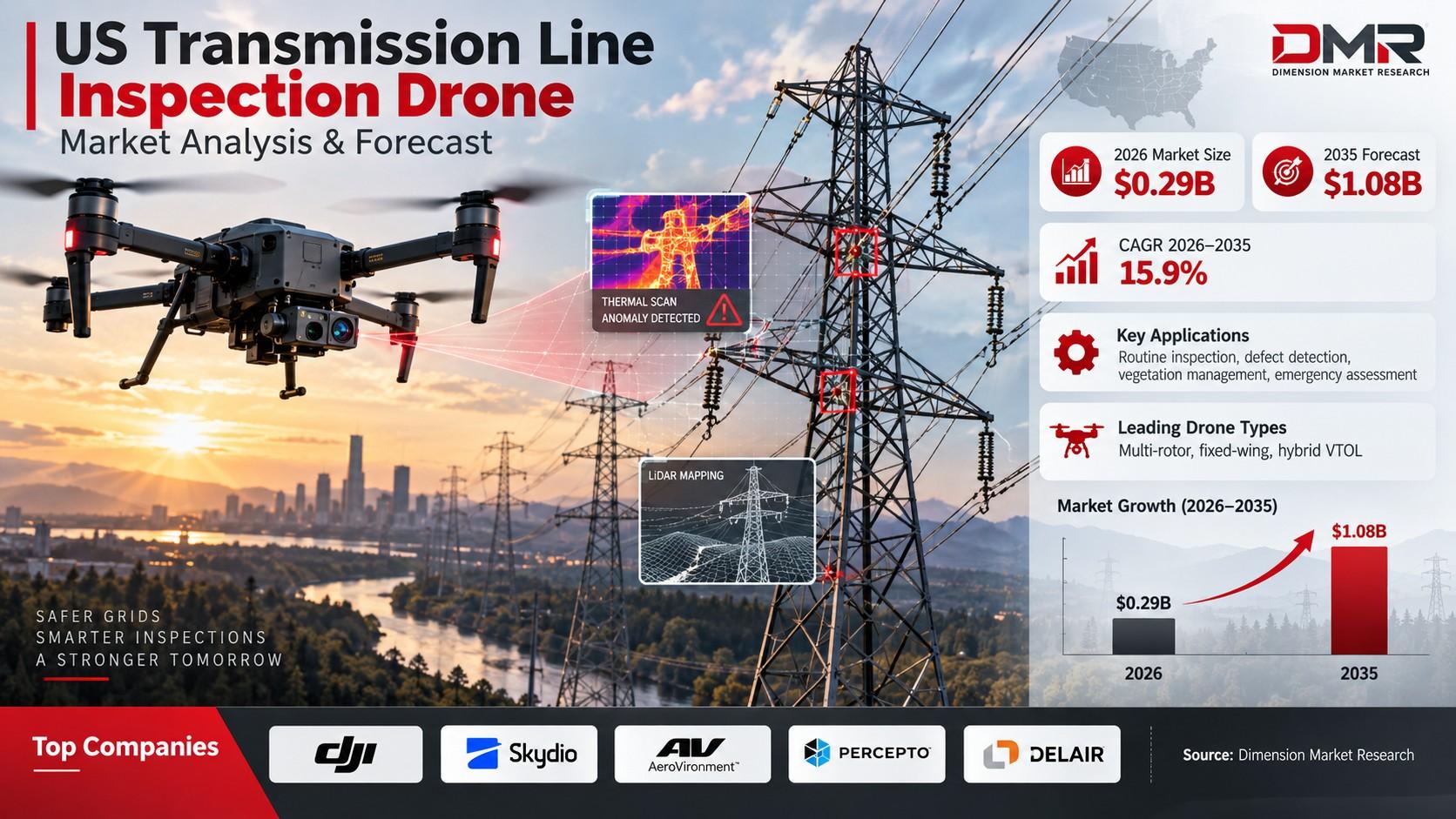
US Transmission Line Inspection Drone Market Overview
The US Transmission Line Inspection Drone Market size is projected to grow from USD 285 million in 2026 to USD 1,080 million by 2035, registering a compound annual growth rate (CAGR) of 15.9% during 2026 to 2035, according to Dimension Market Research. The expansion reflects growing demand for safer infrastructure monitoring, efficient power grid maintenance, automated inspection technologies, and improved transmission asset reliability.
Drone-based inspection is changing how American electric utilities monitor high-voltage transmission lines, towers, conductors, insulators, and surrounding vegetation. Multi-rotor aircraft currently lead the market because they provide maneuverability and detailed close-range imagery. Meanwhile, hybrid vertical takeoff and landing (VTOL) drones are gaining attention for long-distance corridor coverage. Artificial intelligence (AI), thermal imaging, LiDAR, and autonomous flight capabilities are creating additional opportunities for drone manufacturers, software developers, and inspection service providers.
US Transmission Line Inspection Drone Market Snapshot
● 2026 market size: USD 285 million, reflecting expanding utility adoption.
● 2035 forecast: USD 1,080 million, supported by digital inspection demand.
● 2026 to 2035 CAGR: 15.9%, indicating strong forecast-period growth.
● Leading drone type in 2026: Multi-rotor drones, with a 58% share.
● Leading application in 2026: Routine inspection, accounting for 39%.
● Leading end user in 2026: Electric utilities, representing 62%.
● Fastest-growing drone segment: Hybrid VTOL drones, at a 21.4% CAGR.
● Historical analysis: 2021 to 2025, with forecasts covering 2026 to 2035.
Get insight you need (request free sample)
Market Research Findings
The report identifies multi-rotor drones as the leading aircraft category in 2026, supported by their ability to hover near transmission infrastructure and capture detailed component imagery. Routine inspection remains the largest application, accounting for 39% of the market, while electric utilities represent 62% of end-user demand. Hybrid VTOL drones are projected to grow at the fastest rate, with a 21.4% CAGR, as operators seek greater corridor coverage and flexible flight capabilities. Emergency and damage assessment is another important growth area, with a projected CAGR of 18.9%. Inspection service providers are also expected to expand, supported by outsourced inspection operations, specialized equipment, and data analytics services.
Why Is the US Transmission Line Inspection Drone Market Growing?
Market growth is closely linked to the need to maintain aging electrical infrastructure while improving worker safety, inspection frequency, and operational efficiency. Traditional inspection methods may require climbing crews, helicopters, or extensive ground patrols, particularly across remote transmission corridors. Drones provide an alternative by collecting high-resolution imagery and sensor data from difficult-to-access locations.
Grid modernization initiatives are also encouraging utilities to adopt digital asset-management tools. AI-assisted defect detection, thermal monitoring, and LiDAR mapping help identify potential equipment deterioration and vegetation encroachment. Following storms, wildfires, and other disruptive events, drones can provide rapid visual assessments that support repair prioritization. As these capabilities become integrated with utility maintenance systems, inspection programs can shift toward data-driven and condition-based asset management.
Key Growth Drivers in the US Transmission Line Inspection Drone Market
● Aging transmission infrastructure increases the need for regular asset inspections.
● Worker safety priorities encourage alternatives to climbing and helicopter surveys.
● Grid modernization investments support digital inspection and monitoring systems.
● AI analytics improve defect identification and maintenance prioritization.
● Thermal imaging and LiDAR expand inspection capabilities beyond visible imagery.
● Wildfire and storm risks increase demand for rapid infrastructure damage assessment.
● Autonomous flight creates opportunities for scalable transmission corridor monitoring.
Research Scope and Leading Market Segments
The research examines the US Transmission Line Inspection Drone Market across drone type, application, end user, and inspection technology. These segments help explain where demand originates, which aircraft configurations are preferred, and how inspection requirements influence purchasing decisions. The following leading segments are particularly important for understanding the market's current structure and future growth opportunities.
1. Drone Type: Multi-Rotor and Hybrid VTOL Drones
Multi-rotor drones hold the leading position, with an estimated 58% market share in 2026. Their ability to hover, maneuver around transmission towers, and capture close-range images makes them suitable for inspecting insulators, conductors, fasteners, and structural components. Their operational flexibility also supports emergency inspections and localized fault detection.
Hybrid VTOL drones represent the fastest-growing category, with a projected 21.4% CAGR. These aircraft combine vertical takeoff and landing with more efficient forward flight, making them attractive for inspecting long transmission corridors. Fixed-wing drones also contribute to the market through extended endurance and corridor mapping capabilities. Future demand will depend on mission requirements, regulatory permissions, aircraft performance, and the economics of large-scale operations.
● Multi-rotor drones: Close-range inspections and detailed component imagery.
● Fixed-wing drones: Long-distance coverage and corridor mapping.
● Hybrid VTOL drones: Flexible deployment and extended inspection missions.
2. Application: Routine Inspection and Emergency Assessment
Routine inspection represents the largest application, accounting for approximately 39% of the market in 2026. Electric utilities require recurring assessments of transmission towers, conductors, insulators, hardware, and right-of-way conditions. Drones provide repeatable visual records that can help maintenance teams track asset conditions and identify components requiring further investigation.
Emergency and damage assessment is projected to grow at an 18.9% CAGR. Severe weather, wildfires, lightning, and other disruptive events can damage critical infrastructure and complicate ground access. Drone missions enable operators to assess affected assets and prioritize restoration activities. Fault detection and vegetation management are also important applications because early identification of equipment deterioration and vegetation encroachment can help utilities manage reliability risks.
● Routine inspection: Recurring condition assessment and asset documentation.
● Fault and defect detection: Identification of damage and abnormal conditions.
● Vegetation management: Monitoring encroachment along transmission corridors.
● Emergency assessment: Rapid surveys following storms and other incidents.
Read more about this market: https://dimensionmarketresearch.com/report/us-transmission-line-inspection-drone-market/
3. End User: Electric Utilities
Electric utilities account for an estimated 62% of the market in 2026. Their ownership and operational responsibility for extensive transmission networks create sustained demand for inspection solutions that improve maintenance efficiency, safety, and infrastructure reliability. Drone data can support routine patrols, asset-condition monitoring, and repair planning.
Transmission system operators represent approximately 23% of the market, reflecting their need to monitor high-voltage corridors and support grid reliability. Inspection service providers account for roughly 15% but are projected to grow at a 19.8% CAGR. Outsourcing allows utilities to access specialist pilots, advanced sensors, analytics platforms, and inspection capabilities without building every function internally.
● Electric utilities: Direct asset ownership and recurring inspection requirements.
● Transmission system operators: Corridor monitoring and reliability management.
● Inspection service providers: Specialized operations and outsourced analytics.
US Transmission Line Inspection Drone Market Dynamics
Market Trends: AI and Integrated Inspection Platforms
The market is moving toward integrated inspection platforms that combine aircraft, sensors, automated flight planning, cloud software, and AI-based analytics. High-resolution RGB cameras identify visible defects, thermal sensors detect abnormal heat signatures, and LiDAR supports three-dimensional corridor mapping. When combined, these technologies provide a broader view of transmission asset conditions.
AI-powered computer vision can help classify potential defects, compare current images with historical records, and prioritize assets for maintenance review. Integration with geographic information systems and utility asset-management software further increases the value of collected data. Vendors that provide complete inspection workflows may gain an advantage over suppliers offering aircraft alone.
Growth Opportunities: Autonomous BVLOS Operations
Beyond-visual-line-of-sight (BVLOS) operations offer an important opportunity because transmission networks extend across long distances and frequently pass through remote terrain. With suitable aircraft, safety systems, communications, and regulatory authorization, BVLOS missions can expand inspection coverage and reduce the need to reposition field crews repeatedly.
The Federal Aviation Administration's proposed BVLOS framework announced in August 2025 highlighted the regulatory focus on scaling drone operations. Its practical impact will depend on final requirements, authorizations, and operational compliance. Companies providing autonomous aircraft, detect-and-avoid systems, inspection software, and managed services could benefit as utilities evaluate larger-scale deployments.
Market Challenges: Regulation and Data Integration
Regulatory requirements remain an important challenge for commercial transmission inspections, particularly when missions extend beyond visual line of sight. Operators must consider airspace safety, pilot qualifications, communications, operational procedures, and applicable FAA permissions. These requirements can increase implementation costs and delay wider adoption.
Data management is another challenge. High-resolution images, thermal records, and LiDAR datasets require secure storage, processing, quality control, and integration with existing utility systems. AI findings must be sufficiently reliable for engineering teams to use them in maintenance decisions. Cybersecurity and critical-infrastructure data governance also influence procurement, making complete, secure, and interoperable inspection solutions increasingly important.
Regional and Country Outlook
The report focuses on the United States market. According to Dimension Market Research, the market is estimated at USD 285 million in 2026 and is projected to reach USD 1,080 million by 2035, representing a 15.9% CAGR during 2026 to 2035. No separate regional market values or regional CAGRs are provided in the supplied report data.
Demand is associated with transmission infrastructure maintenance, grid modernization, inspection automation, and the need for reliable asset monitoring across geographically dispersed utility networks. Adoption patterns will depend on utility investment priorities, local operating conditions, applicable aviation requirements, and the availability of suitable drone inspection services.
Key Competitor Companies
The competitive landscape includes drone manufacturers, autonomous inspection technology providers, analytics companies, and specialist infrastructure service providers. Companies identified in the supplied research include:
● DJI
● Skydio
● Inspired Flight Technologies
● AeroVironment
● Parrot
● Autel Robotics
● Percepto
● Sharper Shape
● SkySpecs
● Zeitview
● DroneDeploy
● Nearthlab
● JOUAV
● American Robotics
● Flyability
Competition increasingly centers on flight autonomy, endurance, sensor integration, analytics quality, cybersecurity, and compatibility with utility maintenance workflows. Market participants are also exploring recurring software revenue and inspection-as-a-service models. The companies listed represent participants identified in the supplied research; the list does not establish a verified market-share ranking.
Get 10% instant discount on report purchase
Explore more report:
● US BESS Diagnostic Equipment Market
● US BESS Battery Testing Equipment Market
● US Battery Manufacturing Robotics Market
● US Agentic Automation Market
Frequently Asked Questions
1. What is the US Transmission Line Inspection Drone Market size in 2026?
The market is estimated at USD 285 million in 2026, according to Dimension Market Research.
2. What is the projected market size by 2035?
The market is forecast to reach approximately USD 1,080 million by 2035.
3. What is the expected market CAGR from 2026 to 2035?
The report projects a compound annual growth rate of 15.9% over the 2026 to 2035 forecast period.
4. Which drone type leads the US transmission inspection market?
Multi-rotor drones lead, accounting for an estimated 58% share of the market in 2026.
5. Which drone segment is expected to grow the fastest?
Hybrid VTOL drones are projected to record the fastest growth, with a 21.4% CAGR.
6. What is the largest application of transmission inspection drones?
Routine inspection is the leading application, accounting for approximately 39% of the market in 2026.
7. Which end user dominates the market?
Electric utilities lead with an estimated 62% market share in 2026, supported by recurring inspection requirements.
8. How is AI changing transmission line drone inspections?
AI supports defect classification, thermal anomaly analysis, vegetation monitoring, historical image comparisons, and maintenance prioritization.
9. What are the major challenges facing the market?
Key challenges include BVLOS regulatory requirements, data integration, cybersecurity, implementation costs, and inspection analytics reliability.
10. Which companies compete in this market?
Identified participants include DJI, Skydio, AeroVironment, Percepto, SkySpecs, DroneDeploy, and other drone and inspection technology providers.
Access the Full US Transmission Line Inspection Drone Market Report
Understanding this market requires evaluating forecast growth alongside aircraft selection, inspection applications, end-user demand, technology development, and competitive positioning. For utilities and technology suppliers, these factors can help inform investment priorities, product development, and service expansion. Investors and business strategists can also use market segmentation to assess opportunities in autonomous flight, AI analytics, and outsourced inspection services.
The report covers market estimates, forecast trends, segment shares, growth opportunities, restraints, and competitive analysis for the 2026 to 2035 period. Readers can explore the findings to understand how drone-based inspection may support the next phase of US transmission infrastructure monitoring.
About Us
Dimension Market Research (DMR) is a global market intelligence and consulting firm delivering data-driven insights that help organizations make informed strategic decisions. With expertise across 12+ industries and global markets, DMR provides syndicated reports, custom research, competitive analysis, white space analysis, and business strategy consulting.
Our research solutions combine analytical rigor, industry expertise, and forward-looking intelligence to identify opportunities, reduce risks, and support sustainable growth. Trusted by clients across diverse sectors, DMR is committed to delivering accurate, actionable insights that enable businesses to navigate evolving market landscapes with confidence.
Contact Us
Phone USA: +17323699777
Phone India: +919310023843
E-mail: enquiry@dimensionmarketresearch.com
Address USA: 957 Route 33, Suite 12 #308, Hamilton Square, NJ-08690
Address India: D44, Sector 6, Noida 201301, India
- Managerial Effectiveness!
- Future and Predictions
- Motivatinal / Inspiring
- Fitness and Wellness
- Medical & Health
- Manufacturing
- Education
- Real-Estate
- Food Industry
- Hospitality
- Online Games
- Sports
- Home Services
- Civil Engineering
- Safety and Protection
- Software Products & Services
- Fashion and Jewellery
- Artificial Intelligence
- Entrepreneurship
- Mentoring & Guidance
- Marketing
- Networking
- HR & Recruiting
- Literature
- Shopping
- Career Management & Advancement