

 SkillClick
Adaptive Clothing Market to Grow at 7.8% CAGR Through 2036, Says Fact.MR
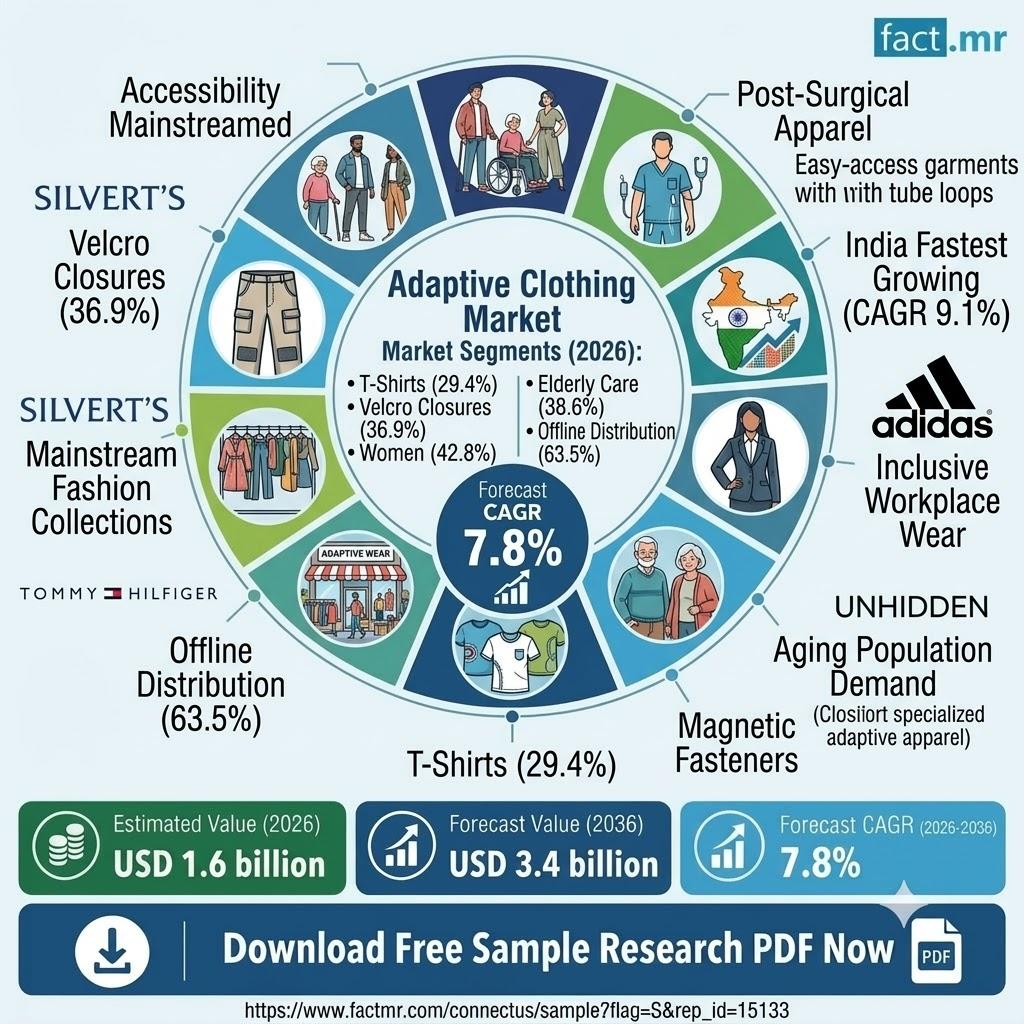
Subheadline: Fact.MR projects the adaptive clothing market to grow at a 7.8% CAGR through 2036, supported by aging populations and rising demand for accessible apparel.
October 12, 2026 The global adaptive clothing market is projected to reach USD 3.4 billion by 2036, rising from USD 1.6 billion in 2026 at a compound annual growth rate (CAGR) of 7.8%, according to Fact.MR analysis updated June 9, 2026. The forecast reflects growing demand for clothing designed for people with disabilities, mobility limitations, age-related conditions, and post-surgical recovery needs. The market is expected to generate approximately USD 1.8 billion in additional revenue between 2026 and 2036.
The expansion creates opportunities for apparel manufacturers and retailers to serve consumers who need easier dressing without sacrificing everyday style. However, affordability and limited product awareness in developing economies remain barriers to wider adoption. Fact.MR identifies aging populations, improved accessibility awareness, and broader online retail availability as important factors shaping demand over the forecast period.
Get detailed market forecasts, competitive benchmarking, and pricing trends: https://www.factmr.com/connectus/sample?flag=S&rep_id=15133
Adaptive Clothing Market Growth Reflects Changing Apparel Needs
The adaptive clothing market covers garments designed to make dressing more accessible for people with physical disabilities, reduced mobility, or age-related conditions. These products incorporate modified fits and specialized closures that reduce dressing difficulty while supporting comfort and independence.
Market fact: Fact.MR is a market research and consulting firm that provides industry forecasts and commercial intelligence. Its adaptive clothing market study estimates a USD 1.6 billion market value in 2026 and projects USD 3.4 billion by 2036.
Adaptive apparel has historically served specialist healthcare and rehabilitation settings. Its reach is now extending into mainstream fashion as established clothing brands introduce accessibility-focused collections. The shift gives consumers more options beyond garments sold exclusively through medical supply stores or specialist providers.
Product design remains central to this transition. Clothing that combines practical fastening systems with familiar styles can serve people who need dressing assistance while retaining the appearance of everyday apparel.
T-Shirts Lead Product Demand as Velcro Closures Gain Ground
T-shirts are projected to account for 29.4% of the adaptive clothing market by product in 2026, making them the leading product category in the Fact.MR analysis. Frequent daily use, comfort requirements, and the suitability of T-shirts for adaptive modifications support their position. Their versatility also allows manufacturers to serve elderly care and disability support applications through familiar clothing formats.
Velcro closures are expected to account for 36.9% of the market by closure type in 2026. These fastenings can simplify dressing for people with limited dexterity because they require less precise hand movement than conventional buttons. Magnetic closures, adapted zippers, and snap closures also form part of the product landscape.
The end-user segment shows another notable pattern. Women are projected to represent 42.8% of the market in 2026, supported by a broader range of adaptive casualwear, innerwear, and rehabilitation clothing.
Offline distribution is expected to retain the largest share, at 63.5% in 2026. Physical stores allow customers to assess fit, comfort, and fastening mechanisms before purchasing. Online platforms complement these outlets by improving product visibility and access to specialized designs.
Elderly care apparel is projected to account for 38.6% of the market in 2026. This segment reflects demand for garments that simplify dressing in assisted-care environments and support older adults who want to maintain independence.
Adaptive Clothing Market Opportunities Expand Across Countries
India is projected to record the fastest growth among the countries highlighted in the Fact.MR study, with a CAGR of 9.1% from 2026 to 2036. Improving healthcare access, organized retail expansion, and greater online availability are expected to support demand.
China follows with a projected CAGR of 8.5%, reflecting demographic aging and increasing demand for healthcare-related consumer products. The United States is forecast to grow at 7.2%, while Germany is expected to register 6.8%. Japan is projected to expand at 6.5% through 2036.
These differences offer useful direction for companies evaluating market entry and product distribution. India and China present faster projected growth, while established markets such as the United States, Germany, and Japan continue to offer opportunities linked to accessibility awareness and aging populations.
Apparel Brands Bring Accessibility Into Mainstream Fashion
Established fashion companies and specialist adaptive apparel providers are helping broaden product availability. Examples cited in the Fact.MR study include adidas, which introduced adaptive training wear and universal-design apparel for the Paris 2024 Olympic and Paralympic cycle, and Primark, which launched a 49-piece adaptive clothing collection developed with adaptive designer Victoria Jenkins of Unhidden.
These developments illustrate how accessibility features are entering familiar apparel categories. Primark's collection included magnetic fastenings, tube-access features, and wheelchair-friendly cuts, demonstrating how garment construction can address specific dressing requirements.
The competitive landscape also includes Tommy Hilfiger Adaptive, Silvert’s Universal Dressing Solutions Inc., Zappos Adaptive, Unhidden, The Able Label, and No Limbits. Companies compete through product accessibility, comfort, assortment, brand visibility, and distribution reach.
Affordability remains a constraint. Specialized design features can increase production costs, limiting access for price-sensitive households. Greater product visibility alone may not resolve this challenge; manufacturers must also consider pricing and distribution when developing offerings for emerging markets.
Fact.MR Outlook on the Adaptive Clothing Market
Shambhu Nath Jha, Principal Consultant at Fact.MR, said, “Growth opportunities are shifting toward apparel that combines accessibility with everyday fashion appeal. Companies that improve product visibility and affordability are positioned to strengthen market penetration.”
The outlook points to a market where practical garment design and mainstream retail access will both influence future demand. Manufacturers can assess opportunities across elderly care apparel, disability support clothing, post-surgical garments, and rehabilitation apparel while adapting product ranges to regional needs.
The Fact.MR forecast covers 2026 to 2036 and draws on primary interviews with adaptive apparel manufacturers, specialty retailers, healthcare clothing distributors, rehabilitation specialists, and apparel industry executives. The research uses a hybrid top-down and bottom-up forecasting model supported by apparel sales analysis, demographic trends, retail penetration, and accessibility-product demand assessments.
View Related Reports :
https://ayushjadhavblogs.blogspot.com/2026/10/infant-nutrition-market-to-reach-usd.html
https://1nigeria.radiobenue.be.gov.ng/read-blog/36455
About Fact.MR
Fact.MR is a market research and consulting firm that provides industry analysis, market forecasts, and strategic insights to businesses across multiple sectors. Its research combines primary interviews, desk research, and market-sizing models to evaluate demand patterns, competitive developments, and regional growth opportunities.
- Managerial Effectiveness!
- Future and Predictions
- Motivatinal / Inspiring
- Fitness and Wellness
- Medical & Health
- Manufacturing
- Education
- Real-Estate
- Food Industry
- Hospitality
- Online Games
- Sports
- Home Services
- Civil Engineering
- Safety and Protection
- Software Products & Services
- Fashion and Jewellery
- Artificial Intelligence
- Entrepreneurship
- Mentoring & Guidance
- Marketing
- Networking
- HR & Recruiting
- Literature
- Shopping
- Career Management & Advancement