

 SkillClick
How Predictive Analytics Is Transforming Real Estate Mobile Apps
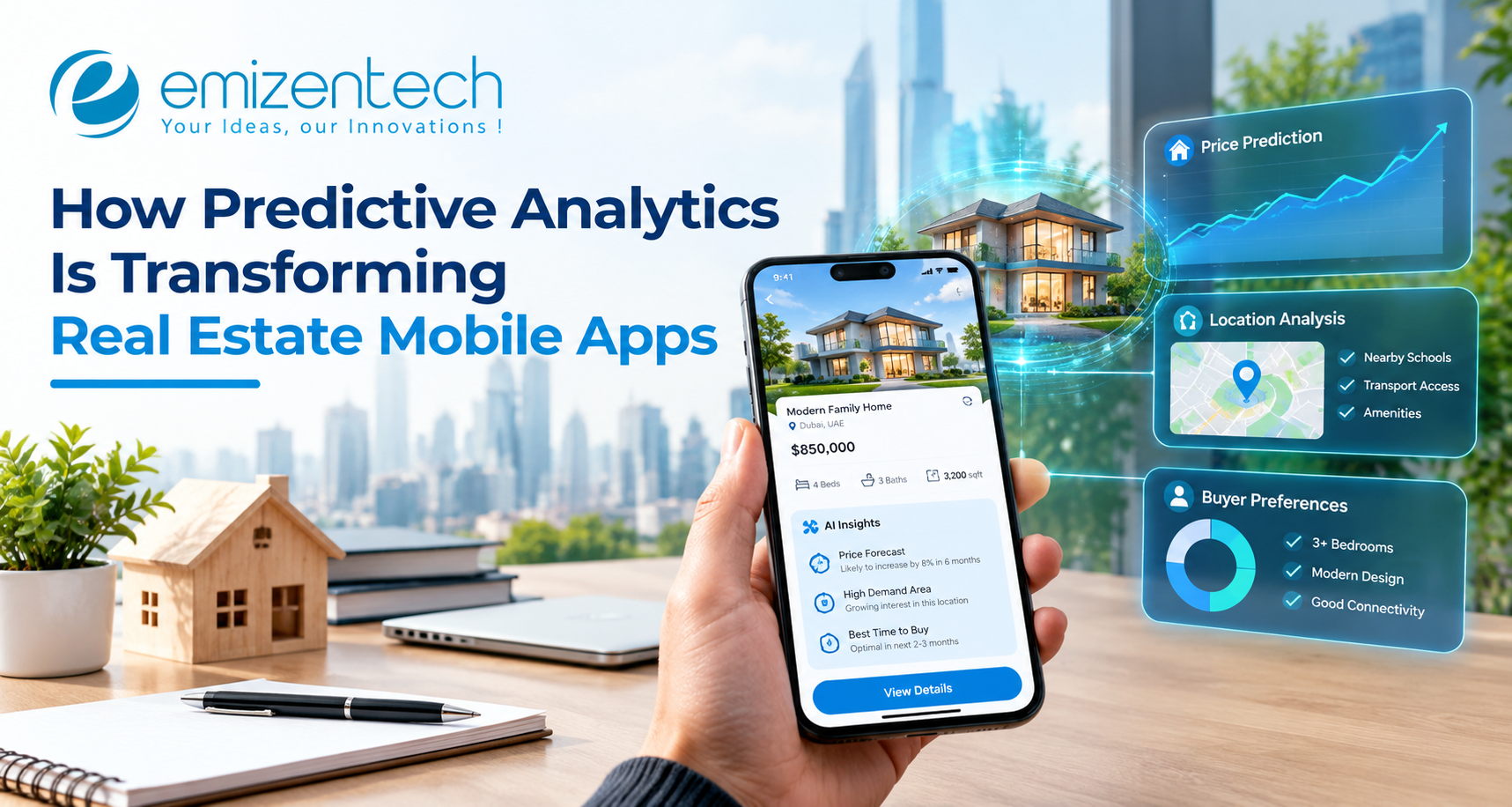
Real estate apps have moved far beyond simple property listings. Today, buyers, sellers, and investors expect apps that can estimate prices, suggest the right homes, and warn them about market shifts. Predictive analytics makes this possible by turning historical and live data into forecasts. This blog explains how it works, where it adds value, which features and technologies matter, how to build such an app, and what it costs.
What Is Predictive Analytics in Real Estate?
Predictive analytics in real estate uses historical data, statistical models, and machine learning to forecast outcomes such as property prices, rental demand, buyer intent, and neighborhood growth. In a mobile app, the system collects data from MLS listings, public records, demographic reports, geo-location data, and user behavior. Machine learning models then find patterns in this data and turn them into price estimates, recommendations, and alerts. Traditional analysis relies on manual comparisons and past averages. Predictive models keep learning from fresh data, so their forecasts improve over time.
Why Real Estate Mobile Apps Need Predictive Analytics
The property app market is crowded, and listings alone no longer give users a reason to stay. People want personalized suggestions, accurate valuations, and insights they can act on quickly. Predictive analytics delivers this by helping buyers judge fair prices, helping sellers choose the right time to list, helping agents focus on high-intent leads, and helping investors assess risk and returns. For businesses investing in real estate app development, these capabilities improve engagement, retention, and conversions. That gives the app a clear edge over competitors still offering only basic search and filters.
Key Ways Predictive Analytics Is Transforming Real Estate Apps
Predictive analytics adds intelligence to almost every part of a property app. Here are the ways it changes how users search, decide, and invest, and how agents and owners work.
Accurate Property Price Prediction
Machine learning models study past sales, location, size, amenities, and market movement to estimate a property's value instantly, helping buyers avoid overpaying and helping sellers set competitive, realistic listing prices.
Personalized Property Recommendations
By analyzing search history, saved listings, and browsing patterns, the app learns each user's preferences and suggests matching homes, so people find the right property faster and stay engaged longer.
Market Trend and Demand Forecasting
Predictive models track pricing cycles, buyer demand, and local development activity to forecast where markets are heading, giving users timely insight into the best areas and when to buy or sell.
Lead Scoring for Agents
Algorithms rank leads by their likelihood to convert, using inquiry activity, search behavior, and budget signals, so agents spend their time on serious prospects instead of chasing every inquiry equally.
Investment Risk and ROI Analysis
Investors get projected appreciation, rental returns, and risk levels for each property, built from historical performance and neighborhood data, which helps them compare opportunities and make confident, data-backed investment decisions.
Rental Yield and Vacancy Prediction
Landlords and property managers can forecast rental income, expected vacancy periods, and ideal rent levels, which reduces empty months and helps them price units accurately according to real local demand.
Must-Have Predictive Analytics Features in a Real Estate App
The right features decide whether predictive analytics actually helps users. These are the must-have capabilities to include when planning a data-driven property app that people trust and return to regularly.
-
AI Price Estimator: Gives instant property value estimates based on location, size, condition, and recent sales. It shows a confidence range so users understand how reliable each estimate is.
-
Smart Search and Recommendations: Learns from user behavior to rank listings, suggest similar homes, and surface new properties that match saved preferences, without repeated manual filtering.
-
Neighborhood Insights and Growth Heatmaps: Visual maps show price trends, demand levels, nearby amenities, and projected growth, so users can compare areas at a glance.
-
Mortgage and Affordability Predictor: Estimates monthly payments and the affordable price range from income, interest rates, and down payment, so buyers know what they can realistically afford.
-
Real-Time Alerts: Push notifications for price drops, new matching listings, and market shifts help users act at the right moment instead of discovering changes too late.
Technologies Behind Predictive Real Estate Apps
Predictive models depend on the right mix of data, algorithms, and infrastructure. These are the core technologies that power accurate forecasts, and many AI tools for startups use them too.
-
Machine Learning and Deep Learning: Regression, gradient boosting, and neural networks built with TensorFlow, PyTorch, or XGBoost power valuation, recommendation, and forecasting models.
-
Big Data Platforms: Tools like Apache Spark and Kafka process large volumes of listings, transactions, and user activity in real time.
-
Cloud Infrastructure: AWS, Microsoft Azure, or Google Cloud provide scalable storage, model training, and deployment, so the app handles growing traffic without slowing down.
-
Geospatial and GIS Tools: Google Maps Platform, Mapbox, and GIS libraries enable location-based insights, heatmaps, and proximity scoring for schools, transport, and amenities.
-
Mobile Frameworks: Flutter, React Native, or native Swift and Kotlin deliver smooth, responsive apps across iOS and Android.
-
Backend and APIs: Python or Node.js backends with REST or GraphQL APIs connect the models, databases, and the mobile app reliably.
How to Build a Real Estate App with Predictive Analytics
Building a predictive real estate app takes a clear process, from planning to post-launch improvement. Follow these simple steps to move from a basic idea to a reliable, high-performing product.
Define Goals and Target Users
Decide whether the app serves buyers, renters, agents, or investors, then set clear goals such as better valuations or higher lead conversion, so every feature and model supports a measurable business outcome.
Collect and Prepare Data
Gather data from MLS feeds, public records, market reports, and user activity, then clean, label, and organize it carefully, because the accuracy of every prediction depends on the quality of this data.
Choose the Right ML Models
Select models that match each use case, such as regression for price prediction, collaborative filtering for recommendations, and time-series models for demand forecasting, then compare their accuracy before finalizing the approach.
Design the UI/UX.
Present predictions in a simple, visual way using charts, price ranges, and heatmaps, and keep navigation smooth so users understand insights quickly without needing any technical, financial, or market background.
Develop and Integrate the App
Build the mobile app and connect it with prediction models, maps, and payment tools. Working with a team that offers real estate app development services helps you integrate these pieces smoothly.
Test, Train, and Validate Models
Test the app on real devices and validate model predictions against actual sale prices, then retrain with new data and fix bias or errors before release to keep results trustworthy.
Launch, Monitor, and Improve
Release the app, track accuracy and user engagement, and keep feeding fresh market data into the models so predictions stay relevant as prices, demand, and user expectations change over time.
Cost of Developing a Predictive Analytics Real Estate App
The overall cost depends on feature depth, AI complexity, and team expertise. Here is what to expect and what to ask a real estate app development company before you commit. The figures below are approximate and vary by scope and location.
-
Basic App ($25,000 to $40,000): Property listings, search and filters, user profiles, and a simple price estimator. Development usually takes around 3 to 4 months.
-
Mid-Level App ($40,000 to $80,000): Adds a recommendation engine, neighborhood insights, a mortgage calculator, real-time alerts, and CRM integration. The timeline is typically 4 to 6 months.
-
Advanced App ($80,000 to $150,000+): Includes a full predictive suite with custom ML models, investment analytics, growth heatmaps, and chatbot support. Expect about 6 to 9 months of development.
-
Factors That Affect Cost: Number of features, complexity of AI models, iOS, Android, or cross-platform choice, data sourcing and licensing, third-party integrations, team location, and ongoing maintenance.
Conclusion
Predictive analytics has turned real estate apps from simple listing tools into smart decision-making platforms. From accurate price predictions and personalized recommendations to lead scoring and investment insights, it helps every user group act with more confidence. Building such an app needs quality data, the right models, and a clear development process. If you plan to launch one, EmizenTech can help you turn this idea into a reliable, data-driven product.
FAQs
1. What is predictive analytics in real estate apps?
It is the use of historical and live data with machine learning to forecast property prices, demand, rental income, and user behavior. Apps show these forecasts as estimates, recommendations, and alerts.
2. How accurate are property price prediction models?
Accuracy depends on data quality, location, and model design. Well-trained models can come close to actual sale prices in active markets, but they work best as a guide, not a guarantee.
3. How much does it cost to build a real estate app with AI?
Costs generally range from about $25,000 for a basic app to $150,000 or more for an advanced one, depending on features, AI complexity, and platforms.
4. Which technologies are best for predictive analytics in real estate apps?
Python-based machine learning frameworks like TensorFlow and PyTorch, big data tools like Spark, cloud platforms such as AWS or Google Cloud, and GIS tools for location insights are commonly used.
5. Can small real estate businesses use predictive analytics?
Yes. Small businesses can start with a focused feature, such as a price estimator or lead scoring, and add more capabilities as the app and data grow.
- Managerial Effectiveness!
- Future and Predictions
- Motivatinal / Inspiring
- Fitness and Wellness
- Medical & Health
- Manufacturing
- Education
- Real-Estate
- Food Industry
- Hospitality
- Online Games
- Sports
- Home Services
- Civil Engineering
- Safety and Protection
- Software Products & Services
- Fashion and Jewellery
- Artificial Intelligence
- Entrepreneurship
- Mentoring & Guidance
- Marketing
- Networking
- HR & Recruiting
- Literature
- Shopping
- Career Management & Advancement