

 SkillClick
Offshore Energy Storage Market Research: Technology, Demand and Opportunities
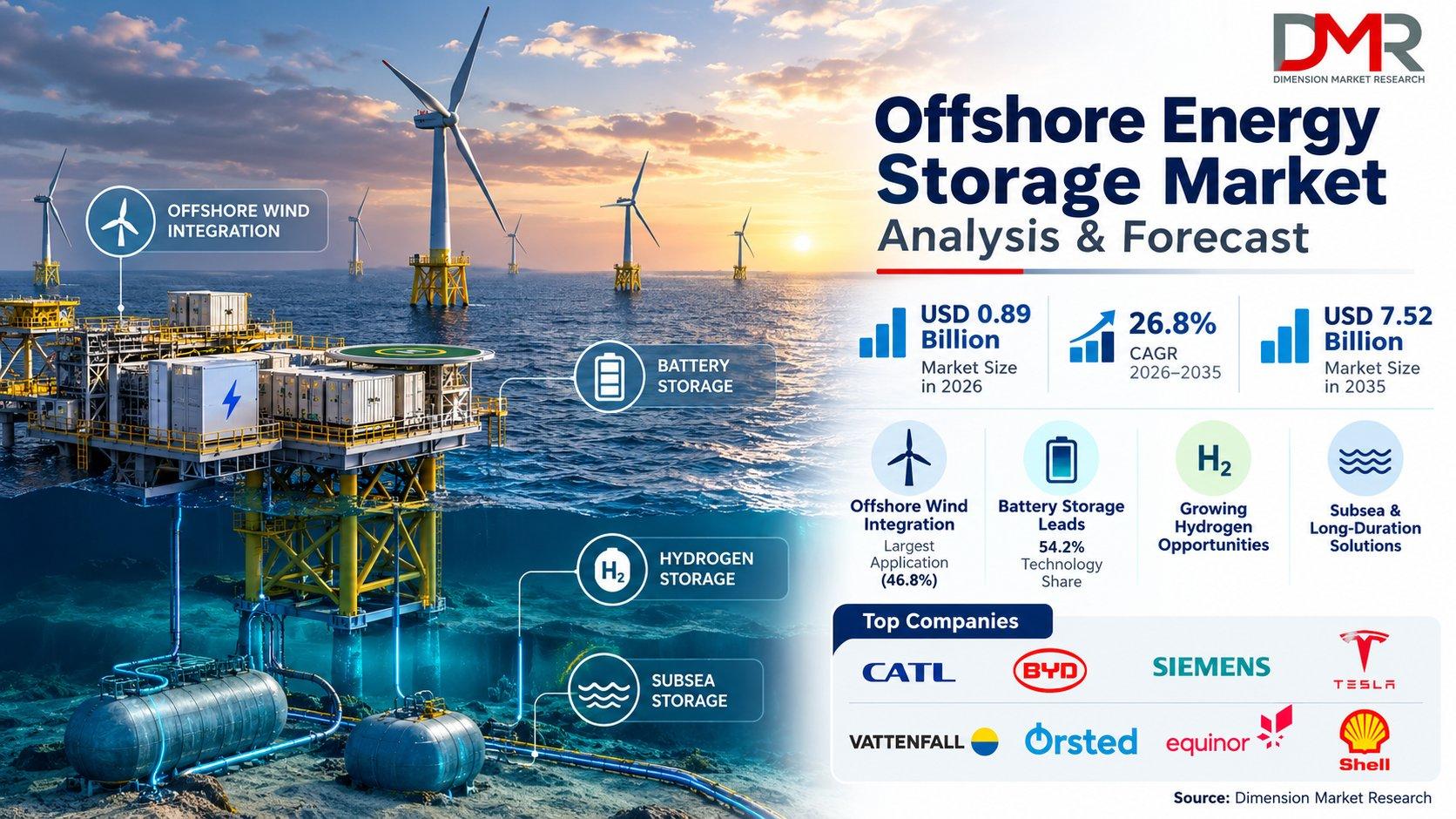
Offshore Energy Storage Market: 2026 Outlook
The Global Offshore Energy Storage Market is estimated at USD 0.89 billion in 2026 and is projected to reach USD 7.52 billion by 2035, advancing at a 26.8% CAGR. According to Dimension Market Research, the market is moving from pilot projects toward commercial procurement as offshore wind expansion, platform electrification and demand for reliable marine power increase. The market covers battery, mechanical, hydrogen and thermal energy storage systems deployed on fixed offshore structures, floating platforms and subsea installations.
For anyone tracking the next phase of offshore renewable infrastructure, the important question is no longer whether energy storage will be used offshore. The more relevant question is which technology will win across different water depths, storage durations and applications. Battery energy storage currently leads, while hydrogen, compressed air, subsea pumped hydro and other long-duration solutions are opening new opportunities.
Get insight you need (request free sample)
What Is Driving the Offshore Energy Storage Market?
Offshore energy storage is becoming increasingly important because offshore power generation does not always match electricity demand. Wind conditions can change quickly, while offshore platforms and marine operations require dependable electricity. Storage can capture excess renewable generation, provide backup power, stabilize offshore grids and reduce dependence on conventional generators.
Offshore wind energy integration is the largest application, accounting for 46.8% of the market in 2026. Storage allows developers to manage wind variability and reduce the financial impact of curtailed electricity. Platform electrification is another important demand driver, particularly across mature offshore oil and gas regions where operators are seeking lower-emission power systems.
● Offshore wind expansion is increasing storage requirements.
● Platform electrification is creating new battery demand.
● Grid congestion is increasing interest in co-located storage.
● Long-duration storage is expanding beyond conventional batteries.
● Marine certification is becoming central to project qualification.
Offshore Energy Storage Market Technology Landscape
Battery Energy Storage Systems
Battery Energy Storage Systems hold the leading position, representing 54.2% of storage technology demand in 2026. Their ability to respond within milliseconds makes them particularly suitable for frequency regulation, peak shaving, backup power and offshore wind integration.
Lithium-ion batteries account for 71.2% of battery technology demand. Their high energy density and strong round-trip efficiency are valuable where offshore deck space and equipment weight are constrained. Lithium-ion technology is therefore expected to remain central to fixed and floating offshore battery deployments, although alternative chemistries are gaining attention for longer-duration applications.
Mechanical Energy Storage
Mechanical storage is attracting interest where batteries become less economical for extended discharge periods. Compressed Air Energy Storage leads the mechanical segment with a 42.4% share in 2026. Subsea compressed air, gravity storage, flywheels and subsea pumped hydro can potentially address storage requirements ranging from several hours to multiple days.
Hydrogen and Thermal Storage
Hydrogen energy storage has a smaller current market share but offers significant long-term potential. Offshore platforms can combine renewable generation, electrolysis and hydrogen storage to create integrated energy systems. Thermal storage remains more specialized, particularly for offshore industrial processes and applications involving waste heat recovery.
Deployment and Storage Duration Trends
Fixed offshore systems account for 67.8% of deployment demand in 2026. Existing fixed offshore wind infrastructure and established oil and gas platforms provide a practical foundation for storage installation. However, floating offshore systems are expected to experience faster growth as offshore wind development moves into deeper waters.
The 4 to 8 hour storage segment leads the market with a 37.4% share. This duration aligns with daily energy shifting and offshore wind variability. Longer-duration systems above 12 hours are becoming increasingly relevant for remote offshore platforms and grid-disconnected floating wind projects.
● Fixed systems currently dominate offshore deployment.
● Floating systems offer strong future growth potential.
● Four to eight hours is the leading duration segment.
● Long-duration storage supports remote offshore operations.
Leading Companies in the Market
● Siemens Energy
● GE Vernova
● ABB Ltd.
● Wärtsilä
● Fluence Energy, Inc.
● Tesla, Inc.
● CATL
● BYD Company Ltd.
● Equinor ASA
● Ørsted A/S
● RWE AG
● Saipem S.p.A.
● Subsea 7 S.A.
● NOV Inc.
● Hitachi Energy
● Schneider Electric SE
● Kraken Robotics Inc.
● SubCtech GmbH
● Verlume Ltd.
● TNO
Regional Outlook for Offshore Energy Storage
Europe
Europe leads the global market with a 56.2% share in 2026, valued at approximately USD 0.39 billion. The region benefits from its extensive offshore wind infrastructure, ambitious renewable energy targets and growing interest in grid flexibility. North Sea and Baltic projects are particularly important for the development of fixed, floating and subsea storage concepts.
Asia Pacific
Asia Pacific represents one of the strongest growth opportunities. Offshore wind development in China, Japan, South Korea and Taiwan is increasing the need for energy storage and grid integration. The region's combination of rapidly expanding offshore renewable capacity and evolving transmission infrastructure creates substantial demand for offshore storage solutions through 2035.
North America
North America's opportunity is linked to offshore wind development and offshore platform electrification. The United States also provides a potential market for hybrid battery systems supporting offshore operations, while Gulf of Mexico assets can create near-term demand before offshore wind reaches greater commercial scale.
Latin America and Middle East & Africa
Latin America remains an emerging market, with Brazil's offshore oil and gas sector providing an important opportunity. The Middle East and Africa market is also developing around platform electrification, offshore energy projects and green hydrogen initiatives. Over time, floating wind and autonomous marine power systems could broaden demand across both regions.
Get detailed market insight: https://dimensionmarketresearch.com/report/offshore-energy-storage-market/
Key Market Opportunities Through 2035
The next phase of market development is likely to focus on applications where conventional onshore storage cannot fully solve offshore power requirements. Floating wind is particularly important because projects located farther from shore require greater energy autonomy. Subsea storage could also reduce the need for large surface installations in locations where deck space is limited.
Another opportunity comes from repurposing offshore oil and gas infrastructure. Decommissioned platforms may provide existing structural assets, electrical connections and marine access that could be adapted for energy storage hubs. Green hydrogen platforms represent another emerging avenue, especially where offshore renewable electricity can be converted into hydrogen for storage and transportation.
● Floating wind creates demand for integrated offshore storage.
● Subsea systems can address space and access constraints.
● Green hydrogen opens a longer-duration storage pathway.
● Retired platforms could become storage infrastructure.
● AI can improve battery performance and maintenance.
AI and Digitalization in Offshore Energy Storage
Artificial intelligence is becoming relevant across offshore energy storage operations. Machine learning can optimize charge and discharge cycles based on wind forecasts, electricity demand and battery condition. Predictive maintenance can also identify thermal, electrical or degradation issues before they become costly failures.
For offshore operators, the value is particularly clear. Maintenance requires suitable weather windows, vessels and trained personnel. Digital monitoring and autonomous inspection technologies can reduce unnecessary technician visits while improving asset availability. As offshore storage fleets grow, intelligent energy management systems are likely to become an increasingly important differentiator among vendors.
Challenges Shaping Market Adoption
The strongest constraint remains the additional cost of offshore deployment. Battery systems must withstand saltwater exposure, corrosion, vibration, wave loading and demanding temperature conditions. Subsea systems introduce additional pressure-rating and remote-maintenance requirements.
These factors increase both capital expenditure and operating costs compared with conventional onshore storage. Supply chain concentration is another concern because battery cells and critical minerals are concentrated in a limited number of global manufacturing regions. Certification, marine engineering expertise and availability of qualified offshore technicians can also influence project timelines.
● Marine conditions increase equipment and maintenance costs.
● Certification requirements can extend project schedules.
● Subsea maintenance remains technically challenging.
● Battery material supply chains create procurement risks.
Investment and Competitive Landscape
Competition is developing across several technology categories rather than around one dominant solution. Large energy technology companies can combine power conversion, grid integration and storage expertise, while specialist marine companies bring subsea engineering and offshore certification capabilities.
The competitive advantage increasingly depends on more than battery price. Developers are evaluating total cost of ownership, offshore installation capability, certification, lifecycle performance, maintenance requirements and integration with existing electrical infrastructure. Partnerships between battery manufacturers, offshore engineering companies and renewable energy developers are therefore becoming an important route to market.
What the Offshore Energy Storage Market Means for Investors and Developers
The market's projected rise from USD 0.89 billion in 2026 to USD 7.52 billion by 2035 points to a rapidly expanding opportunity. However, market participants should not view offshore storage as a single technology market. Different applications will favor different combinations of batteries, hydrogen, compressed air, thermal storage and other solutions.
Near-term demand is likely to remain concentrated around lithium-ion BESS, fixed offshore systems and 4 to 8 hour storage. Longer-term growth could increasingly come from floating platforms, subsea systems and long-duration energy storage. The companies that combine reliable technology with marine certification, project execution and lifecycle services are positioned to capture a larger share of this expansion.
Report Also Cover
What is the current size of the Offshore Energy Storage Market?
What will be the Offshore Energy Storage Market size by 2035?
Which technology leads the Offshore Energy Storage Market?
Why are lithium-ion batteries dominant in offshore energy storage?
What is driving offshore wind energy storage demand?
Which region holds the largest Offshore Energy Storage Market share?
What opportunities exist in floating offshore energy storage?
How will hydrogen influence offshore energy storage growth?
Who are the leading companies in the Offshore Energy Storage Market?
What are the major challenges affecting offshore energy storage projects?
Offshore Energy Storage Market Outlook
The Offshore Energy Storage Market is entering an important commercialization phase. Offshore wind integration, platform electrification, grid balancing and remote marine operations are creating a broader need for reliable energy storage beyond the shoreline. Battery systems are expected to remain the foundation of near-term deployment, while subsea compressed air, hydrogen, floating storage and other long-duration technologies can expand the addressable market.
With Europe currently leading and Asia Pacific providing strong growth potential, the market outlook through 2035 remains closely connected to offshore renewable investment, marine infrastructure development and the falling cost of energy storage technologies. For businesses evaluating suppliers, technologies, regional opportunities or investment priorities, detailed market segmentation and competitive analysis can provide a clearer basis for strategic decisions.
Get 10% instant discount on report purchase
Similar Topic
● US Grid Energy Storage Equipment Market
● Battery Energy Storage Inverter Market
About Us
Dimension Market Research (DMR) is a global market intelligence and consulting firm delivering data-driven insights that help organizations make informed strategic decisions. With expertise across 12+ industries and global markets, DMR provides syndicated reports, custom research, competitive analysis, white space analysis, and business strategy consulting.
Our research solutions combine analytical rigor, industry expertise, and forward-looking intelligence to identify opportunities, reduce risks, and support sustainable growth. Trusted by clients across diverse sectors, DMR is committed to delivering accurate, actionable insights that enable businesses to navigate evolving market landscapes with confidence.
Contact Us
Phone USA: +17323699777
Phone India: +919310023843
E-mail: enquiry@dimensionmarketresearch.com
Address USA: 957 Route 33, Suite 12 #308, Hamilton Square, NJ-08690
Address India: D44, Sector 6, Noida 201301, India
- Managerial Effectiveness!
- Future and Predictions
- Motivatinal / Inspiring
- Fitness and Wellness
- Medical & Health
- Manufacturing
- Education
- Real-Estate
- Food Industry
- Hospitality
- Online Games
- Sports
- Home Services
- Civil Engineering
- Safety and Protection
- Software Products & Services
- Fashion and Jewellery
- Artificial Intelligence
- Entrepreneurship
- Mentoring & Guidance
- Marketing
- Networking
- HR & Recruiting
- Literature
- Shopping
- Career Management & Advancement