

 SkillClick
Food Grade Titanium Dioxide Market Growth Supported by Chloride-Process TiO2
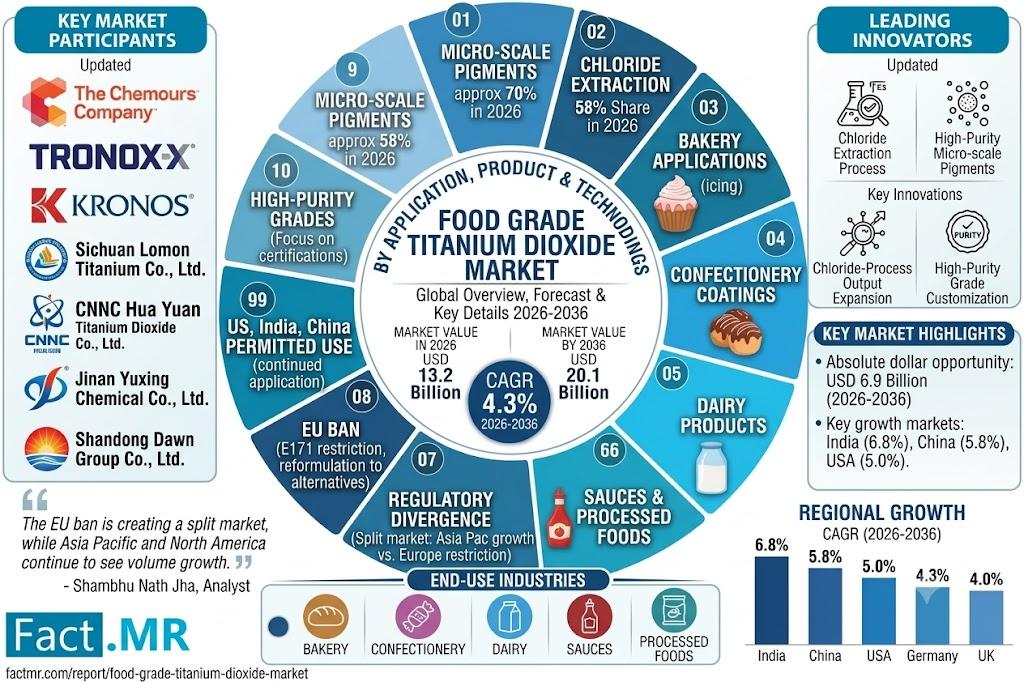
Micro-scale pigments hold about 70% share in 2026, while India leads country growth at 6.8% CAGR through 2036, according to Fact.MR.
October 1, 2026 — The Food Grade Titanium Dioxide Market is projected to reach USD 20.1 billion by 2036, up from an estimated USD 13.2 billion in 2026, according to Fact.MR analysis. The market is forecast to expand at a 4.3% CAGR during 2026–2036, generating USD 6.9 billion in incremental revenue as food production growth in Asia Pacific offsets regulatory-driven demand reductions in Europe.
Fact.MR identifies a clear regional divide. India is projected to record the fastest country-level growth at a 6.8% CAGR through 2036, followed by China at 5.8% and the United States at 5.0%. Germany is projected at 4.3%, while the United Kingdom records 4.0%.
Get detailed market forecasts, competitive benchmarking, and pricing trends: https://www.factmr.com/connectus/sample?flag=S&rep_id=14657
Food Grade Titanium Dioxide Market reflects different regulatory paths
The market was valued at USD 12.7 billion in 2025. Fact.MR estimates that demand will reach USD 13.2 billion in 2026 before rising to USD 20.1 billion by 2036.
The regulatory environment explains much of the difference between regions. EU Regulation 2022/63 banned titanium dioxide as a food additive from August 2022, prompting food manufacturers to reformulate products containing E171. European demand has consequently shifted toward alternative whitening ingredients.
The United States, India, and China continue to permit food-grade TiO2 under their respective regulatory frameworks. This allows food manufacturers in these markets to maintain applications in bakery, confectionery, dairy, sauces, and other processed food products.
Fact.MR is a market research and consulting company that provides industry forecasts, competitive analysis, and market intelligence based on primary and secondary research.
Micro-scale pigments remain the dominant form
Micro-scale pigments are expected to account for approximately 70% of the market in 2026. Fact.MR attributes this position to their established use in bakery icing, dairy products, and confectionery coatings.
The shift away from nano-form titanium dioxide is also influencing product selection. Fact.MR cites increasing regulatory scrutiny of nano-TiO2 as a factor supporting demand for micro-scale grades that meet applicable purity and regulatory requirements.
The extraction method is another key market distinction. Chloride extraction is expected to hold about 58% share in 2026 because the process produces higher-purity TiO2 with lower contaminant levels.
An industry detail highlighted by Fact.MR is that India increased imports of chloride-process TiO2 by 14% in 2024. The increase reflects stronger demand for high-purity grades used in food manufacturing and export-oriented production.
Asia Pacific supports volume growth
Asia Pacific remains the largest volume-growth region in the Fact.MR assessment. India’s expanding food-processing sector and China’s established domestic TiO2 production base are central to the regional outlook.
India’s food-grade TiO2 demand is projected to grow at 6.8% CAGR through 2036. FSSAI confirmed that TiO2 remained a permitted additive in 2024, supporting continued use in bakery, confectionery, and dairy applications.
China follows at 5.8% CAGR. Large-scale confectionery and dairy manufacturing supports consumption, while domestic production capacity helps maintain competitive input costs. The supplied Fact.MR analysis also notes that GB 2760-2024 continues to permit TiO2 use in specified food categories.
Shambhu Nath Jha, an analyst at Fact.MR, said the regulatory split is becoming increasingly visible across supply chains.
“The EU ban is creating a split market. Europe is moving through reformulation, while Asia Pacific and North America continue to see volume growth.”
Europe focuses on reformulation
Europe presents a different market environment. Germany is projected to grow at 4.3% CAGR through 2036, with demand shaped primarily by compliance and reformulation following the EU E171 restriction.
The United Kingdom is forecast to grow at 4.0%. Post-Brexit alignment with EU food additive restrictions limits the scope for TiO2 use across processed food categories, while alternatives such as calcium carbonate and rice starch are being used in reformulated products.
North America retains a separate demand profile. The United States is projected to expand at 5.0% CAGR through 2036, with FDA-permitted use supporting continued applications in bakery, confectionery, and dressing products.
The competitive landscape includes The Chemours Company, Tronox, Kronos, Sichuan Lomon Titanium Co., Ltd., CNNC Hua Yuan Titanium Dioxide Co., Ltd., Jinan Yuxing Chemical Co., Ltd., and Shandong Dawn Group Co., Ltd.
Chloride-process capacity is receiving particular attention. The Chemours Company has reported investment in chloride-process TiO2 capacity, while Tronox has expanded output at its Mississippi facility, according to the supplied company disclosures cited by Fact.MR.
“Buyers are paying close attention to purity and certification,” Jha said. “That matters more when products cross regulated export markets.”
The Fact.MR study uses shipment volumes, pricing trends, food-production data, producer disclosures, regulatory publications, and primary interviews with food additive procurement managers, TiO2 manufacturers, and food safety compliance officers. The forecast covers 2026 to 2036 across North America, Europe, Asia Pacific, Latin America, and the Middle East and Africa.
View Related Reports :
https://social.mytamam.com/blogs/44424/Semiconductor-Diffusion-Equipment-Market-Set-to-Grow-at-8-4
https://www.panchit.com/blogs/107351/Welding-Equipment-Market-Arc-Welding-Holds-48-Product-Share
https://uddokta64.com/blogs/9848/Metal-Casting-Market-Growth-Supported-by-EV-and-Industrial-Demand
https://gulfsena.com/blogs/99329/Switch-Mode-Power-Supply-Transformers-Market-Outlook-5-09-Billion
About Fact.MR
Fact.MR is a market research and consulting company providing market intelligence, industry analysis, forecasts, and strategic insights across global business sectors. Its research combines primary interviews, secondary research, company disclosures, regulatory sources, and quantitative market modelling.
- Managerial Effectiveness!
- Future and Predictions
- Motivatinal / Inspiring
- Fitness and Wellness
- Medical & Health
- Manufacturing
- Education
- Real-Estate
- Food Industry
- Hospitality
- Online Games
- Sports
- Home Services
- Civil Engineering
- Safety and Protection
- Software Products & Services
- Fashion and Jewellery
- Artificial Intelligence
- Entrepreneurship
- Mentoring & Guidance
- Marketing
- Networking
- HR & Recruiting
- Literature
- Shopping
- Career Management & Advancement