

 SkillClick
HDPE Pipe Price Analysis 2026: Trends and Market Outlook
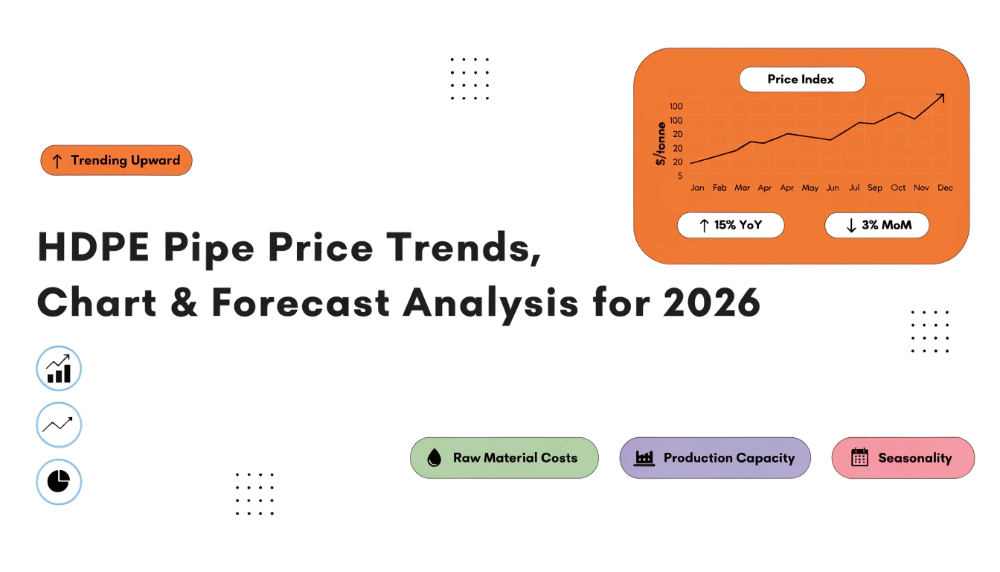
Global HDPE Pipe Prices Trend & Updates – Q2 2026
HDPE Pipe Price Analysis 2026 indicates a mixed but generally firm pricing environment during Q2, with stronger prices in the USA, Germany, the United Kingdom, and Brazil, while China moved lower. Across the five supplied markets, Q2 prices ranged from USD 920/MT to USD 1410/MT, showing a wide regional cost gap. The HDPE Pipe price trend was mainly influenced by infrastructure demand, water management projects, polyethylene feedstock costs, and regional supply conditions. IMARC Group’s Q2 2026 price-tracking database and methodology indicate that procurement activity from utilities, construction companies, irrigation projects, and industrial users remained an important pricing driver. The HDPE Pipe Price Forecast provides buyers with a forward-looking reference for sourcing and contract planning.
Regional HDPE Pipe Price Snapshot: Q2 2026
- USA: USD 1308/MT — upward
- China: USD 920/MT — downward
- Germany: USD 1070/MT — upward
- United Kingdom: USD 1410/MT — upward
- Brazil: USD 1103/MT — upward
The Q2 spread indicates significant regional cost differences. The United Kingdom recorded the highest price at USD 1,410/MT, while China was lowest at USD 920/MT. The gap reflects differences in polyethylene costs, operating expenses, infrastructure demand, freight, local supply, and procurement intensity. The USA and European markets showed firmer conditions, while China faced softer downstream demand and ample availability.
HDPE Pipe Price Analysis: USA, China, Germany, UK And Brazil
North America: USA HDPE Pipe Price and Demand Conditions
The USA benchmark reached USD 1308/MT in Q2. Prices moved upward as demand from water distribution, irrigation, gas pipelines, construction, and infrastructure projects improved. Firmer polyethylene feedstock costs and stronger downstream pipe conversion activity encouraged suppliers to maintain higher offers.
Asia-Pacific: China HDPE Pipe Price and Supply Conditions
China recorded USD 920/MT, with prices moving downward during Q2. Softer construction, municipal pipeline, and industrial water-management demand reduced purchasing urgency, while sufficient domestic supply and weaker feedstock support encouraged buyers to delay larger bookings.
Europe: Germany And UK HDPE Pipe Prices
Germany reached USD 1070/MT, supported by infrastructure rehabilitation, district water systems, and industrial pipeline projects. The UK recorded the highest supplied benchmark at USD 1410/MT, as utility upgrades, drainage networks, civil engineering activity, and pipeline replacement programs supported demand.
Latin America: Brazil HDPE Pipe Price and Demand
Brazil recorded USD 1103/MT in Q2. Demand from irrigation, mining, sanitation, and municipal water projects strengthened procurement, while polymer input costs and infrastructure-related order visibility supported firmer supplier quotations.
Supply And Demand Overview – Q2 2026
Supply conditions remained broadly balanced across the major markets, but regional demand differences produced divergent price movements. North America and Europe benefited from water infrastructure, utility replacement, drainage, and construction activity. Brazil also saw stronger demand from irrigation and sanitation projects.
China represented the main downward market because buyers adopted need-based purchasing amid softer project activity and sufficient local availability. Overall, there was no broad supply shortage, but differences in resin costs, operating expenses, inventories, and project pipelines influenced regional quotations.
HDPE Pipe Price Trend: Quarterly Index and Historical Analysis
The Q2 movement was not uniform across markets. The USA, Germany, United Kingdom, and Brazil recorded firmer pricing, whereas China experienced a decline. A separate Q2 market analysis based on the supplied benchmarks estimated overall prices were approximately 3%–5% higher than Q1 2026, indicating a gradual recovery despite regional differences.
The historical direction also shows a contrast with softer conditions toward late 2025, when excess supply and weaker demand placed pressure on prices. By Q2 2026, infrastructure procurement and firmer polyethylene economics provided greater support in several markets.
HDPE Pipe Price Chart: What Q2 2026 Shows
The HDPE Pipe Price Chart shows a substantial regional spread, from USD 920/MT in China to USD 1410/MT in the United Kingdom. This difference highlights how local resin costs, infrastructure demand, operating expenses, freight, and supply availability can affect the final procurement price.
For buyers, the quarterly benchmark should therefore be evaluated together with pipe grade, specification, delivery terms, freight, supplier location, and contract volume.
HDPE Pipe Price Forecast 2026: Next 12 Months
The next 12 months are likely to remain closely linked to infrastructure investment, water and wastewater projects, irrigation demand, polyethylene feedstock costs, and regional production conditions. Continued utility replacement and construction activity could support prices in markets with firm project pipelines.
At the same time, high production availability or weaker construction demand could limit price increases, particularly in markets where inventories remain comfortable. Procurement teams should monitor resin quotations, plant operating rates, freight costs, import activity, and infrastructure spending before committing to longer-term contracts.
Key Factors Affecting HDPE Pipe Prices: Quarterly Perspective
- Polyethylene feedstock costs: Changes in resin prices directly affect pipe manufacturing costs.
- Infrastructure spending: Water, gas, drainage, and utility projects can increase demand.
- Construction activity: Residential, commercial, and civil engineering projects influence pipe consumption.
- Irrigation demand: Agricultural water-management projects support HDPE pipe purchases.
- Energy costs: Electricity and fuel expenses affect manufacturing and conversion costs.
- Freight: Shipping and inland logistics influence delivered procurement prices.
- Plant operating rates: Maintenance and production changes can alter regional availability.
- Inventory levels: High inventories can pressure supplier quotations, while tighter stocks may support prices.
What Is HDPE Pipe and Where Is It Used?
HDPE pipe is a piping product manufactured from high-density polyethylene, a thermoplastic polymer produced from ethylene. It is valued for strength, flexibility, chemical resistance, abrasion resistance, corrosion resistance, and long service life.
Major applications include potable water distribution, natural gas networks, sewage and wastewater systems, irrigation, mining, industrial fluid handling, drainage, and cable protection. Heat-fusion joining also allows manufacturers and contractors to create durable, leak-resistant pipeline systems.
Recent HDPE Pipe Developments: Q2 2026 Highlights
Q2 2026 showed stronger procurement in North America, Europe, and Latin America, particularly for water infrastructure, utility replacement, irrigation, sanitation, and construction applications. China moved in the opposite direction as softer downstream demand and sufficient domestic supply reduced purchasing pressure.
The wider HDPE industry is also seeing capacity development. In January 2025, LyondellBasell announced that Indian Oil Corporation selected its Hostalen Advanced Cascade Process technology for a new HDPE plant in Paradip, India, with production intended to serve applications including infrastructure pipes.
FAQs About HDPE Pipe Prices 2026
What Is the HDPE Pipe Price Trend in Q2 2026?
The Q2 trend was mixed, with prices increasing in the USA, Germany, United Kingdom, and Brazil while China declined. The supplied benchmarks ranged from USD 920/MT to USD 1410/MT.
What Does the HDPE Pipe Price Chart Show?
The HDPE Pipe Price Chart shows a wide regional spread, with the United Kingdom at USD 1410/MT and China at USD 920/MT. Differences in resin costs, demand, logistics, operating expenses, and local supply explain much of the variation.
What Is the HDPE Pipe Price Forecast 2026?
The outlook will depend mainly on infrastructure demand, polyethylene costs, production availability, freight, and construction activity. Strong water, irrigation, and utility projects may support prices, while ample supply or weaker downstream demand could limit increases.
How IMARC Helps with HDPE Pipe Procurement Planning
IMARC Group tracks HDPE pipe prices across major markets and evaluates supply, demand, polyethylene feedstock costs, logistics, infrastructure activity, and regional market conditions. Its pricing analysis helps procurement teams compare benchmarks and understand differences between local and international quotations. Q2 2026 showed stronger pricing in several infrastructure-driven markets but weaker conditions in China. Going forward, monitoring resin costs, utility projects, production capacity, freight, and inventory levels will remain important for HDPE pipe sourcing and contract planning.
Explore pricing coverage across 500+ commodities: https://www.imarcgroup.com/pricing-market-reports
Contact Us:
IMARC Group
134 N 4th St., Brooklyn, NY 11249, USA
Email: sales[@]imarcgroup.com
Tel No:(D) +91 120 433 0800
United States: +1-201971-6302
- Managerial Effectiveness!
- Future and Predictions
- Motivatinal / Inspiring
- Fitness and Wellness
- Medical & Health
- Manufacturing
- Education
- Real-Estate
- Food Industry
- Hospitality
- Online Games
- Sports
- Home Services
- Civil Engineering
- Safety and Protection
- Software Products & Services
- Fashion and Jewellery
- Artificial Intelligence
- Entrepreneurship
- Mentoring & Guidance
- Marketing
- Networking
- HR & Recruiting
- Literature
- Shopping
- Career Management & Advancement