

 SkillClick
Imported vs. Domestic Equipment: A Cost and Performance Comparison
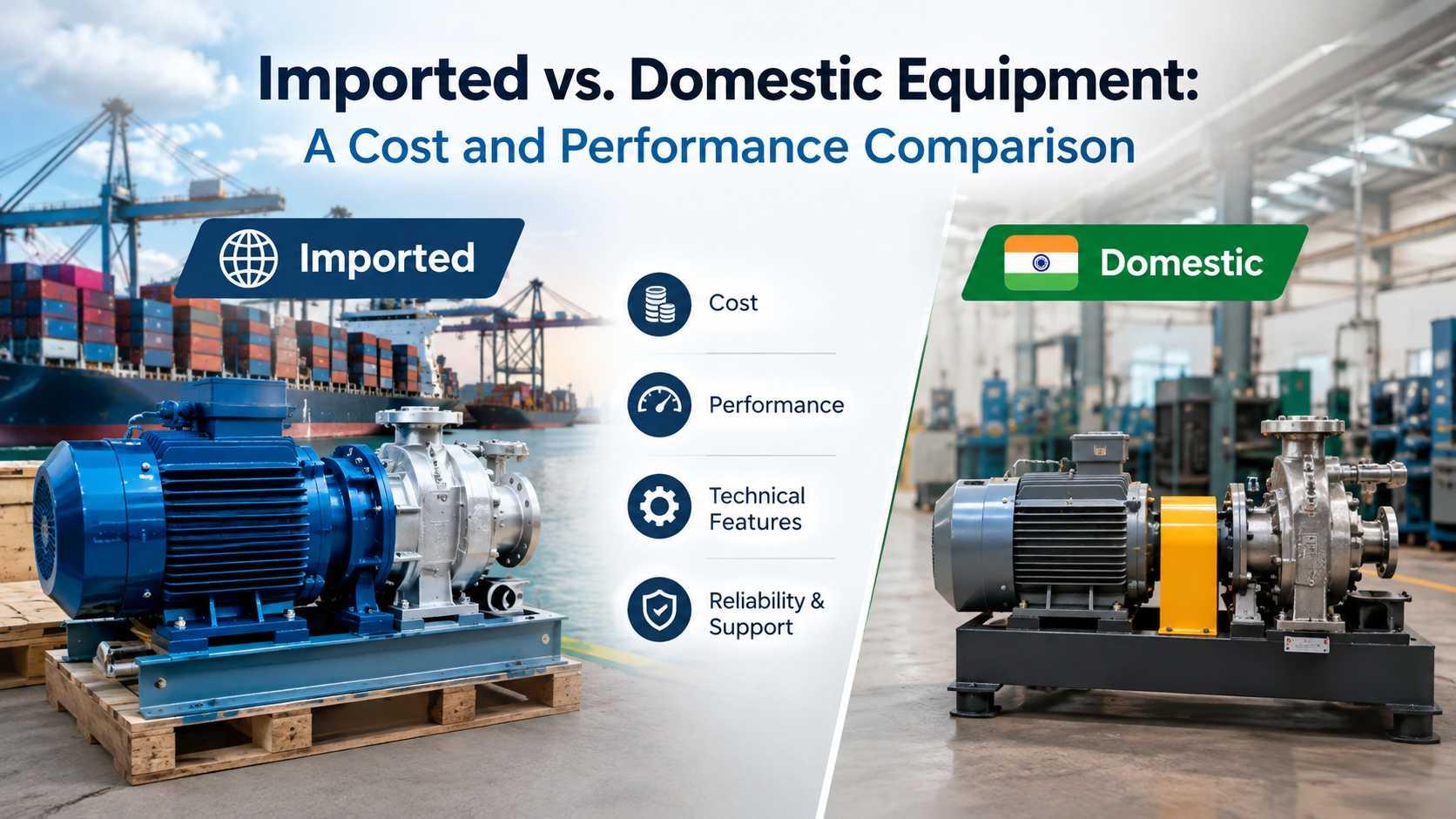
The quoted price on an imported machine and the number that actually lands on the factory floor are rarely the same figure. Duty, freight, currency movement, and commissioning delays routinely add 25 to 40% to the original quotation, and most of that gap only becomes visible after the purchase order is signed.
Getting this comparison right at the specification stage, before a machine is shortlisted, changes the outcome of the decision far more than most manufacturers expect. A structured Imported vs. Domestic Equipment evaluation looks at landed cost, currency exposure, lead time, and after-sales support together, rather than comparing two ex-works quotations in isolation.
The Real Landed Cost of an Imported Machine
Basic Customs Duty (BCD) on most industrial equipment in India runs between 7.5% and 10%, but that is only the first layer of cost.
- A 10% Social Welfare Surcharge (SWS) applies on top of the BCD amount itself
- IGST at 18% is then charged on the combined value of the machine, the BCD, and the SWS
- On a ₹5 lakh machine at 7.5% BCD, the total duty works out to roughly ₹1,38,675, taking the landed cost to about ₹6,38,675, an increase of nearly 28% over the base value
- Freight, insurance, and clearance charges typically add another 15 to 30% on top of the base price, depending on the equipment category and country of origin
- A concessional 5% BCD is available under the project import route for complete plant and machinery tied to a new industrial project, though this requires prior registration with customs
- The Export Promotion Capital Goods (EPCG) scheme allows zero BCD on capital goods, but only against an export obligation of six times the duty saved, met within six years
Domestic manufacturers do not carry any of this import overhead, which is the main reason equivalent Indian-built machines commonly price 25 to 40% lower than a comparable imported unit once landed cost is factored in.
Currency Risk Is Now a Bigger Variable Than It Used to Be
Equipment quoted in US dollars or euros carries exposure that domestic sourcing simply does not.
- The Indian rupee has moved from around ₹85.53 per US dollar in early 2025 to above ₹95 by May 2026, a depreciation of more than 10% in a little over a year
- On a typical six-month lead time between quotation and final payment, currency movement alone can shift the effective cost by 3 to 5% in either direction
- A machine invoiced in dollars months before delivery can end up costing significantly more in rupee terms by the time the final payment falls due, even if the dollar-denominated price never changes
- Domestic contracts, priced and settled in rupees, remove this variable entirely from the procurement decision
Lead Time: Where the Gap Is Widest
Cost is only half the comparison. The time between order placement and a machine actually running production tells its own story.
- Ocean freight from Europe or China alone typically takes 4 to 6 weeks
- Manufacturing lead time for a built-to-order imported line commonly runs 4 to 6 months before it even ships
- A full cycle from purchase order to commissioned production frequently stretches past 8 to 9 months once customs clearance and the OEM engineer's site visit are included
- Industry data on capital equipment sourcing more broadly points to 8 to 16 week lead times as standard for imported machinery, even before accounting for specification issues discovered after shipment
- Domestic manufacturers, without the freight, customs, and cross-border commissioning steps, routinely compress this timeline substantially, since fabrication and calibration both happen without leaving the country
The Cost That Shows Up After Commissioning: Spare Parts and Service
The comparison that matters most often happens a year into operation, not on the day of purchase.
- Local manufacturers can typically dispatch a spare part within 24 hours, compared to a cycle that can stretch to weeks for an imported component once international shipping and customs clearance are factored in
- Service calls for domestically built equipment are generally handled by a technician familiar with that specific machine, often reaching site the next day rather than after a multi-day international response cycle
- Every hour of unplanned downtime carries a direct cost, and the gap between a 24-hour fix and a two-week fix on a critical production line is frequently the difference between hitting a delivery commitment and missing one
- Imported equipment support usually runs through a regional distributor or a support desk in a different time zone, which adds diagnostic and escalation time even before a replacement part is sourced
Where Performance Still Favours Imported Equipment
The comparison is not one-directional, and imported equipment remains the right call in specific situations:
- Highly specialised or first-of-its-kind machinery where no domestic equivalent exists at the required precision or certification level
- Projects that specifically require a certified product line or a protocol and component standard the buyer has already standardised on globally
- Applications in sectors such as oil and gas, rail, or heavy process industries where established global engineering history and reference installations carry real weight
- Situations where an EPCG-linked export obligation makes the effective duty-adjusted cost of importing genuinely competitive
What This Means for Equipment Specification and Sourcing Decisions
- Calculate landed cost, not ex-works price, before comparing any imported quotation against a domestic one, since duty, SWS, IGST, and freight together can add 25% or more
- Build currency movement into the budget explicitly if the quotation is dollar or euro-denominated and the lead time exceeds a few months
- Confirm the realistic lead time in writing, including customs clearance and commissioning, rather than relying on the manufacturing time quoted by the OEM alone
- Map spare parts availability and typical response time before finalising the vendor, since this determines the real cost of ownership over the equipment's working life
- Check whether the project qualifies for the concessional 5% project import duty rate or the EPCG scheme before assuming the standard BCD applies
How IMARC Engineering's Expertise Can Help in Imported vs. Domestic Equipment Selection
- Builds the full landed cost model for imported equipment, covering BCD, SWS, IGST, freight, and commissioning, before a purchase decision is finalised
- Benchmarks domestic manufacturers against imported alternatives on technical specification, not price alone, to confirm genuine equivalence
- Advises on eligibility for concessional duty routes such as project imports and the EPCG scheme where applicable
- Assesses realistic lead time and spare parts support commitments as part of the vendor evaluation, not as an afterthought post-purchase
- Drafts technical specifications precise enough that domestic and imported vendors can be compared on a like-for-like basis
- Supports currency and contract structuring guidance for equipment quoted in foreign currency with extended lead times
Consult With Our Team: https://www.imarcengineering.com/contact?service=equipment-selection-and-technical-specs-drafting
Conclusion
Comparing imported and domestic equipment on ex-works price alone consistently understates the real cost of importing, once duty, currency movement, lead time, and after-sales support are factored in. Domestic equipment generally wins on total cost of ownership and response time, while imported machinery still holds its place where certification, precision, or export-linked incentives genuinely justify it. The right call depends on running both cost pictures side by side before specifying, not after.
Contact Us:
IMARC Engineering
Phone: +91-120-433-0800
Email: sales@imarcengineering.com
India: C-130, Sector 2, Noida, Uttar Pradesh 201301
LinkedIn: https://www.linkedin.com/showcase/imarc-engineering/
- Managerial Effectiveness!
- Future and Predictions
- Motivatinal / Inspiring
- Fitness and Wellness
- Medical & Health
- Manufacturing
- Education
- Real-Estate
- Food Industry
- Hospitality
- Online Games
- Sports
- Home Services
- Civil Engineering
- Safety and Protection
- Software Products & Services
- Fashion and Jewellery
- Artificial Intelligence
- Entrepreneurship
- Mentoring & Guidance
- Marketing
- Networking
- HR & Recruiting
- Literature
- Shopping
- Career Management & Advancement