

 SkillClick
4 Wire Smoke Detector and GSM Dialer – Combining Detection with Remote Notification
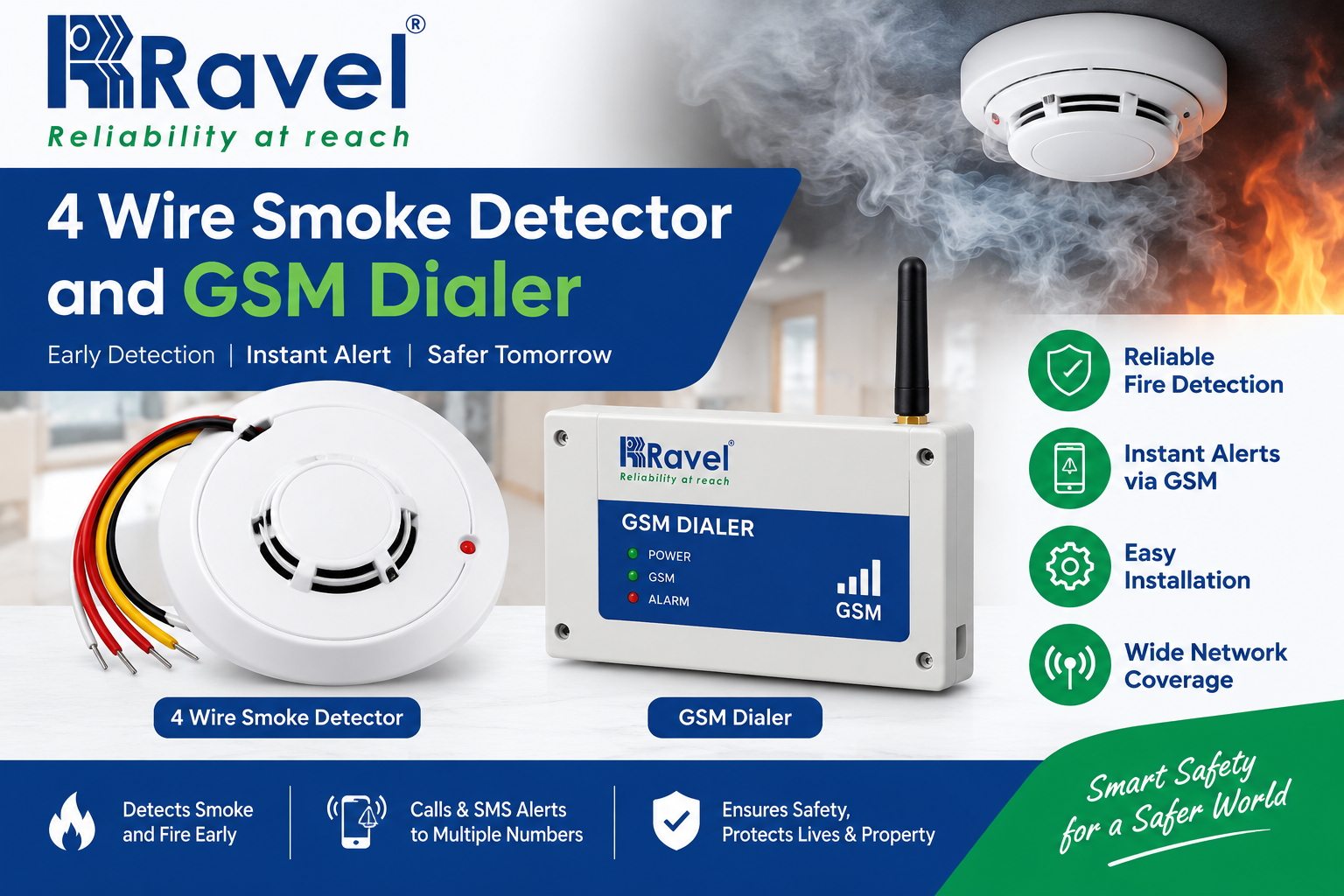
Fire safety systems are becoming increasingly connected, allowing alarm information to reach responsible personnel more quickly. A 4 wire smoke detector can provide reliable smoke detection within a properly designed fire alarm system, while a gsm dialer can provide an additional communication pathway for sending alarm information to designated contacts, depending on system design and local requirements.
Smoke detection is an essential part of many fire protection systems because smoke can be produced during the early stages of numerous fires. Detecting smoke promptly can provide occupants with valuable time to evacuate and allow responsible personnel to initiate emergency procedures.
The design of a smoke detection system depends on building layout, occupancy, environmental conditions, ceiling configuration, and fire risks. A 4 wire smoke detector uses four conductors in its typical connection arrangement, commonly separating power and alarm circuit functions according to the specific detector and control system.
The exact wiring arrangement varies by manufacturer and product model, so installers should always follow the relevant technical documentation. Correct wiring is essential for reliable detector operation and proper supervision of the circuit.
A gsm dialer can add another communication capability to an alarm system. Depending on the device and configuration, it may communicate alarm events through a cellular network to predefined contacts or a monitoring service.
Remote notification can be particularly useful for facilities that are not continuously occupied. If an alarm occurs after business hours, designated personnel may need to know about the event even when they are away from the building.
However, cellular communication should be considered part of a larger emergency communication strategy. Network availability, signal strength, power backup, configuration, and monitoring arrangements all need to be evaluated.
A 4 wire smoke detector should be positioned according to fire detection principles and the manufacturer's instructions. Detector placement should account for airflow, ceiling height, obstructions, room use, and potential sources of unwanted alarms.
Dust, steam, aerosols, and other environmental conditions can affect smoke detector performance. Areas with such conditions may require alternative detection technologies or carefully selected detector types.
Regular testing is essential. Testing can confirm whether the detector responds appropriately, the control panel receives the signal, alarm notification works, and connected communication equipment sends the expected information.
A gsm dialer also requires testing because communication systems can fail for reasons unrelated to the fire detector itself. SIM configuration, network coverage, antenna position, power supply, and contact settings should be checked as part of maintenance.
Power backup is especially important for emergency communication. If a building loses mains electricity during an incident, critical components may need to continue operating from backup power.
Another consideration is message accuracy. Remote alerts should clearly identify the relevant site and alarm condition so that recipients can understand what action may be required.
Businesses should define who receives notifications and what happens after an alert. Simply receiving an alarm message is not enough; there should be a documented response procedure.
For larger facilities, multiple notification levels may be appropriate. The system could alert onsite security, facility managers, maintenance personnel, or an external monitoring service depending on the arrangement.
Cybersecurity and communication security should also be considered for connected alarm equipment. Access credentials, configuration controls, and system maintenance should be handled appropriately.
When purchasing a 4 wire smoke detector, users should review detector specifications, operating voltage, alarm characteristics, environmental limits, compatibility, and installation requirements.
Similarly, when selecting a gsm dialer, consider communication technology, supported networks, notification options, power requirements, event handling, and compatibility with the alarm panel.
The combination of local detection and remote communication can improve awareness. A detector can identify a possible fire, while a dialer can help communicate the event beyond the physical location.
Nevertheless, remote notification should never replace local audible and visual alarms or established evacuation procedures. Occupants inside the building need immediate warnings that do not depend on a remote communication channel.
FAQ
Q1. What is a 4 wire smoke detector?
It is a smoke detector that typically uses four conductors for its connection arrangement, depending on the specific product and system.
Q2. What does a GSM dialer do?
It can transmit alarm information through a cellular network to configured contacts or monitoring systems, depending on the device.
Q3. Is a GSM dialer a replacement for a fire alarm?
No. It can provide additional notification but does not replace the detection and local alarm functions.
Q4. Does a 4 wire detector require maintenance?
Yes. Inspection, cleaning, functional testing, and replacement when necessary are important.
Q5. Can a GSM dialer work during a power failure?
This depends on the system's backup power arrangement and the specific device.
CTA
Effective fire protection combines detection, local notification, communication, and emergency response. If your project requires a 4 wire smoke detector and remote communication, select compatible equipment and have it professionally installed and tested. A suitable gsm dialer can add valuable remote awareness when correctly integrated into the overall safety system.
- Managerial Effectiveness!
- Future and Predictions
- Motivatinal / Inspiring
- Fitness and Wellness
- Medical & Health
- Manufacturing
- Education
- Real-Estate
- Food Industry
- Hospitality
- Online Games
- Sports
- Home Services
- Civil Engineering
- Safety and Protection
- Software Products & Services
- Fashion and Jewellery
- Artificial Intelligence
- Entrepreneurship
- Mentoring & Guidance
- Marketing
- Networking
- HR & Recruiting
- Literature
- Shopping
- Career Management & Advancement