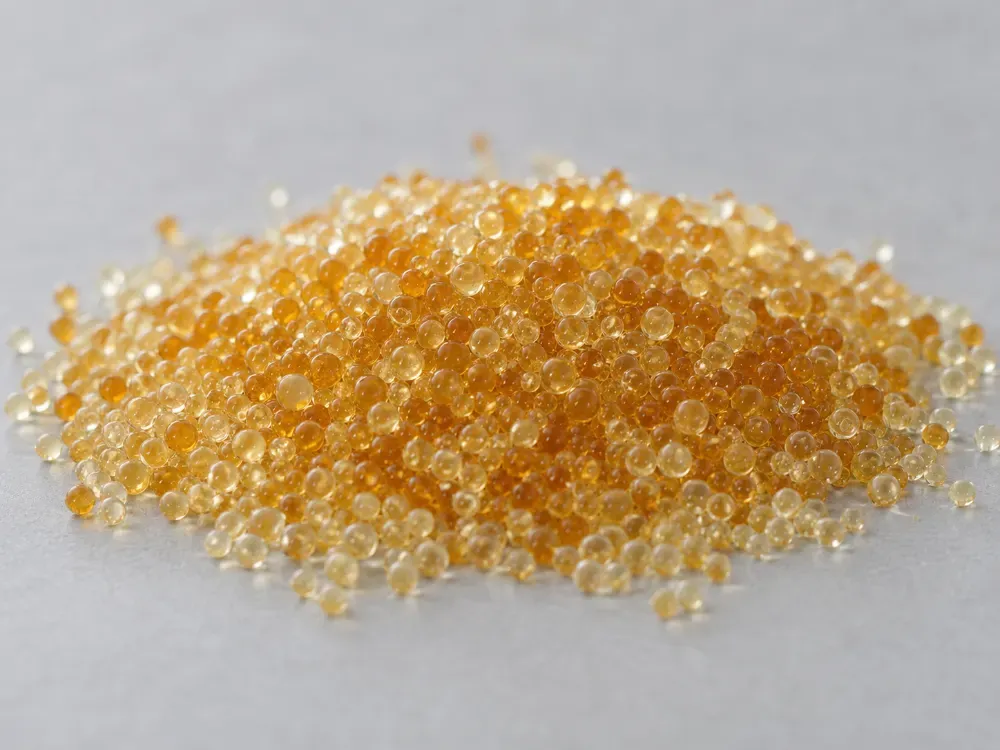
Mixed bed resin is an ion exchange material designed to remove dissolved ionic contaminants from water and produce highly demineralized or high-purity water. It combines cation and anion exchange resins in the same vessel, allowing both positively and negatively charged ions to be removed during treatment.
Mixed bed resin is commonly used as a final polishing stage after reverse osmosis (RO) or conventional deionization, particularly when very low conductivity and high water purity are required.
What Is Mixed Bed Resin?
Mixed bed resin is a carefully prepared mixture of two ion exchange resins:
- Strong acid cation resin
- Strong base anion resin
The cation resin exchanges unwanted positively charged ions, such as calcium, magnesium, sodium, and other cations, for hydrogen ions.
The anion resin exchanges negatively charged ions, such as chloride, sulfate, nitrate, and other anions, for hydroxide ions.
Together, these two resins provide comprehensive removal of dissolved ionic contaminants.
How Does Mixed Bed Resin Work?
The operation of mixed bed resin is based on ion exchange.
When untreated water enters the resin vessel, dissolved cations interact with the cation resin, while dissolved anions interact with the anion resin.
The cation resin releases hydrogen ions (H⁺), and the anion resin releases hydroxide ions (OH⁻). These ions combine to form water:
H⁺ + OH⁻ → H₂O
Because the two resin types are mixed throughout the vessel, water repeatedly encounters cation and anion exchange sites. This helps reduce remaining ionic impurities and achieve very low conductivity.
Where Is Mixed Bed Resin Used?
Mixed bed resin is particularly useful in applications where high water purity is essential.
1. Ultrapure Water Treatment
Mixed bed resin can be used after RO and primary deionization to remove residual ions and improve the quality of the final water.
2. Semiconductor Manufacturing
Semiconductor production requires highly purified water for wafer cleaning, rinsing, and other sensitive processes. Mixed bed resin can help reduce trace ionic contamination in ultrapure water systems.
3. Pharmaceutical Manufacturing
Pharmaceutical facilities may require purified water for manufacturing, cleaning, and laboratory operations. Mixed bed resin can provide additional ionic purification when required.
4. Laboratory Water Purification
Laboratories use purified water for analytical testing, research, equipment cleaning, and other applications. Mixed bed resin can help achieve the low conductivity needed for specific laboratory processes.
5. Power Generation
High-purity water is important in many power-generation systems. Mixed bed polishing can help reduce dissolved ions that may contribute to deposits and corrosion.
Benefits of Mixed Bed Resin
There are several advantages to using mixed bed resin:
- Produces highly demineralized water
- Removes both cations and anions
- Provides effective final water polishing
- Can achieve very low conductivity
- Reduces ionic leakage
- Works effectively after RO systems
- Suitable for demanding industrial applications
- Can be used in compact polishing systems
Actual performance depends on the resin characteristics, feed-water chemistry, flow rate, temperature, and treatment-system design.
Mixed Bed Resin vs. Dual Bed Resin
Mixed bed and dual bed systems both use cation and anion exchange resins, but the resins are arranged differently.
In a dual bed system, the cation and anion resins are installed in separate vessels. In a mixed bed system, both resins are blended together in one vessel.
Dual bed systems are commonly used for primary demineralization, while mixed bed resin is often used as a final polishing stage when very high water purity is required.
The regeneration process is also different. Separate cation and anion beds are easier to regenerate, whereas mixed bed resin must first be separated into its individual resin components.
Does Mixed Bed Resin Need Regeneration?
Yes. Mixed bed resin eventually becomes exhausted when its available ion exchange capacity has been consumed.
During regeneration, the cation and anion resins must be separated. The cation resin is generally regenerated with an acid, while the anion resin is regenerated with an alkaline solution.
After regeneration and rinsing, the resins can be mixed again.
Because regeneration requires specialized equipment, many facilities choose to replace exhausted mixed bed resin or use professionally regenerated resin.
How to Choose the Right Mixed Bed Resin
Selecting the correct mixed bed resin requires consideration of the specific water treatment conditions.
Important factors include:
- Feed-water chemistry
- Required water purity
- Flow rate
- Daily water consumption
- Conductivity or resistivity target
- Silica concentration
- Operating temperature
- Resin capacity
- Vessel size
- Regeneration requirements
A feed-water analysis is particularly important because different contaminants can affect resin capacity, service life, and treatment performance.
Mixed Bed Resin in a High-Purity Water System
A typical high-purity water treatment process may include:
Pretreatment → Reverse Osmosis → Deionization → Mixed Bed Polishing → Final Water
Each stage performs a different function. Pretreatment protects downstream equipment, RO removes a significant portion of dissolved contaminants, and deionization further reduces ionic content.
The mixed bed unit can then provide final polishing to reach the required water-quality target.
How to Maintain Mixed Bed Resin
Proper monitoring can help maintain consistent performance and identify resin exhaustion.
Important parameters include:
- Product-water conductivity
- Feed-water quality
- Flow rate
- Pressure drop
- Service time
- Resin exhaustion
- Final water quality
If product-water conductivity begins to increase, the resin may be approaching exhaustion and should be evaluated for regeneration or replacement.
Why Resin Quality Matters
The quality of mixed bed resin can directly influence water purity, service life, pressure drop, and system efficiency.
When selecting a product, consider characteristics such as exchange capacity, bead uniformity, chemical stability, particle size, and physical strength. The resin should also be matched to the actual feed-water conditions and treatment requirements.
Conclusion
Mixed bed resin is an effective ion exchange solution for applications requiring highly demineralized and high-purity water. By combining cation and anion resins in one vessel, it can remove residual dissolved ions and provide effective final water polishing.
It is widely applicable to ultrapure water production, semiconductor manufacturing, pharmaceutical processing, laboratory water treatment, power generation, and industrial applications.
For optimal results, select mixed bed resin based on feed-water chemistry, required water purity, flow rate, operating conditions, and overall system design.


 SkillClick