

 SkillClick
Calibration Vendor Qualification Checklist: Key Criteria for Manufacturing Plants
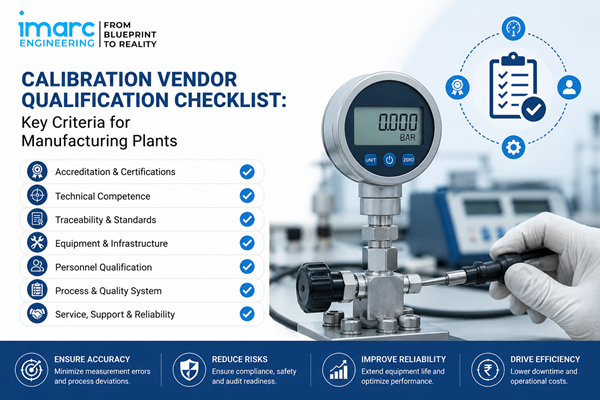
If you're reading this, you're probably not looking for a definition of calibration. You already know what it is , you're trying to figure out how to pick a vendor who won't leave you exposed during an audit, won't hand you a certificate that means nothing, and won't disappear when an instrument comes back out of tolerance three days before a customer inspection.
That's a fair thing to worry about. Most calibration vendor "checklists" online are really just a list of buzzwords: NABL, ISO 17025, traceability, with no explanation of what to actually do with them. This guide takes a different approach. It is built around the real decision points involved in Calibration Vendor Qualification, helping plant managers, quality heads, and maintenance leads assess and select a calibration service provider based on technical competence, compliance, traceability, documentation, and actual plant requirements.
The Mistake Most Plants Make: Stopping at Are They Accredited?
Here's something worth knowing before you go further: accreditation is not a yes/no question.
A lab can genuinely hold NABL accreditation and still be the wrong choice for your instrument. That's because NABL , like every accreditation body , doesn't accredit a company across the board. It accredits specific capabilities, for specific parameters, within specific ranges, using specific methods. This is called the lab's scope of accreditation.
So instead of asking a vendor "are you NABL accredited?", ask this instead:
"Is the exact calibration I need , this instrument, this range, this accuracy , inside your current accredited scope?"
That single question filters out a surprising number of vendors who are accredited in general but not for what you actually need calibrated. Always ask to see the scope document, not just the accreditation certificate.
What Traceability Should Actually Mean to You
Every vendor will tell you their calibration is traceable. Almost none of them will explain what that means in practice.
Traceability is a documented, unbroken chain connecting your instrument's calibration result back to a national or international measurement standard, with every link in that chain contributing some amount of uncertainty. It's not a claim , it's a paper trail.
Before signing off on a vendor, ask them to show you:
-
What reference standards they used for your calibration
-
Who calibrated those reference standards, and when
-
Whether that chain ultimately connects to a recognized national metrology institute
-
The measurement uncertainty introduced at each stage
One point that rarely gets said out loud: traceability alone doesn't guarantee the result is good enough for your purpose. A traceable measurement with too much uncertainty can still be useless for a tight-tolerance application. Traceability tells you the number is honest. Uncertainty tells you whether the number is precise enough to trust for your decision.
The Real Qualification Checklist
Break this into sections rather than treating it as one long list , it mirrors how a proper vendor audit actually unfolds.
1. Company and Accreditation Basics
-
Legal entity, years in operation, relevant industry experience
-
Current NABL/ISO 17025 accreditation certificate
-
Accreditation scope document reviewed against your specific instruments
-
Discipline confirmed (mechanical, thermal, electro-technical, fluid flow, etc.)
2. Technical Capability
-
Vendor can name the calibration method/standard used for each instrument type
-
Reference standards are appropriate for your required accuracy
-
Stated measurement uncertainty (CMC) meets your application's needs
-
On-site calibration capability confirmed, if required, with environmental controls explained
3. People Behind the Work
-
Technicians hold documented, instrument-specific competency , not just a general certificate
-
Evidence of ongoing training and periodic requalification
-
Named personnel are authorized to sign off calibration results
4. Certificates You Can Actually Use
A calibration certificate should let you answer "what was tested, how, and what does it mean" without a phone call. Confirm it includes:
-
Clear equipment identification (make, model, serial number)
-
Calibration date, location, and method reference
-
Measurement results with units and acceptance criteria
-
Stated uncertainty, where relevant
-
Traceability statement
-
Next due date and authorized signatory
5. What Happens When Something Fails
Ask directly: "What's your process when an instrument comes back out of tolerance?" A vendor with a real quality system will describe a defined sequence , flagging the result, evaluating potential impact, notifying you promptly, and documenting corrective action. If the answer is a shrug and "we just recalibrate it," that's a warning sign, especially for regulated manufacturing where an out-of-tolerance critical instrument can trigger a full impact investigation.
6. Service Reality
Technical competence means little if the vendor can't keep up with your plant's schedule. Check:
-
Standard and emergency turnaround times
-
Capacity to handle shutdown-period bulk calibration
-
Pickup/delivery logistics and associated costs
-
Ability to support multiple sites consistently, if applicable
A Simple Way to Score Vendors Instead of Guessing
Rather than comparing vendors on gut feel, weight the criteria that actually carry risk. A workable starting framework:
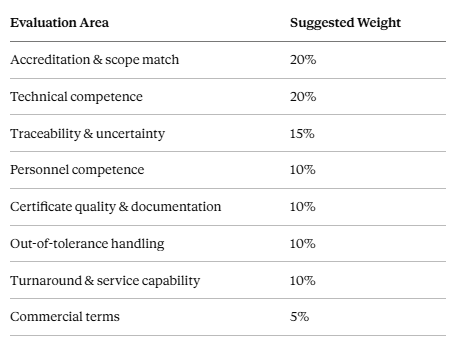
Notice that price sits at the bottom. That's intentional , a cheap calibration that produces a rejected certificate or an unusable result costs far more once you account for rework, audit findings, or a missed shipment.
Warning Signs Worth Walking Away From
-
"We're NABL accredited" with no scope document offered on request
-
No mention of measurement uncertainty anywhere in the conversation or certificate
-
Certificates with vague equipment identification or missing traceability statements
-
No defined process for handling failed or out-of-tolerance results
-
Pricing significantly below market with no explanation of what's different about their process
Qualification Doesn't End at Approval
A vendor that passes qualification today isn't guaranteed to perform the same way in eighteen months. Build in periodic re-evaluation using a few simple, trackable indicators:
-
On-time calibration completion rate
-
Certificate rejection or correction rate
-
Response time to out-of-tolerance events
-
Nonconformities found during any follow-up audits
Treat approval as the start of a relationship you monitor, not a one-time checkbox.
How IMARC Engineering Can Help
Qualifying a calibration vendor properly takes time most plant and quality teams don't have , verifying accreditation scope against dozens of instrument types, chasing down traceability documentation, reviewing sample certificates line by line, and setting up a monitoring system that actually gets used after the first audit.
IMARC Engineering works alongside manufacturing plants across India to take this off your plate. Our team helps identify and shortlist calibration vendors suited to your specific instrument base, verify NABL/ISO 17025 accreditation scope against your actual requirements, review certificates and traceability chains for gaps before they become audit findings, and set up practical vendor performance monitoring so requalification isn't an annual scramble. Whether you're commissioning a new plant, expanding an existing line, or simply cleaning up a calibration program that's grown unmanageable, we can coordinate the process end to end so your team stays focused on production, not paperwork.
Speak With An Expert: https://www.imarcengineering.com/contact?service=equipment-calibration-and-vendor-coordination
Conclusion
Choosing a calibration vendor is a quality decision with operational consequences, not a routine procurement task. The vendors worth working with are the ones who can show you , not just tell you , that their accreditation scope matches your instruments, their traceability chain is documented end to end, their uncertainty figures are appropriate for your application, and their process for handling failures is defined rather than improvised. Build your qualification process around those points, score vendors honestly against them, and keep checking in after approval. That's what actually protects your plant during an audit , not a logo on a website.
Contact Us:
IMARC Engineering
Phone: +91-120-433-0800
Email: sales@imarcengineering.com
India: C-130, Sector 2, Noida, Uttar Pradesh 201301
LinkedIn: https://www.linkedin.com/showcase/imarc-engineering/
- Managerial Effectiveness!
- Future and Predictions
- Motivatinal / Inspiring
- Fitness and Wellness
- Medical & Health
- Manufacturing
- Εκπαίδευση
- Real-Estate
- Food Industry
- Hospitality
- Online Games
- Sports
- Home Services
- Civil Engineering
- Safety and Protection
- Software Products & Services
- Fashion and Jewellery
- Artificial Intelligence
- Entrepreneurship
- Mentoring & Guidance
- Marketing
- Networking
- HR & Recruiting
- Literature
- Shopping
- Career Management & Advancement