

 SkillClick
Laundry Chemical Price & Cost Per KG: How Much Should a Commercial Laundry Budget?
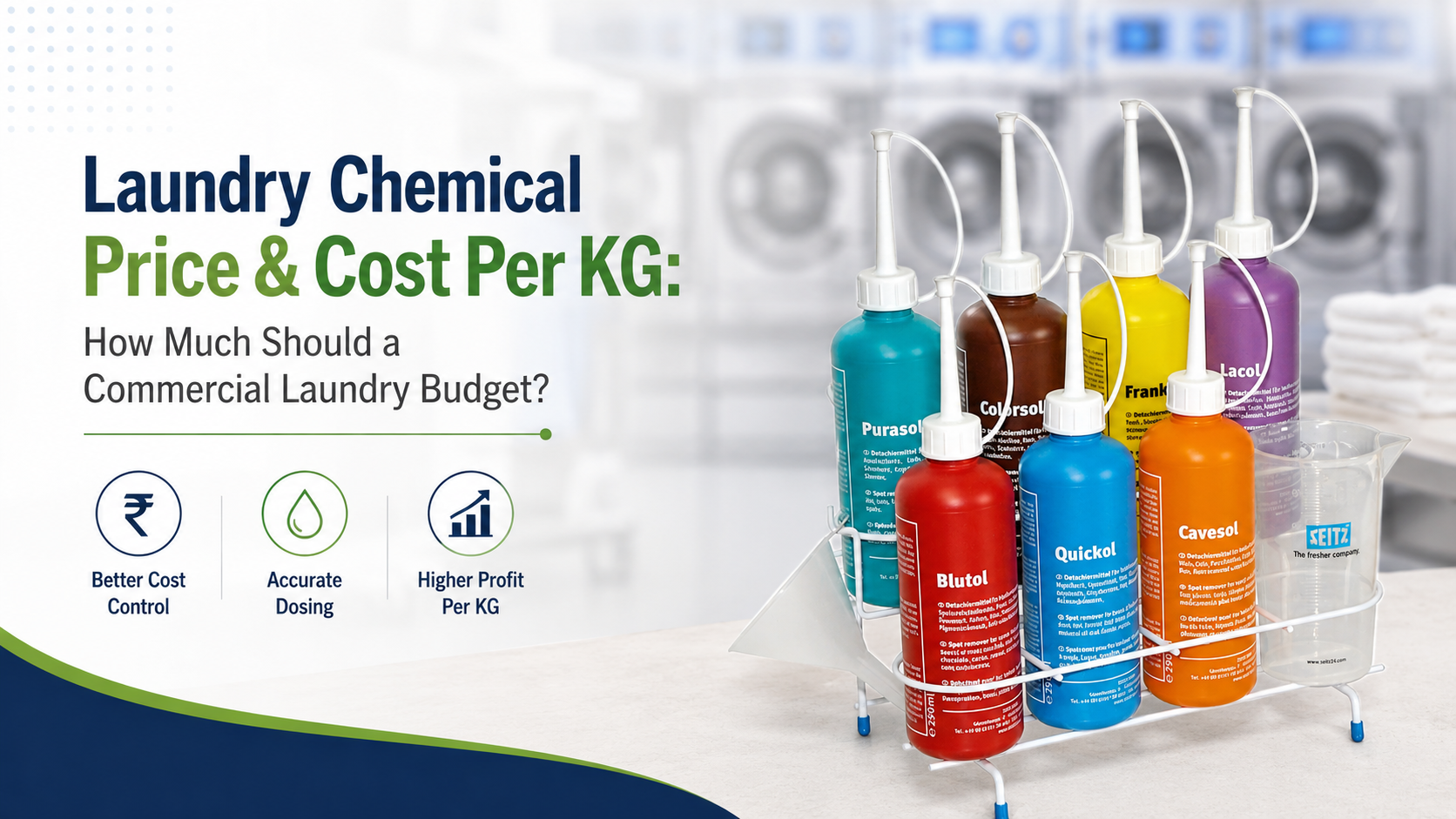
Chemicals are a recurring operating expense in every professional laundry. While equipment is usually a major upfront investment, detergents and process chemicals are consumed every day. For a growing laundry, even a small difference in chemical usage per load can become significant over thousands of kilograms.
That is why comparing only the laundry chemical price is not enough. Laundry owners should understand chemical consumption, cost per kilogram of processed linen, dosing accuracy, water conditions, and rewash levels.
A better question is not simply, “How much does the chemical cost?” But “How much is my complete wash chemistry costing for every kg I process?”
How Much Do Laundry Chemicals Cost for a Commercial Laundry?
There is no standard chemical expense that applies to every commercial laundry.
The actual laundry chemical cost depends on the products being used, dosage, linen type, soil level, water quality, wash program, daily processing volume, and supplier pricing.
Two laundries processing the same kilograms per day can therefore have very different monthly chemical expenses.
Instead of comparing only container prices, evaluate the cost per usable dose and cost per KG processed.
What Determines Laundry Chemical Price?
The commercial laundry chemical price can vary according to chemical type, concentration, packaging size, formulation, application, and supplier.
Concentrated products may have a higher purchase price per container but require a lower dosage. A cheaper product may require a higher quantity per load.
Therefore:
Lowest Purchase Price ≠ Lowest Processing Cost
Compare chemicals according to the complete wash process and actual consumption rather than purchase price alone.
Which Chemicals Should a Commercial Laundry Budget For?
The chemical programme depends on what the laundry processes. A professional setup may require products such as:
-
Detergent
-
Alkali or builder
-
Bleaching agents
-
Neutraliser or sour
-
Fabric softener
-
Stain-treatment products
-
Specialist chemicals where required
A hotel linen facility, garment laundry, hospital laundry, and commercial linen plant may require different wash programmes. Your laundry chemical budget should therefore reflect your actual customer mix.
How Much Do Laundry Chemicals Cost Per KG of Laundry?
The most useful way to monitor spending is laundry chemical cost per KG.
Instead of asking how much a drum of detergent costs, calculate how much chemical expense is being generated by every kilogram processed.
This creates a consistent performance metric that can be compared across weeks and months.
However, there is no universal cost-per-KG figure that every laundry should target.
How to Calculate Laundry Chemical Cost Per KG
Use this simple formula:
Laundry Chemical Cost Per KG = Total Chemical Cost ÷ Total KG of Laundry Processed
For example, suppose a laundry spends ₹30,000 on its wash chemicals during a period in which it processes 15,000 KG:
₹30,000 ÷ 15,000 KG = ₹2 per KG
This ₹2 figure is only an illustrative example, not an industry benchmark.
The same calculation using your actual purchase and production records gives you a useful measure of laundry chemical consumption and cost.
How Much Laundry Chemical Is Required Per KG of Linen?
There is no responsible single dosage that can be applied to every kilogram of laundry.
Chemical dosing per KG can change based on soil level, textile type, chemical concentration, water conditions, wash temperature, machine loading, and programme design.
The correct dosage should follow the chemical manufacturer's recommendations and the requirements of the specific wash process.
Using more chemical does not automatically produce cleaner linen.
Why Is There No Single Chemical Cost Per KG for Every Laundry?
Consider two businesses.
Laundry A mainly processes lightly soiled hotel room linen. Laundry B handles heavily soiled textiles requiring different wash programmes.
Even if both process 300 KG daily, their chemical requirements may not be identical.
This is why comparing commercial laundry cost per KG requires operational context rather than relying on one general industry figure.
How Does Daily Laundry Volume Affect Your Chemical Budget?
As processing volume increases, chemical consumption usually increases with it.
But the relationship should be monitored.
If your processed KG increases moderately while chemical consumption rises disproportionately, investigate possible causes such as dosing, rewash, machine loading, programme selection, or changes in the linen mix.
Growing businesses should monitor chemical expenditure alongside production volume.
How to Estimate Monthly Laundry Chemical Cost
A simple budgeting model is:
Monthly Laundry KG = Daily KG × Operating Days
Then:
Estimated Monthly Chemical Budget = Monthly Laundry KG × Estimated Chemical Cost Per KG
For a new business, the cost-per-KG assumption should be developed using the proposed chemical programme, supplier recommendations, water conditions, textile mix, and expected wash requirements.
Once operations begin, replace estimates with actual data.
Chemical Budget for a 100 KG, 300 KG and 500 KG/Day Laundry
Daily capacity can help you understand how quickly chemical expenditure scales.
|
Daily Volume |
At 26 Operating Days |
Monthly Processing |
|
100 KG/day |
100 × 26 |
2,600 KG |
|
300 KG/day |
300 × 26 |
7,800 KG |
|
500 KG/day |
500 × 26 |
13,000 KG |
Now multiply your actual or estimated chemical cost per KG by the monthly volume.
For example:
13,000 KG × Actual Chemical Cost/KG = Estimated Monthly Chemical Budget
This approach is more useful than assigning an arbitrary chemical budget to a 100, 300, or 500 KG laundry.
How Does Linen Type Affect Laundry Chemical Consumption?
Different textiles bring different cleaning requirements.
Bedsheets, towels, restaurant linen, uniforms, guest garments, and heavily soiled workwear may require different programmes.
A laundry processing mainly hotel room linen should therefore not automatically copy the chemical programme of an operation processing restaurant linen or industrial garments.
Segmentation can improve both wash consistency and laundry chemical management.
How Does Water Quality Affect Chemical Usage and Cost?
Water conditions can affect wash performance and chemical requirements.
Hardness and other water characteristics should be considered when developing wash programmes. Ignoring them can result in inconsistent results even when the same detergent quantity is used.
For a new commercial laundry, understanding incoming water conditions should be part of process planning.
Does Manual Dosing Increase Laundry Chemical Cost?
Manual dosing does not automatically mean excessive cost, but it can introduce greater dependence on operator consistency.
Different operators may measure differently, especially during busy shifts.
Over time, inconsistent laundry chemical dosing can make consumption harder to control and analyse.
Manual vs Automatic Chemical Dosing: Which Is More Cost-Efficient?
Manual dosing can be practical for certain smaller operations when measurements and procedures are properly controlled.
An automatic chemical dosing system can become valuable where higher processing volumes require repeatable programmes and controlled chemical delivery.
The decision should consider workload, number of programmes, operator involvement, chemical consumption, and the economics of installing the system.
How Does Chemical Overdosing Affect Laundry Cost Per KG?
Overdosing directly increases chemical consumption.
It can also affect the overall wash process when the programme is not correctly balanced.
For a commercial laundry processing thousands of kilograms each month, repeated excess dosing across multiple loads can create substantial laundry chemical wastage.
The goal should be correct dosing—not maximum dosing.
Can Underdosing Also Increase Your Laundry Operating Cost?
Reducing dosage simply to lower chemical spending can be counterproductive.
If insufficient chemistry contributes to unacceptable wash results and linen needs to be processed again, the business consumes additional water, energy, labour, machine time, and chemicals.
Chemical savings should therefore never be evaluated separately from wash quality.
How Rewash Can Increase Your Actual Chemical Cost
Rewash is one of the hidden factors affecting laundry business operating cost.
Every unnecessary repeat cycle may require additional machine time, water, energy, chemicals, and labour.
Track:
Rewash Rate = Rewashed KG ÷ Total Processed KG × 100
If chemical cost looks acceptable but rewash is increasing, the overall process may still be becoming more expensive.
How to Track Chemical Cost Per KG Every Month
Record three numbers consistently:
Total KG Processed + Total Chemical Consumption + Total Chemical Spend
Then monitor cost per KG alongside rewash levels and changes in customer or linen mix.
A sudden increase gives management a reason to investigate instead of discovering the problem only through higher monthly bills.
How Can Commercial Laundries Control Chemical Costs Without Compromising Wash Quality?
Cost control should come from process control rather than simply reducing chemical quantity.
Focus on correct machine loading, suitable wash programmes, accurate dosing, water conditions, chemical concentration, linen segregation, staff procedures, and rewash monitoring.
The objective is to achieve the required wash result with a controlled and repeatable process.
What Should You Check Before Choosing Commercial Laundry Chemicals?
Before selecting commercial laundry chemicals, evaluate the textiles being processed, soil levels, machine type, water conditions, programme requirements, product concentration, recommended dosage, supplier support, storage requirements, and overall cost per processed KG.
For businesses comparing laundry chemicals price in India, purchase price should be only one part of the decision.
How OrgaEarth Can Help You Plan Laundry Chemicals and Dosing
OrgaEarth helps commercial laundry operations evaluate professional laundry chemicals and dosing requirements according to their processing needs.
Rather than looking at chemical price in isolation, the objective is to develop a more controlled wash process based on textile type, machine configuration, water conditions, programmes, and operating volume.
For growing laundries, hotels, institutions, and professional laundry businesses, this approach can make chemical consumption easier to monitor while supporting consistent wash results.
Contact Us
Orgaearth Laundry Solutions
Plot no. 774, Udyog Vihar, Phase 5, Gurugram, Haryana, India-122016
Email: marketing@orgaearth.com
Contact No.: +91 7042912777
FAQs
What is the average laundry chemical cost per KG?
There is no universal average suitable for every laundry. Cost varies according to chemical programme, textile type, soil level, concentration, dosage, water conditions, and supplier pricing.
How much chemical is required for 1 KG of laundry?
The required amount depends on the specific chemical, its concentration, wash programme, textile type, soil level, water quality, and manufacturer recommendations. Avoid using one fixed dosage for every application.
How much should a commercial laundry budget for chemicals?
Estimate monthly processed KG first and multiply it by a realistic chemical cost per KG based on your proposed wash programme. Once the laundry is operational, use actual consumption data to improve budgeting accuracy.
Does a lower laundry detergent price reduce cost per KG?
Not necessarily. A lower-priced product may require a different dosage or concentration. Compare actual cost per processed KG and wash performance rather than container price alone.
Can automatic dosing reduce laundry chemical wastage?
Automatic dosing can improve consistency by delivering programmed quantities and reducing dependence on manual measurement. Whether it provides a financial benefit depends on the laundry's volume, existing dosing accuracy, chemical programme, and system cost.
- Managerial Effectiveness!
- Future and Predictions
- Motivatinal / Inspiring
- Fitness and Wellness
- Medical & Health
- Manufacturing
- Education
- Real-Estate
- Food Industry
- Hospitality
- Online Games
- Sports
- Home Services
- Civil Engineering
- Safety and Protection
- Software Products & Services
- Fashion and Jewellery
- Artificial Intelligence
- Entrepreneurship
- Mentoring & Guidance
- Marketing
- Networking
- HR & Recruiting
- Literature
- Shopping
- Career Management & Advancement