

 SkillClick
AI Governance Market Size, Share and Forecast 2026-2034
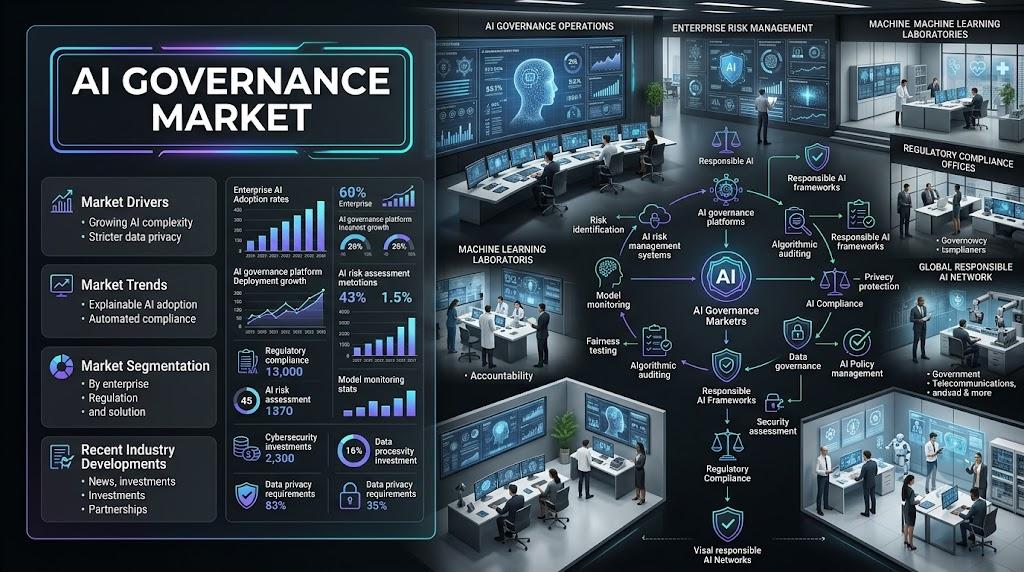
Market Overview:
According to IMARC Group's latest research publication, "AI Governance Market: Global Industry Trends, Share, Size, Growth, Opportunity and Forecast 2026-2034", The global AI governance market size was valued at USD 353.1 Million in 2025. Looking forward, IMARC Group estimates the market to reach USD 5,748.6 Million by 2034, exhibiting a CAGR of 35.25% from 2026-2034.
This detailed analysis primarily encompasses industry size, business trends, market share, key growth factors, and regional forecasts. The report offers a comprehensive overview and integrates research findings, market assessments, and data from different sources. It also includes pivotal market dynamics like drivers and challenges, while also highlighting growth opportunities, financial insights, technological improvements, emerging trends, and innovations. Besides this, the report provides regional market evaluation, along with a competitive landscape analysis.
How Regulation and Agentic AI Are Reshaping the AI Governance Market
- Organizations are moving away from manual, spreadsheet-based oversight toward dedicated governance platforms as the number of AI models, tools, and vendors in use across a typical enterprise multiplies faster than compliance teams can track manually.
- The emergence of autonomous AI agents that can take real actions inside business systems, rather than simply answering prompts, is creating an entirely new governance discipline focused on agent identity, permissions, and auditability rather than just model behavior.
- Financial institutions and other heavily regulated enterprises are embedding governance councils and model-risk frameworks directly into their AI rollout plans from day one, treating oversight as a precondition for scale rather than an afterthought.
- Analyst recognition of AI governance platforms is increasingly shaping enterprise buying decisions, with organizations favoring vendors that can map controls across multiple frameworks such as the EU AI Act, NIST AI RMF, and ISO 42001 in a single system.
- In January 2026, Airia launched a dedicated AI Governance product as the third pillar of its enterprise AI platform, joining its existing security and agent orchestration capabilities to give organizations unified visibility and control over AI deployments.
Download a sample PDF of this report: https://www.imarcgroup.com/ai-governance-market/requestsample
Key Trends in the AI Governance Market
- Rising Concerns Regarding Ethical AI Usage: As artificial intelligence becomes embedded in decision-making across banking, healthcare, hiring, and other sensitive areas, organizations are facing mounting pressure to prove their systems are fair, explainable, and free of harmful bias. Growing public awareness of algorithmic discrimination and opaque decision-making has pushed businesses to formalize AI ethics guidelines, review boards, and documented development standards rather than relying on informal internal practices. This shift is being reinforced by high-profile incidents involving biased or unexplainable AI outcomes, which have made ethical oversight a boardroom priority rather than a purely technical concern. Enterprises are increasingly building bias-detection and transparency checks directly into their model development pipelines to reduce reputational and legal exposure before systems reach production, a trend that is broadening demand for structured AI governance tools across industries.
- Stringent Government Regulations Mandating AI Governance: Regulatory bodies across major economies are moving from voluntary guidance to enforceable requirements, compelling organizations to build formal governance frameworks rather than treating compliance as optional. The phased rollout of obligations under frameworks such as the EU AI Act, with enforcement of prohibited practices already underway and high-risk system requirements advancing through 2026, is forcing multinational companies to standardize documentation, risk assessments, and human oversight processes across their global AI footprint. Beyond Europe, sector-specific regulators in financial services, healthcare, and government are introducing their own AI-specific expectations, adding further complexity for organizations operating across multiple jurisdictions. This regulatory momentum is one of the strongest forces expanding demand for governance platforms, since manual compliance tracking cannot keep pace with the volume and speed of new AI-specific rules.
- Increasing Emphasis on Data Privacy and Security: Because AI systems depend on large volumes of data that often include sensitive or personal information, organizations are placing growing emphasis on privacy-preserving techniques and secure data handling as a core part of AI governance. Companies are increasingly adopting privacy-enhancing methods such as differential privacy and on-device or federated learning approaches that limit the exposure of raw personal data during model training and inference. Adherence to established privacy regulations continues to shape how governance platforms are designed, with audit trails, encryption, and anonymization capabilities becoming standard requirements rather than optional add-ons. As AI systems increasingly touch regulated data categories, this convergence of privacy and governance needs is expanding the addressable market for platforms that can manage both simultaneously.
- Governance of Autonomous AI Agents: The rapid shift from single-purpose AI tools to autonomous agents capable of executing multi-step tasks across enterprise systems is creating governance challenges that traditional model-oversight tools were not built to handle. Enterprises now need to track agent identity, define what actions an agent is permitted to take, and maintain audit logs proving who or what initiated a given action, particularly as agents connect into core business systems through emerging integration protocols. Vendors are responding by building dedicated agent registries and runtime policy enforcement layers alongside their existing model governance capabilities. This is becoming one of the fastest-growing sub-segments of the broader AI governance market as agentic AI adoption accelerates.
- Growing Enterprise Investment in Governance-First AI Deployment: Large enterprises with significant AI investment are increasingly building governance infrastructure before scaling AI usage, rather than retrofitting controls after deployment. Financial institutions running AI across large employee bases are pairing that scale with dedicated oversight councils, model-risk management frameworks, and human-in-the-loop review processes embedded from the outset. This governance-first approach is being cited as a key enabler of safe, large-scale AI rollout, and is prompting other industries to adopt similar oversight structures as they expand their own AI initiatives.
We explore the factors driving the growth of the market, including technological advancements, consumer behaviors, and regulatory changes, along with emerging AI governance market trends.
Growth Factors in the AI Governance Market
- Expanding Use of AI Across Regulated Industries: As banking, healthcare, insurance, and other heavily regulated sectors deepen their reliance on AI for decision-making, the need for structured governance frameworks that can withstand regulatory scrutiny is intensifying. These industries face heightened obligations around explainability, auditability, and fairness, which is driving sustained demand for governance platforms capable of mapping AI activity to sector-specific compliance requirements. As adoption widens beyond early-mover industries into broader segments of the economy, the addressable base of organizations requiring formal AI oversight continues to expand.
- Accelerating Global Regulatory Enforcement: The transition of AI regulation from proposed frameworks to active enforcement, particularly around prohibited practices and high-risk system obligations, is compelling organizations to move quickly from informal AI oversight to documented, auditable governance programs. Non-compliance penalties tied to major regulatory frameworks are substantial enough to make governance investment a board-level priority, pushing enterprises to adopt platforms that can generate compliance evidence on demand rather than relying on periodic manual reviews.
- Rising Adoption of Agentic and Generative AI: The rapid enterprise uptake of generative AI tools and autonomous agents is expanding the scope of what governance platforms must manage, from static models to dynamic systems capable of independent action. This is driving demand not only from organizations formalizing governance for the first time, but also from early AI adopters that need to extend existing governance programs to cover agentic use cases they had not previously anticipated.
- Growing Financial and Reputational Stakes of Ungoverned AI: As AI systems increasingly influence consequential decisions, the financial, legal, and reputational costs of ungoverned or poorly governed AI have grown substantially. Data breaches linked to uncontrolled AI tool usage, compliance violations from unregulated deployments, and errors stemming from unchecked AI outputs are pushing organizations to treat governance investment as risk mitigation rather than discretionary spending.
- Vendor Innovation in Governance and Compliance Automation: Continued investment by governance platform vendors in automated policy enforcement, pre-built regulatory mapping, and audit-ready reporting is lowering the barrier for organizations to adopt formal AI governance. As platforms increasingly offer coverage across multiple frameworks within a single system, enterprises are able to consolidate previously fragmented compliance efforts, further accelerating market adoption.
Leading Companies Operating in the Global AI Governance Industry:
- Atos SE
- Dataiku
- FICO Inc.
- Google LLC (Alphabet Inc.)
- H2O.ai Inc.
- International Business Machines Corporation
AI Governance Market Report Segmentation:
Breakup By Component:
- Solution
- Services
Solution leads the market as organizations increasingly adopt dedicated tools for bias detection, transparency, and compliance monitoring, while demand for governance-related services grows alongside the rising complexity of enterprise AI systems.
Breakup By Deployment Mode:
- On-premises
- Cloud-based
On-premises deployment holds the largest share as organizations handling sensitive data prioritize full control over information flows, while cloud-based deployment continues to gain traction for its scalability and ease of multi-location monitoring.
Breakup By Enterprise Size:
- Large Enterprises
- Small and Medium-sized Enterprises (SMEs)
Large enterprises account for the largest share given the complexity of their AI environments and the reputational stakes involved, while SMEs are increasingly adopting governance tools to meet regulatory and customer trust requirements.
Breakup By Industry Vertical:
- BFSI
- Government and Defense
- Healthcare and Life Sciences
- Media and Entertainment
- Retail
- IT and Telecom
- Automotive
- Others
The BFSI sector represents a significant share due to strict regulatory requirements around fraud prevention, anti-money laundering compliance, and the handling of sensitive financial data.
Breakup By Region:
- North America (United States, Canada)
- Asia Pacific (China, Japan, India, South Korea, Australia, Indonesia, Others)
- Europe (Germany, France, United Kingdom, Italy, Spain, Others)
- Latin America (Brazil, Mexico, Others)
- Middle East and Africa
North America holds the leading position, supported by early regulatory activity, a strong concentration of governance platform vendors, and continued investment in AI research and development.
Recent News and Developments in the AI Governance Market
- September 2025: A leading governance, risk, and compliance platform provider introduced new AI-powered agents, including a Privacy Agent and a Third-Party Risk Agent, designed to automate routine governance and compliance work across enterprise AI deployments.
- January 2026: Airia launched a dedicated AI Governance product as the third pillar of its enterprise AI management platform, joining its existing AI security and agent orchestration capabilities to give organizations unified visibility, control, and compliance across their AI systems.
- May 2026: Microsoft launched Entra AI Governance, a solution that automates access reviews and policy enforcement across AI models regardless of the underlying provider, extending identity and access management principles into enterprise AI oversight.
Note: If you require specific details, data, or insights that are not currently included in the scope of this report, we are happy to accommodate your request. As part of our customization service, we will gather and provide the additional information you need, tailored to your specific requirements. Please let us know your exact needs, and we will ensure the report is updated accordingly to meet your expectations.
About Us:
IMARC Group is a global management consulting firm that helps the world's most ambitious changemakers to create a lasting impact. The company provides a comprehensive suite of market entry and expansion services. IMARC offerings include thorough market assessment, feasibility studies, company incorporation assistance, factory setup support, regulatory approvals and licensing navigation, branding, marketing and sales strategies, competitive landscape and benchmarking analyses, pricing and cost research, and procurement research.
Contact Us:
IMARC Group
134 N 4th St. Brooklyn, NY 11249, USA
Email: sales@imarcgroup.com
Tel No: (D) +91 120 433 0800
United States: +1-201-971-6302
- Managerial Effectiveness!
- Future and Predictions
- Motivatinal / Inspiring
- Fitness and Wellness
- Medical & Health
- Manufacturing
- Onderwijs
- Real-Estate
- Food Industry
- Hospitality
- Online Games
- Sports
- Home Services
- Civil Engineering
- Safety and Protection
- Software Products & Services
- Fashion and Jewellery
- Artificial Intelligence
- Entrepreneurship
- Mentoring & Guidance
- Marketing
- Networking
- HR & Recruiting
- Literature
- Shopping
- Career Management & Advancement