

 SkillClick
Blockchain Development Company in 2026: How Blockchain-Based Machine Economies Are Creating a New Internet of Value
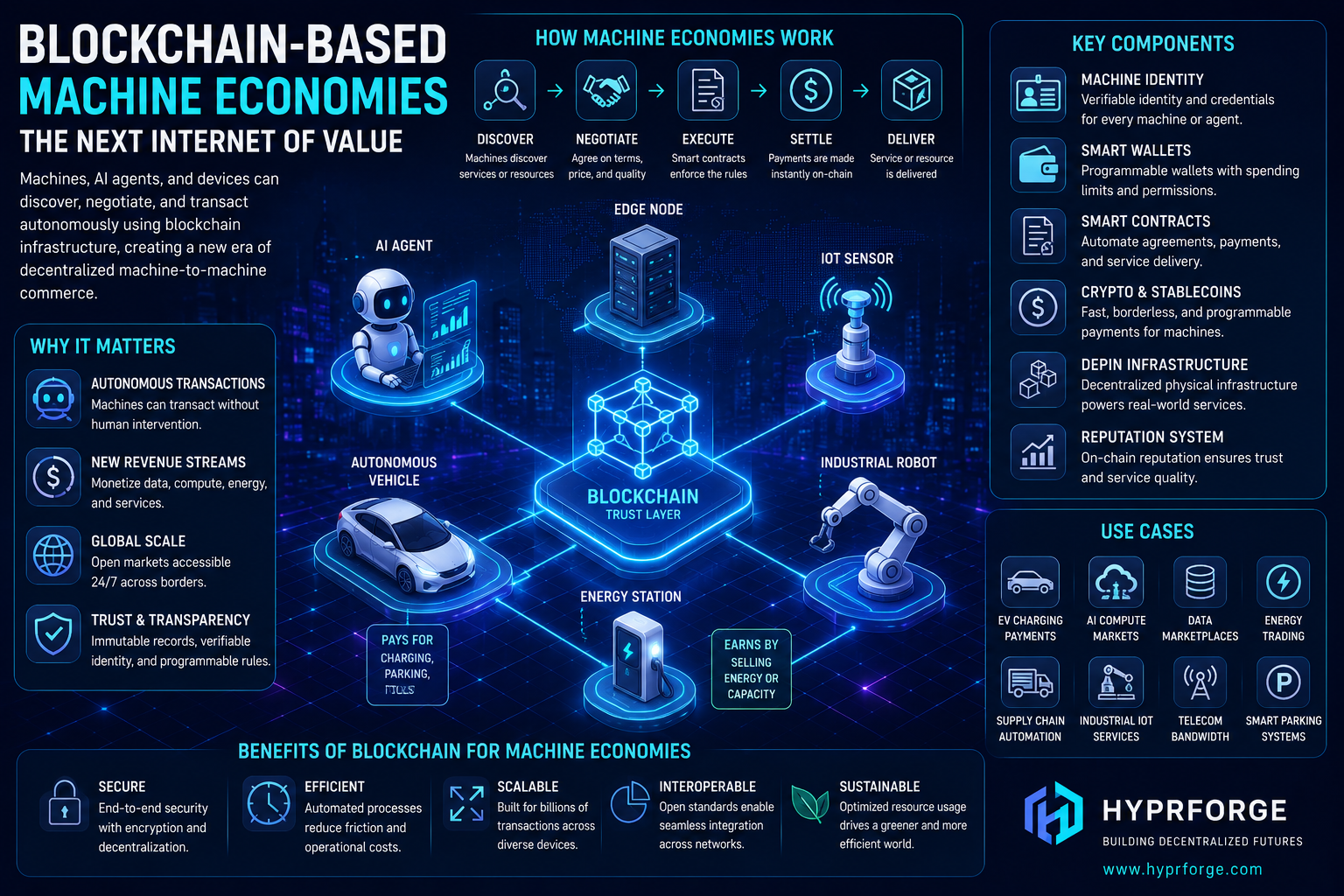
The internet is evolving from a network designed primarily for human interaction into an environment where AI agents, machines, devices, and autonomous software can participate in economic activity.
For decades, online transactions have required humans to search, compare, authorize, and complete payments. The emergence of AI agents and machine-to-machine communication is changing that model.
A software agent can now analyze information, select a service, call an API, and potentially initiate a transaction. Connected devices can generate data, consume computing resources, and interact with digital infrastructure.
This creates a new question:
Can machines become economic participants?
Blockchain technology provides an interesting foundation for answering that question.
Through programmable wallets, smart contracts, decentralized identity, tokenized assets, and cryptocurrency-based payments, blockchain can provide infrastructure for emerging machine economies.
For businesses exploring this opportunity, an experienced Blockchain Development Company can help build the infrastructure required to connect autonomous software, devices, digital assets, and programmable payments.
What Is a Machine Economy?
A machine economy is an ecosystem where software, devices, AI agents, and autonomous systems can exchange resources and value with limited human intervention.
A simplified model looks like:
Machine → Service Request → Verification → Payment → Service Delivery
For example, an autonomous vehicle could pay for charging.
An AI agent could purchase computing resources.
A sensor network could sell verified data.
A software agent could pay another API for specialized processing.
Blockchain can provide the settlement and authorization layer for these interactions.
Why Machine Economies Are Becoming Important
The number of connected devices continues to expand.
Modern infrastructure includes:
-
IoT devices
-
Autonomous vehicles
-
AI agents
-
Industrial robots
-
Smart appliances
-
Edge-computing systems
-
Connected energy systems
-
Software agents
These systems generate enormous amounts of data and increasingly interact with digital services.
Traditional payment systems were primarily designed for humans.
Machine economies require:
-
Programmable payments
-
Low-friction settlement
-
Machine identities
-
Automated authorization
-
Transparent transaction rules
This is where blockchain becomes relevant.
The Role of a Blockchain Development Company
A professional Blockchain Development Company can build the core infrastructure required for machine-to-machine commerce.
This may include:
-
Smart contracts
-
Machine wallets
-
Digital identities
-
Payment channels
-
Token systems
-
API integrations
-
Data marketplaces
-
IoT integrations
-
DePIN infrastructure
A blockchain technology development company can connect these components with existing enterprise systems and cloud infrastructure.
Machine-to-Machine Payments
Imagine a connected machine needing a service.
Instead of asking a human to make a payment, the machine can use a programmable wallet.
The process could be:
Machine Identity
↓
Service Discovery
↓
Price Verification
↓
Payment Authorization
↓
Service Delivery
This enables autonomous commerce.
AI Agents as Economic Participants
AI agents may become some of the most important participants in machine economies.
An agent could purchase:
-
Data
-
Cloud computing
-
GPU resources
-
Storage
-
APIs
-
Digital content
-
Specialized AI models
The agent doesn't necessarily need to own unlimited funds.
Smart wallets can enforce spending policies.
Smart Wallets for Machines
Machines need financial controls just like businesses do.
A smart wallet could specify:
Daily Limit: $50
Maximum Transaction: $5
Approved Services: Charging + Maintenance
Blocked Contracts: Everything Else
This prevents an autonomous system from making unrestricted transactions.
A blockchain developer company can create customized smart-account infrastructure for these requirements.
Machine Identity
Economic activity requires identity.
A machine needs to establish:
What am I?
Who owns me?
What am I allowed to do?
A decentralized identity architecture can connect:
Device → Identity → Owner → Credential → Permissions
This can make machine-to-machine communication more trustworthy.
Device Credentials
Connected devices can receive cryptographically verifiable credentials.
For example:
EV Charging Station → Verified Device → Service Credential
An electric vehicle can check whether the charging station is authorized before initiating a transaction.
Machine Reputation
Identity alone isn't enough.
A machine may also need reputation.
For example, an AI compute provider could be evaluated based on:
-
Uptime
-
Performance
-
Reliability
-
Service quality
-
Payment history
A decentralized reputation system can help machines select reliable providers.
Autonomous AI Procurement
AI agents could become autonomous procurement systems.
Suppose an AI agent needs additional computing power.
It can:
-
Search providers.
-
Compare prices.
-
Check reputation.
-
Evaluate performance.
-
Select a resource.
-
Pay automatically.
-
Monitor service delivery.
This creates a machine-native marketplace.
AI Agents and DePIN
Machine economies connect naturally with DePIN—Decentralized Physical Infrastructure Networks.
DePIN allows participants to contribute physical resources such as:
-
Computing
-
Storage
-
Connectivity
-
Energy
-
Sensors
AI agents can become customers of these networks.
The architecture becomes:
Physical Infrastructure → DePIN → Marketplace → AI Agent → Payment
Autonomous Compute Markets
AI applications may need computing resources dynamically.
Instead of reserving fixed infrastructure, an AI agent could purchase compute based on current demand.
For example:
Need GPU → Search Network → Compare Capacity → Rent GPU → Pay Provider
This creates a flexible computing economy.
A Blockchain Development Agency can build the smart contracts, marketplace, and payment infrastructure supporting these transactions.
Machine Economies and Edge Computing
Edge computing moves processing closer to where data is generated.
Connected devices can use nearby computing resources rather than sending every task to centralized cloud infrastructure.
Blockchain can potentially coordinate:
Device → Edge Node → Compute Request → Payment
This could become particularly useful for autonomous systems requiring fast responses.
Autonomous Vehicles
Vehicles represent a major potential machine-economy use case.
An autonomous vehicle could potentially pay for:
-
Charging
-
Parking
-
Toll services
-
Maintenance
-
Navigation data
-
Roadside services
The vehicle becomes a digital economic participant.
Electric Vehicle Charging
An EV could identify an available charging station.
It checks:
Price + Availability + Reputation
Then it initiates charging and settles the payment automatically.
This can eliminate unnecessary human interaction.
Smart Energy Markets
Connected energy devices can also participate in machine economies.
For example:
Solar Panel → Generates Energy → Energy Marketplace → Buyer → Automated Settlement
Smart contracts can automate selected settlement rules.
AI-Powered Energy Management
AI agents could manage energy consumption.
An agent might monitor:
-
Energy prices
-
Battery capacity
-
Solar generation
-
Demand
It could determine when to charge or sell energy within predefined policies.
Blockchain can provide transaction records and programmable settlement.
Machine Economies and IoT
IoT devices generate enormous amounts of data.
Instead of data being collected solely by a central platform, devices could potentially participate in decentralized data marketplaces.
For example:
Sensor → Verified Data → Marketplace → Buyer → Payment
A blockchain technology development company can connect IoT infrastructure with blockchain-based data markets.
Data as a Machine Asset
Machines don't just consume resources.
They can produce valuable digital assets in the form of data.
Examples include:
-
Traffic information
-
Weather measurements
-
Industrial data
-
Environmental readings
-
Mobility data
A machine economy can therefore support both resource consumption and data monetization.
Decentralized Data Marketplaces
A decentralized marketplace can connect data producers with consumers.
A smart contract can define:
-
Price
-
Access duration
-
Usage limits
-
Payment
-
Revenue distribution
A Web3 Development Company can build the marketplace interface and blockchain infrastructure.
Machine Economies and Smart Contracts
Smart contracts provide programmable rules.
For example:
If service is delivered → Release payment
If performance falls below threshold → Apply penalty
If resource expires → End access
This makes transactions more predictable.
A blockchain smart contract development agency can create customized automation logic.
Micropayments Between Machines
Machine economies may involve thousands or millions of small transactions.
Examples:
API Request → $0.001
Sensor Data → $0.005
Compute Usage → $0.02
Charging Session → Variable
Traditional payment systems can be inefficient for certain high-frequency transactions.
Blockchain networks and payment-layer technologies can potentially support programmable micropayment models where costs and throughput make them practical.
Stablecoins in Machine Economies
Stablecoins can reduce exposure to volatile cryptocurrency prices for commercial transactions.
A machine can hold or access stable-value digital payment instruments.
This can make automated transactions easier to price.
A blockchain developer company can integrate stablecoin payments into machine wallets and smart contracts.
Cryptocurrency Development for Machine Payments
Cryptocurrency development can provide the economic layer for machine ecosystems.
Possible components include:
-
Utility tokens
-
Stablecoin payments
-
Machine wallets
-
Payment contracts
-
Staking
-
Rewards
-
Treasury systems
The financial architecture should be based on the actual business requirements rather than simply introducing a token.
Machine Economies and Tokenization
Machines can also interact with tokenized real-world assets.
For example:
Vehicle → Tokenized Charging Credit
Factory → Tokenized Energy Asset
Device → Digital Ownership Certificate
This connects machine economies with the growing RWA ecosystem.
AI Agents and Tokenized Assets
AI agents may eventually manage tokenized assets under predefined rules.
An agent could monitor:
-
Asset performance
-
Revenue
-
Market conditions
-
Ownership
It can generate transaction recommendations while smart contracts enforce authorization.
Machine Economies and DEXs
Some machine ecosystems may use tokens that require decentralized liquidity.
A Decentralized Exchange Development Company can build exchange infrastructure for suitable assets.
A Decentralized Exchange Software Development Company can customize:
-
Token swaps
-
Liquidity pools
-
Trading interfaces
-
Wallet integration
-
Automated market infrastructure
Organizations looking for a dex development company should evaluate whether decentralized trading genuinely supports the ecosystem's utility and business model.
Machine-to-Machine Data Trading
Machines could eventually purchase data directly from other machines.
For example:
Autonomous Vehicle → Requests Traffic Data
Sensor Network → Provides Data
Vehicle Wallet → Makes Payment
This creates a machine-native information economy.
Machine Economies and Web3
Web3 provides several components that support machine economies:
-
Wallets
-
Smart contracts
-
Digital identity
-
Tokenized assets
-
Decentralized applications
-
Blockchain settlement
A Web3 Development Agency can combine these components into machine-oriented applications.
Web Development for Machine Platforms
Human operators still need interfaces.
A Web Development Agency can build dashboards showing:
-
Device activity
-
Wallet balances
-
Transactions
-
Permissions
-
Resource consumption
-
Revenue
-
Alerts
The blockchain infrastructure can operate behind a familiar web interface.
API-First Machine Economies
Machines don't interact with websites the same way humans do.
They primarily communicate through APIs.
A Web Development Company can develop APIs connecting:
Machine → Application → Smart Contract → Blockchain
This makes machine commerce easier to integrate with existing software.
Machine Economy Security
Autonomous financial systems introduce serious security requirements.
Potential risks include:
-
Compromised device keys
-
Fake machine identities
-
Unauthorized transactions
-
Malicious firmware
-
Smart-contract vulnerabilities
-
API manipulation
-
Replay attacks
Security must cover the entire stack.
Hardware Security
Private keys stored on ordinary software systems can be vulnerable.
Hardware security modules and secure elements can provide stronger protection for machine credentials depending on the deployment.
Permission Management
Machines shouldn't receive unlimited permissions.
A strong architecture can define:
Who → Can do What → Under Which Conditions → With Which Budget
Smart accounts can enforce these rules.
Human Oversight
Machine economies should not necessarily be completely autonomous.
Organizations can establish approval thresholds.
For example:
Transactions below $10 → Automatic
Transactions above $10 → Human Approval
This creates a hybrid system where machines handle routine operations while humans retain control over high-risk decisions.
Machine Economy Governance
Large decentralized networks need governance mechanisms.
Participants may vote on:
-
Network fees
-
Service standards
-
Hardware requirements
-
Reward mechanisms
-
Protocol upgrades
A Web3 Development Company can build governance infrastructure around these requirements.
The Business Opportunity
Machine economies could create new revenue models.
Businesses could monetize:
-
Computing resources
-
Data
-
Energy
-
Connectivity
-
Storage
-
Machine services
Instead of selling only to humans, companies could sell directly to software and devices.
This creates a new market:
B2M — Business-to-Machine Commerce
The Future of B2M Commerce
Traditional commerce is:
Business → Human → Purchase
The emerging model can become:
Business → AI Agent / Machine → Automated Purchase
The customer isn't always a person.
It can be software.
Why This Trend Matters
Machine economies bring together several major technology trends:
AI Agents
Blockchain
IoT
DePIN
Stablecoins
Smart Contracts
Digital Identity
Autonomous Systems
Each technology solves a different part of the problem.
AI provides decision-making.
IoT provides physical data.
Blockchain provides programmable settlement.
Smart contracts provide rules.
Digital identity provides authentication.
Stablecoins provide predictable digital payments.
DePIN provides decentralized infrastructure.
Together, they can create an internet where machines don't just communicate.
They can transact.
How HyprForge Can Help
HyprForge can help businesses explore machine economies, AI-agent infrastructure, DePIN applications, IoT blockchain integration, smart wallets, cryptocurrency development, Web3 platforms, tokenization, and decentralized marketplaces.
As a Blockchain Development Company, HyprForge can support:
-
Machine wallet development
-
AI-agent payments
-
Smart contracts
-
DePIN integration
-
IoT blockchain solutions
-
Stablecoin payments
-
Digital identity
-
Token development
-
Web3 applications
-
DEX integration
-
Data marketplaces
-
API development
-
Security architecture
Businesses searching for a bockchain app development company can work with HyprForge to develop customized blockchain applications for autonomous commerce, digital assets, decentralized infrastructure, and machine-to-machine transactions.
Conclusion
The next generation of digital commerce may not be driven exclusively by people clicking buttons.
AI agents will increasingly make decisions.
Machines will consume services.
Devices will generate valuable data.
Autonomous systems will require computing and connectivity.
Digital wallets will manage machine spending.
Smart contracts will enforce transaction rules.
Blockchain can provide the infrastructure connecting these activities.
The result could be a new machine economy where software and physical devices become active participants in digital markets.
For businesses preparing for this shift, partnering with the right Blockchain Development Company can provide the technology foundation needed to turn autonomous systems into secure economic participants.
With expertise across blockchain development, cryptocurrency development, smart contracts, Web3, AI agents, DePIN, DEX platforms, IoT integration, and decentralized applications, HyprForge can help businesses build the infrastructure for this emerging machine-native economy.
The future of the internet may not only connect people.
It may connect machines that can identify, negotiate, transact, and create value on their own.
- Managerial Effectiveness!
- Future and Predictions
- Motivatinal / Inspiring
- Fitness and Wellness
- Medical & Health
- Manufacturing
- Education
- Real-Estate
- Food Industry
- Hospitality
- Online Games
- Sports
- Home Services
- Civil Engineering
- Safety and Protection
- Software Products & Services
- Fashion and Jewellery
- Artificial Intelligence
- Entrepreneurship
- Mentoring & Guidance
- Marketing
- Networking
- HR & Recruiting
- Literature
- Shopping
- Career Management & Advancement