

 SkillClick
What Every Purchase Order Should Include to Avoid Disputes
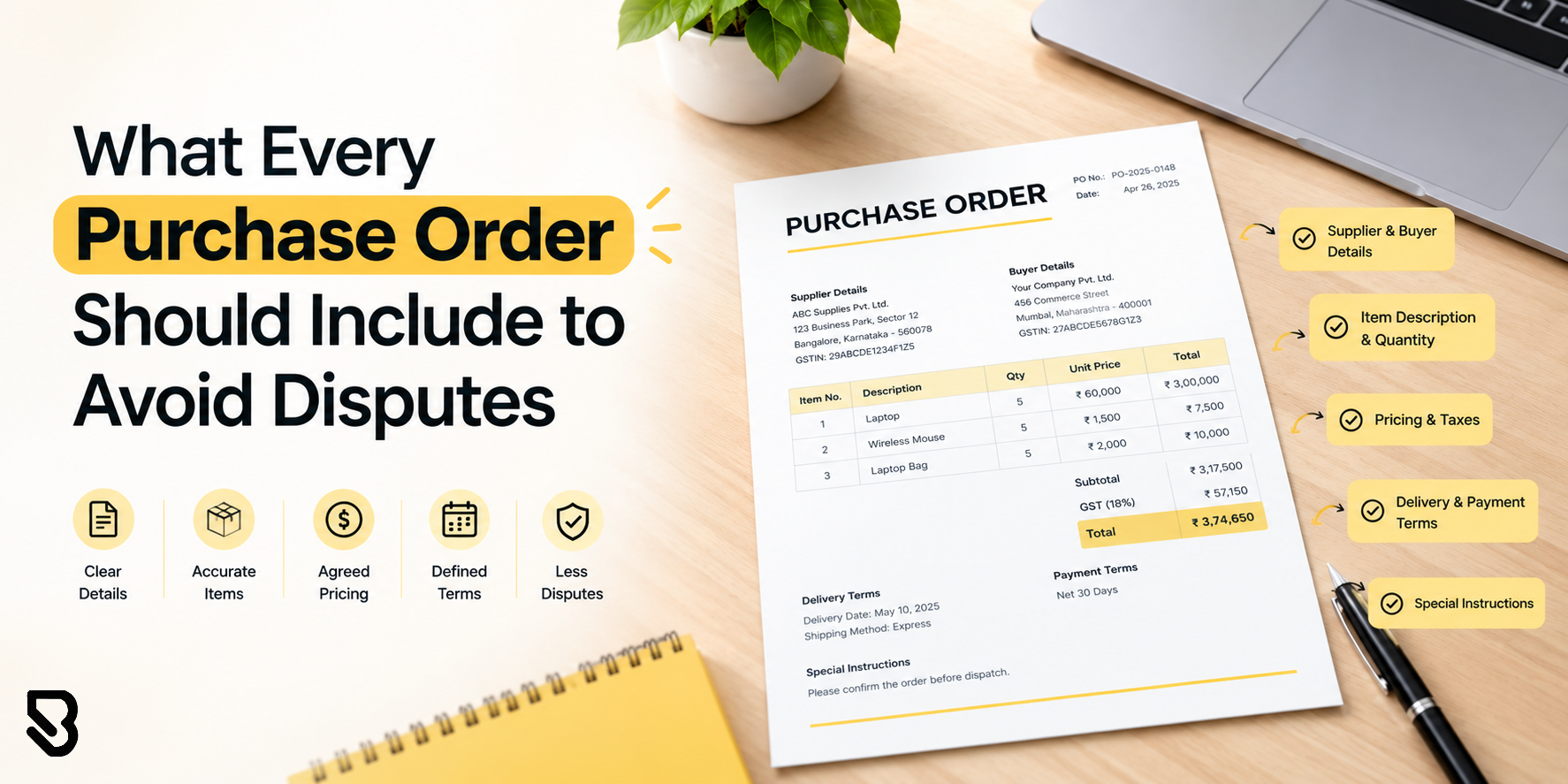
A purchase order exists to remove ambiguity before money changes hands: it tells a supplier exactly what's being bought, how much it costs, and under what terms. When a PO is incomplete or vague, that ambiguity doesn't disappear, it just resurfaces later as a dispute over pricing, quantity, or delivery. Most PO-related disagreements trace back to a handful of missing or unclear details.
A unique purchase order number
Every PO needs its own number, sequential and never repeated. This isn't just administrative tidiness, it's what makes it possible to reference a specific order during a dispute, match it against the eventual invoice, and track it through approval and delivery without confusion.
Complete buyer and supplier details
Both parties need to be clearly identified: business names, addresses, and contact details for whoever is placing the order and whoever is fulfilling it. If a question comes up mid-transaction, there should be no ambiguity about who to contact.
Detailed item descriptions
Vague line items like "materials" or "services" leave room for disagreement about what was actually ordered. A clear description, including specifications, model numbers, or exact service scope where relevant, along with quantity and unit price, removes the most common source of "that's not what I ordered" disputes.
Agreed pricing and totals
The unit price, quantity, subtotal, any applicable tax, and the final total should all be stated explicitly. If pricing was negotiated or discounted from a standard rate, the PO should reflect the agreed number, not a placeholder, so there's a clear reference point if the eventual invoice doesn't match.
Delivery date and location
When the goods or services are expected, and where they should be delivered, matters more than it might seem. Disputes over late delivery are far easier to resolve when the PO stated an explicit date rather than a vague expectation. If delivery happens in stages, each stage should be noted.
Payment terms
The PO should specify when payment is due, relative to delivery, invoicing, or a fixed date, along with the accepted payment method. Ambiguity here is a common source of friction even when both parties actually agree on the underlying transaction.
Authorization
A PO should indicate who approved the order on the buyer's side, whether that's a name, a signature, or an approval reference from an internal system. This matters if a dispute later involves the question of whether the order was properly authorized in the first place.
Why completeness matters more than formality
None of these fields exist to make a purchase order look official for its own sake. Each one closes off a specific way that a transaction can go sideways: wrong item, wrong price, late delivery, unclear payment terms, or a disputed approval. A PO that's missing even one of these is missing a piece of the protection it's meant to provide, for both the buyer and the supplier.
Billaze's purchase order generator is built to walk through each of these fields so nothing gets left off an order by accident, keeping the document complete before it's ever sent.
- Managerial Effectiveness!
- Future and Predictions
- Motivatinal / Inspiring
- Fitness and Wellness
- Medical & Health
- Manufacturing
- Education
- Real-Estate
- Food Industry
- Hospitality
- Online Games
- Sports
- Home Services
- Civil Engineering
- Safety and Protection
- Software Products & Services
- Fashion and Jewellery
- Artificial Intelligence
- Entrepreneurship
- Mentoring & Guidance
- Marketing
- Networking
- HR & Recruiting
- Literature
- Shopping
- Career Management & Advancement