

 SkillClick
Modern Workplace Management Tools for Smarter Work
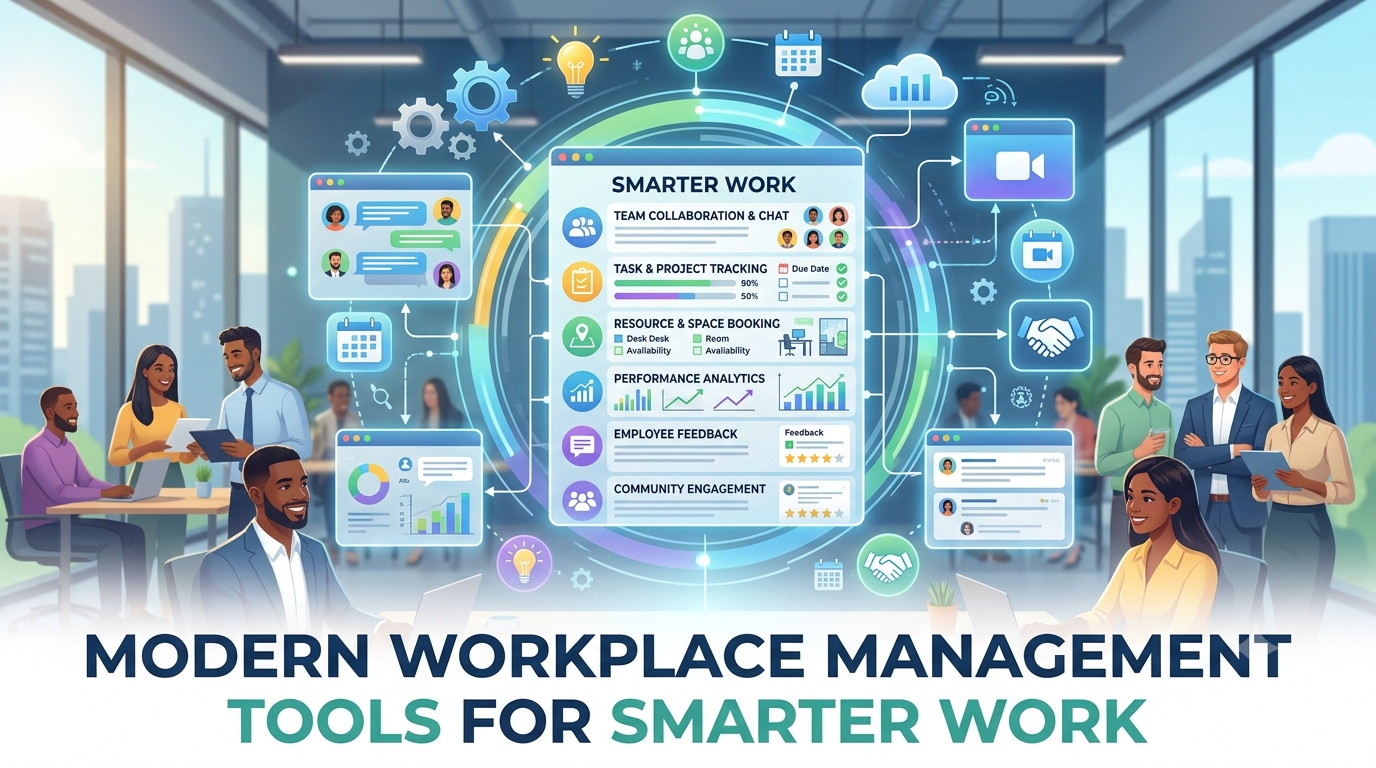
The way people work has changed significantly in recent years. Remote work, hybrid teams, cloud applications, and digital communication have become common across many organizations. As a result, businesses need more than traditional office systems to coordinate employees and daily operations. Modern workplace management tools help organizations create a connected environment where employees can communicate, manage tasks, share information, and complete their work efficiently.
Today, workplace technology is increasingly focused on reducing friction rather than simply adding more applications. Research on digital workplace platforms shows that organizations are using integrated and AI-enabled systems to improve productivity, operational efficiency, and employee experience across hybrid environments.
What Are Modern Workplace Management Tools?
Modern workplace management tools are digital platforms and applications designed to support everyday business activities. They can help employees communicate with colleagues, organize projects, manage schedules, access documents, track tasks, and collaborate from different locations.
Unlike older workplace systems that often handled one specific function, modern solutions increasingly connect several workplace activities. A business may use collaboration software for communication, project management platforms for tasks, cloud storage for documents, and workforce management systems for employee-related processes.
The goal is not simply to have more software. The goal is to create a smoother working environment where employees can quickly find information and focus on meaningful work.
Why Businesses Need Workplace Management Technology
Supporting Hybrid and Remote Teams
Hybrid and remote working models have made workplace coordination more complex. Employees may work from offices, homes, coworking spaces, or different cities. A centralized digital environment helps teams remain connected regardless of location.
Employees can use communication platforms to discuss projects, cloud tools to access documents, and project management systems to understand responsibilities and deadlines. This makes it easier for managers and team members to stay aligned.
Reducing Unnecessary Administrative Work
Repetitive administrative activities can consume valuable working hours. Workplace tools can automate tasks such as reminders, approvals, scheduling, reporting, and routine notifications.
Automation allows employees to spend less time performing repetitive processes and more time handling activities that require creativity, judgment, and problem-solving.
Improving Access to Information
Employees often waste time searching through emails, chat messages, folders, and different applications for information. A well-organized digital workplace can bring important resources into a more accessible environment.
Modern platforms increasingly include enterprise search, knowledge management, and AI-assisted features that help employees locate information more quickly.
Key Types of Workplace Management Tools
Communication and Collaboration Platforms
Communication tools form the foundation of many modern workplaces. They allow employees to exchange messages, hold virtual meetings, share files, and discuss projects without depending entirely on email.
For distributed teams, these platforms can make communication faster and more organized. However, businesses should establish clear communication practices so employees are not overwhelmed by constant notifications.
Project and Task Management Software
Project management tools help teams divide large projects into manageable tasks. Employees can see what needs to be completed, who is responsible, and when work is due.
These systems can also provide visibility into project progress. Managers can identify delays and adjust priorities before small problems become major issues.
Employee Time and Workforce Management Systems
Time and workforce management tools can help organizations understand schedules, attendance, workload, and work patterns. They can provide useful information for planning while reducing manual recordkeeping.
For example, a digital system may help managers organize schedules and employees understand their assigned responsibilities. The key is to use these tools responsibly and transparently rather than creating unnecessary pressure through excessive monitoring.
Knowledge and Document Management Platforms
Important business information should be easy for authorized employees to find. Document management and knowledge platforms provide a central place for policies, guides, project documents, and other resources.
A strong knowledge system can also reduce repeated questions because employees can find answers independently.
The Role of AI in Modern Workplace Management
Artificial intelligence is becoming an important part of workplace technology. Modern platforms can use AI to summarize information, automate repetitive workflows, assist with searches, identify patterns, and provide recommendations.
AI can also support HR and workforce operations by helping organizations analyze information and identify trends. However, human oversight remains important, especially when technology influences employee-related decisions. Experts increasingly emphasize that workplace AI should be implemented with transparency, accountability, and human judgment.
The best approach is to use AI as an assistant rather than assuming that technology can replace human decision-making in every situation.
How Time Management Supports Workplace Efficiency
Time management is another important part of modern workplace operations. Employees need visibility into their responsibilities and priorities so they can organize their working day effectively.
For organizations using workforce tracking and scheduling solutions, Timewarp Taskus represents the type of workplace technology that can be associated with structured time and workforce management. Such systems should be implemented with clear policies and an emphasis on helping employees work efficiently rather than simply measuring activity.
Technology works best when employees understand why a tool is being used and how the information collected will support better workplace processes.
Connecting Workplace Tools With Employee Productivity
Technology alone does not guarantee better performance. Organizations must choose tools that solve genuine workplace problems and integrate them into existing workflows.
Businesses should consider whether employees can easily access the systems they need, whether different applications can work together, and whether employees receive adequate training. When technology is confusing or poorly implemented, it can create additional work instead of reducing it.
Organizations can also explore strategies focused on Improving Employee Productivity by combining effective technology with clear communication, realistic workloads, employee training, and supportive management practices.
Benefits of Modern Workplace Management Tools
Better Collaboration
Digital collaboration tools allow employees to work together even when they are not physically present in the same location. Shared documents, project dashboards, messaging, and virtual meetings can make teamwork more flexible.
Greater Transparency
When responsibilities and project information are visible to the appropriate team members, employees can better understand priorities and deadlines. This can reduce confusion and improve accountability.
Faster Decision-Making
Centralized information can help managers make decisions using current and relevant data. Instead of relying on scattered spreadsheets or long email chains, teams can access information from connected systems.
Improved Employee Experience
A workplace becomes easier to navigate when employees can find resources, communicate with colleagues, submit requests, and complete routine tasks without unnecessary obstacles. Digital workplace services are increasingly being evaluated based on employee experience as well as operational efficiency.
Challenges to Consider
Too Many Tools
Adding software without a clear strategy can create technology overload. Employees may have to switch between multiple applications throughout the day, which can reduce focus. Recent workplace research highlights that having more tools does not automatically result in greater clarity or productivity.
Organizations should therefore review their existing technology before purchasing new systems.
Security and Privacy
Workplace platforms often handle sensitive business and employee information. Strong access controls, secure authentication, appropriate permissions, and responsible data practices are essential.
Businesses should also clearly explain what information is collected, why it is collected, and who can access it.
Employee Training
Even an excellent tool can fail if employees do not know how to use it. Training should be simple, practical, and relevant to everyday responsibilities.
Organizations should also provide ongoing support because workplace software frequently changes and introduces new features.
How to Choose the Right Workplace Management Tools
Businesses should begin by identifying their actual workplace challenges. Instead of asking, “Which tool has the most features?” it is better to ask, “Which problems do we need to solve?”
Consider factors such as ease of use, security, scalability, integrations, reporting capabilities, accessibility, and cost. It is also useful to involve employees in the selection process because they are the people who will use these systems every day.
A successful workplace technology strategy should prioritize simplicity. If a platform can combine important functions while remaining easy to understand, it may be more valuable than several disconnected tools.
The Future of Workplace Management
The future workplace will likely become increasingly connected, automated, and data-driven. AI assistants, intelligent search, workflow automation, workplace analytics, and integrated collaboration platforms are expected to play a larger role in everyday operations.
At the same time, technology should remain human-centered. A productive workplace is not created simply by tracking more activities or introducing more automation. It is created when technology helps people communicate clearly, access useful information, manage their responsibilities, and perform meaningful work.
Organizations are also paying greater attention to the physical workplace. Smart sensors and occupancy data, for example, can help businesses understand how spaces are being used and improve comfort and resource efficiency.
Conclusion
Modern workplace management tools can help businesses build more flexible, connected, and efficient working environments. From communication and project management to workforce coordination, knowledge sharing, and AI-powered automation, these technologies can simplify everyday processes when implemented thoughtfully.
The most successful organizations will not necessarily be those with the largest number of applications. They will be the ones that choose practical tools, integrate them effectively, protect employee data, and provide the right support and training. OutRight Systems understands the importance of combining technology with practical business needs to help organizations move toward smarter and more efficient digital workplaces.
- Managerial Effectiveness!
- Future and Predictions
- Motivatinal / Inspiring
- Fitness and Wellness
- Medical & Health
- Manufacturing
- Education
- Real-Estate
- Food Industry
- Hospitality
- Online Games
- Sports
- Home Services
- Civil Engineering
- Safety and Protection
- Software Products & Services
- Fashion and Jewellery
- Artificial Intelligence
- Entrepreneurship
- Mentoring & Guidance
- Marketing
- Networking
- HR & Recruiting
- Literature
- Shopping
- Career Management & Advancement