

 SkillClick
Biomass Briquettes vs Wood Pellets: Differences, Uses & Production Process
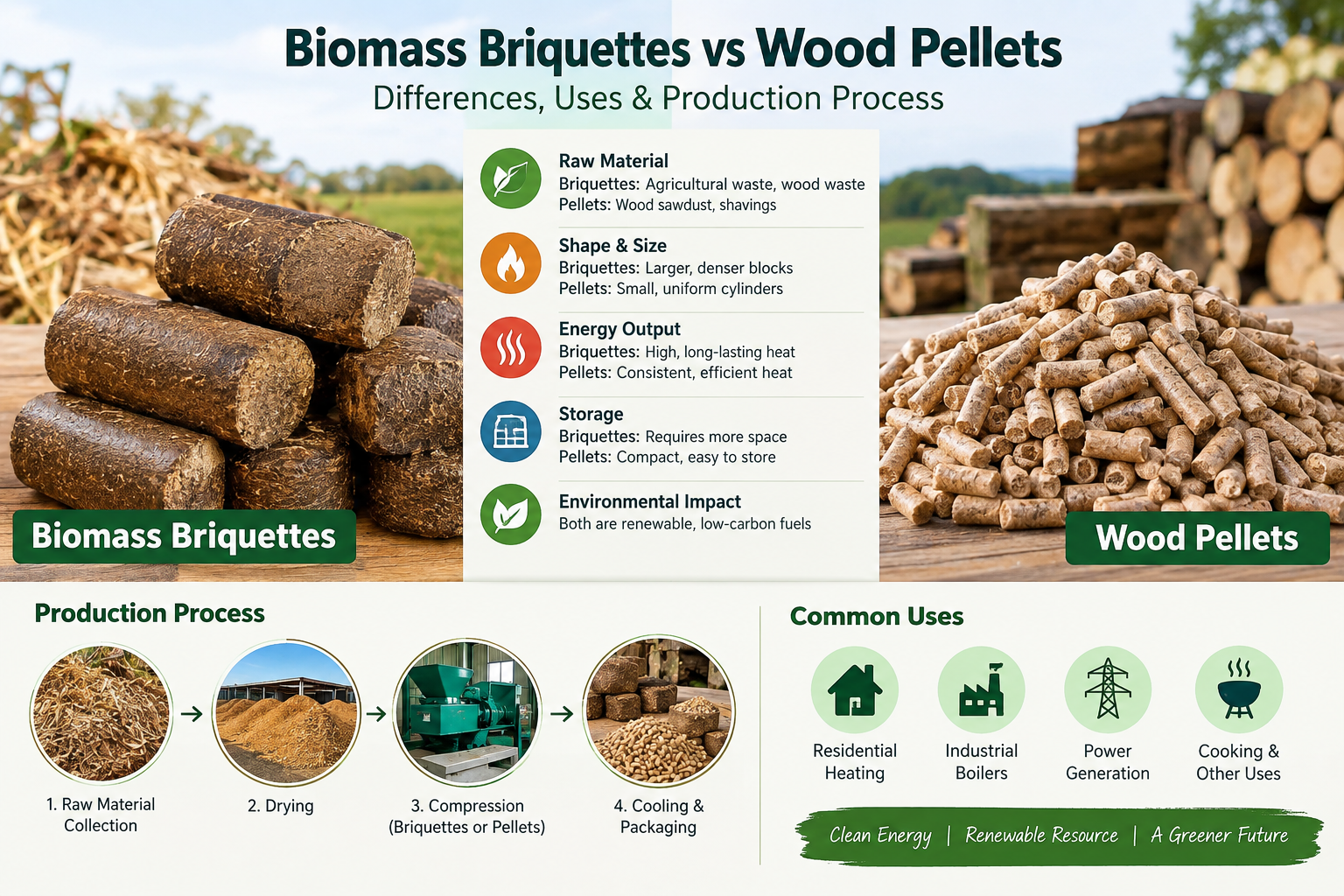
As industries and businesses look for cleaner alternatives to conventional fossil fuels, biomass briquettes and wood pellets have become increasingly important solid biofuels. Both are manufactured from renewable biomass materials and can be produced from agricultural residues, forestry waste, sawdust, wood chips, and other organic materials. However, they differ in size, shape, production process, applications, storage requirements, and fuel characteristics.
Understanding biomass briquettes vs wood pellets can help businesses, manufacturers, and energy users select the right solid biofuel for boilers, heating systems, industrial furnaces, and other applications.
This guide explains the key differences between briquettes and pellets, their common uses, production processes, raw materials, advantages, and important factors to consider when choosing between them.
What Are Biomass Briquettes?
Biomass briquettes are dense blocks or cylindrical logs produced by compressing biomass materials under high pressure. Depending on the manufacturing process and equipment, briquettes can be produced in different shapes and sizes.
Common raw materials used for biomass briquettes include:
-
Sawdust
-
Rice husk
-
Groundnut shells
-
Cotton stalks
-
Bagasse
-
Wood waste
-
Agricultural residues
-
Forestry residues
-
Corn stalks
-
Other dry biomass materials
The biomass briquetting process generally involves collecting and preparing raw materials, reducing their particle size, controlling moisture content, and compressing the prepared biomass into dense fuel blocks.
Because loose agricultural and forestry residues have low bulk density, briquetting makes them easier to handle, transport, store, and use as fuel.
What Are Wood Pellets?
Wood pellets are small, cylindrical pieces of compressed biomass, generally manufactured from finely processed wood materials. They are commonly produced using a pellet mill that compresses prepared biomass through a die.
Typical raw materials include:
-
Sawdust
-
Wood shavings
-
Wood chips
-
Forestry residues
-
Wood-processing waste
-
Clean biomass residues
The wood pellet production process typically involves raw-material preparation, grinding, drying when required, conditioning, pelletizing, cooling, screening, and packaging.
Pellets are usually smaller and more uniform than briquettes, which makes them particularly suitable for automated fuel-feeding systems.
Biomass Briquettes vs Wood Pellets: Key Differences
Although both are solid biofuels made by compressing biomass, briquettes and pellets have several important differences.
|
Factor |
Biomass Briquettes |
Wood Pellets |
|
Shape |
Blocks, logs, or larger cylinders |
Small cylindrical pieces |
|
Size |
Generally larger |
Generally smaller |
|
Raw materials |
Agricultural, forestry, and wood residues |
Primarily wood and fine biomass materials |
|
Production equipment |
Briquetting machine |
Pellet mill |
|
Feeding system |
Often manually or mechanically fed |
Well suited to automated feeding |
|
Storage |
Relatively easy to stack |
Usually stored in bags, silos, or bulk systems |
|
Typical applications |
Industrial boilers, furnaces, heating systems |
Pellet boilers, residential heating, industrial systems |
|
Production process |
Grinding, drying, and high-pressure compression |
Grinding, drying, conditioning, pelletizing, and cooling |
|
Handling |
Easy to handle as larger fuel blocks |
Convenient for automated handling |
The most appropriate fuel depends on the available raw material, equipment, energy system, required fuel size, and intended application.
Briquettes vs Pellets: Production Process
Biomass Briquette Production Process
The biomass briquetting process generally follows these steps:
1. Raw Material Collection
Biomass residues such as sawdust, agricultural waste, and forestry residues are collected and sorted.
2. Size Reduction
Large materials may need to be reduced into smaller particles using equipment such as a hammer mill or crusher. Appropriate particle size helps achieve consistent compression and briquette quality.
3. Drying
Moisture is an important factor in biomass briquetting. Excessively wet material may reduce production efficiency and affect the quality and durability of the finished briquettes. Drying equipment can be used when raw materials contain excessive moisture.
4. Briquetting
The prepared biomass is fed into a briquetting machine. High pressure compresses the material into dense briquettes.
5. Cooling and Storage
Freshly produced briquettes may require cooling before being packed, transported, or stored. Proper storage helps protect the fuel from moisture.
Wood Pellet Production Process
The wood pellet production process generally includes several stages:
1. Raw Material Preparation
Wood residues such as sawdust and wood chips are collected and cleaned.
2. Grinding
Larger wood particles are processed into a suitable, more uniform particle size.
3. Drying
If the material contains excessive moisture, it is dried to an appropriate level for pelletizing.
4. Conditioning
In some pellet production systems, biomass may be conditioned before entering the pellet mill to improve pellet formation.
5. Pelletizing
Prepared biomass enters a pellet mill, where pressure forces the material through a die to form small cylindrical pellets.
6. Cooling
Fresh pellets can be warm after compression. Cooling helps stabilize them before handling and packaging.
7. Screening and Packaging
Fine particles are separated from finished pellets, and the final product can then be packaged or stored in bulk.
What Are the Uses of Biomass Briquettes?
Biomass briquettes are commonly used as a solid fuel in applications that require a relatively dense biomass fuel.
Common biomass briquette uses include:
-
Industrial boilers
-
Steam generation
-
Heating systems
-
Drying systems
-
Furnaces
-
Textile industries
-
Food-processing industries
-
Chemical industries
-
Brick and ceramic industries
-
Small and medium-scale industrial heating
Briquettes can replace or supplement conventional solid fuels in suitable combustion systems, depending on the equipment and fuel specifications.
What Are the Uses of Wood Pellets?
Wood pellets are widely used where a standardized, compact fuel is needed.
Common applications include:
-
Residential pellet heating systems
-
Commercial heating
-
Pellet boilers
-
Industrial boilers
-
Combined heat and power systems
-
Biomass heating plants
-
Automated fuel-feeding systems
Their small and consistent size makes pellets particularly convenient for mechanical and automated feeding systems.
Biomass Briquettes vs Wood Pellets: Which Is Better?
There is no universal answer to whether briquettes or pellets are better. The right choice depends on the application.
Briquettes may be suitable when:
-
Agricultural waste is readily available.
-
Larger solid fuel pieces are preferred.
-
The fuel will be used in industrial boilers or furnaces.
-
A business wants to utilize agricultural or forestry residues.
-
The heating system is designed for larger biomass fuel.
Pellets may be suitable when:
-
Automated feeding is important.
-
Consistent small fuel particles are required.
-
The system is designed specifically for pellets.
-
Bulk handling or silo storage is preferred.
-
Residential or commercial pellet heating is the target application.
Therefore, businesses should evaluate their available raw materials, production capacity, equipment requirements, storage facilities, and end-use system before selecting a biomass fuel type.
Factors That Affect Biomass Fuel Quality
Whether producing briquettes or pellets, several factors can influence the quality of the final product.
Moisture Content
Moisture affects compression, durability, combustion, and storage. Raw materials with unsuitable moisture levels may require drying before processing.
Particle Size
Consistent particle size can help improve feeding and compression. Large or irregular particles may need to be processed using grinding equipment.
Raw Material Type
Different biomass materials have different physical and chemical properties. Sawdust, rice husk, bagasse, and agricultural residues may behave differently during compression.
Compression Pressure
The pressure and operating conditions used during densification influence fuel density, shape, and durability.
Storage Conditions
Biomass fuels should generally be protected from excessive moisture and contamination. Good storage practices can help maintain fuel quality.
Environmental Benefits of Solid Biofuels
Both biomass briquettes and wood pellets can support the utilization of renewable biomass resources. Instead of leaving some agricultural and forestry residues unused or disposing of them inefficiently, these materials can be processed into useful solid fuels.
Biomass densification can also reduce the volume of loose residues, potentially making transportation and storage more practical.
However, the overall environmental impact depends on factors such as the source of the biomass, transportation distance, processing energy, combustion technology, and emissions-control systems.
How to Choose Between Briquettes and Pellets
Before investing in biomass fuel production equipment, consider these questions:
-
What biomass raw materials are available locally?
-
What is the average moisture content?
-
What particle size is required?
-
How much fuel needs to be produced per hour?
-
Will the fuel be fed manually or automatically?
-
What type of boiler or furnace will consume the fuel?
-
How much storage space is available?
-
What are the transportation requirements?
-
What production equipment is required?
-
What fuel specifications does the end user require?
Answering these questions can help identify whether a briquetting system or pellet production system is more appropriate.
Conclusion
The comparison of biomass briquettes vs wood pellets shows that both fuels offer practical ways to convert suitable biomass residues into denser and more manageable solid fuels. Briquettes are generally larger and can be particularly useful for industrial heating applications, while pellets are smaller and well suited to automated feeding and pellet-specific heating systems.
The choice between briquettes vs pellets should be based on raw-material availability, moisture content, required production capacity, fuel-handling system, storage requirements, and final application.
For businesses planning to process agricultural or forestry residues, selecting the appropriate machinery is an important part of establishing an efficient biomass fuel production system. Proper raw-material preparation, moisture management, particle-size control, and densification equipment can all contribute to consistent production.
Ronak Engineering provides biomass processing and densification machinery designed for businesses involved in biomass fuel production. Its range of equipment can help businesses evaluate suitable solutions for converting biomass residues into useful solid fuels.
Frequently Asked Questions
Are biomass briquettes and wood pellets the same?
No. Both are compressed solid biofuels, but briquettes are generally larger, while wood pellets are smaller and more uniform.
Which has a higher energy density, briquettes or pellets?
Energy density depends on the raw material, moisture content, density, and production quality. A direct comparison should therefore consider the specifications of the individual fuel products.
What raw materials can be used to make biomass briquettes?
Depending on the machinery and material characteristics, agricultural residues, sawdust, wood waste, forestry residues, rice husk, bagasse, and other suitable biomass materials can be used.
What is the main purpose of a pellet mill?
A pellet mill compresses prepared biomass through a die to produce small, dense pellets.
Can agricultural waste be used to produce solid biofuel?
Yes. Suitable agricultural residues can be processed into briquettes or pellets after appropriate preparation, including size reduction and moisture control.
Which is better for automated fuel feeding?
Wood pellets are generally well suited to automated feeding systems because their small and relatively uniform size allows mechanical handling and controlled feeding.
- Managerial Effectiveness!
- Future and Predictions
- Motivatinal / Inspiring
- Fitness and Wellness
- Medical & Health
- Manufacturing
- Education
- Real-Estate
- Food Industry
- Hospitality
- Online Games
- Sports
- Home Services
- Civil Engineering
- Safety and Protection
- Software Products & Services
- Fashion and Jewellery
- Artificial Intelligence
- Entrepreneurship
- Mentoring & Guidance
- Marketing
- Networking
- HR & Recruiting
- Literature
- Shopping
- Career Management & Advancement