

 SkillClick
What Paperwork Do You Need to Scrap a Car?
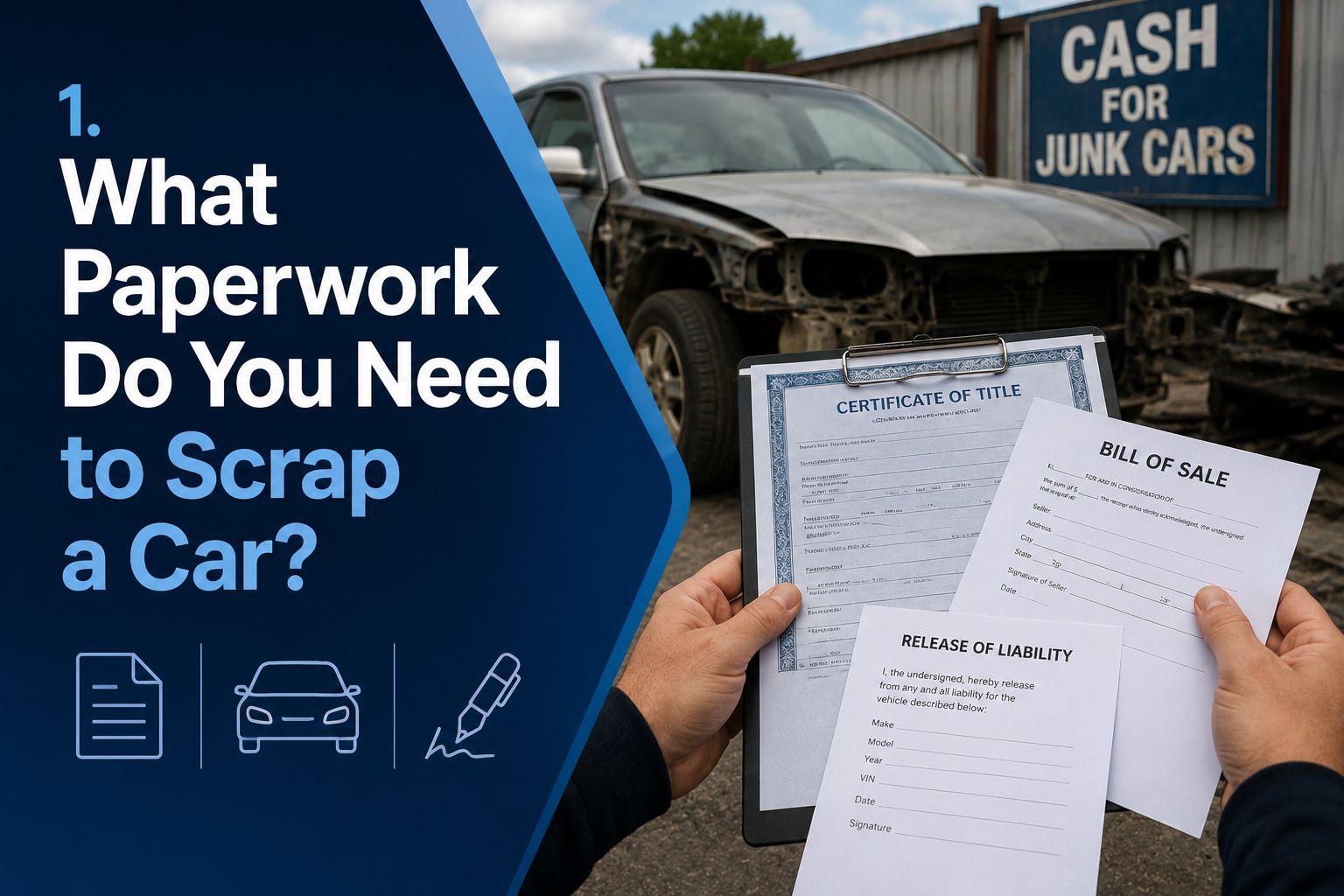
Four documents cover most scrap sales: the title, government-issued photo identification, a bill of sale, and your state's ownership transfer notice. A fifth, the odometer disclosure, applies to any vehicle from model year 2011 or newer. Everything else is situational, driven by liens, inheritance or a missing title. Before gathering any of it, get your value figure from a scrap car value calculator, since that number decides whether chasing a replacement document is worth the wait.
Here is each document, what it must contain, and which ones people forget until it costs them.
The title
This is the one that determines whether the sale can happen at all.
The title proves ownership, and buyers pay materially more when it is present. Sellers who obtained a duplicate before selling have reported final payouts rising 30% to 60%, against a replacement fee that typically runs around $20.
Sign it correctly. The seller's signature must match the name printed on the document exactly, so a name change since issue needs supporting paperwork. Some states require notarization. Do not sign an open title and hand it over blank, since a document without a named buyer creates exactly the liability the transfer notice exists to close.
If the title is missing, three alternatives exist depending on your state and vehicle. Some states permit scrap sales to licensed dismantlers on registration plus identification, subject to age or value thresholds. A duplicate is the cleanest route. A bonded title covers cases where you hold no ownership documentation at all.
Photo identification
Government-issued photo ID is required almost everywhere, and the name on it should match the name on the title.
Buyers are obliged to record identification and transaction details, often retaining those records for years and reporting them to law enforcement databases. This is a consequence of metal theft legislation rather than any suspicion about you, and there is no way around it at a licensed operation.
Bill of sale
Even where a state does not mandate one, prepare it. This is the document that resolves disputes months later.
It should record the date, the buyer's business name and address, the sale price, and the vehicle's year, make, model and vehicle identification number, along with signatures from both parties. Add the odometer reading. Some states supply a title-exempt bill of sale form; others accept a notarized document you draft yourself.
Keep your copy. Toll bills, parking citations and county tax notices sometimes surface long after the car is gone, and this is the paper that establishes precisely when it stopped being yours.
Odometer disclosure
The federal rule changed in 2021 and still causes confusion, so here it is exactly.
Under the Truth in Mileage Act and 49 CFR Part 580, odometer disclosure is required on transfers of vehicles from model year 2011 or newer for the first 20 years. Model year 2010 and older vehicles fall under the previous ten-year rule and are exempt.
In practice, for a sale happening now: a 2010 or older vehicle needs no disclosure, while a 2011 or newer one does. A model year 2011 car becomes exempt in 2031, a 2012 in 2032, and so on.
Three categories are exempt regardless of age: vehicles with a gross weight rating above 16,000 pounds, non-self-propelled vehicles such as trailers, and new vehicles before first retail sale.
Odometer tampering is a federal offense, so record the reading as it appears, even on a car that has not run in years.
Situation-specific documents
Four circumstances add paperwork.
A lien on record. Even a settled loan leaves the lien showing until the lender issues a release. Request it early, since it moves on the lender's timetable. A vehicle under an active lien cannot be sold, and a leased vehicle cannot be scrapped at all.
An inherited vehicle. Expect to provide a death certificate and, commonly, court authorization or letters testamentary. Surviving spouse provisions simplify this considerably in many states.
No ownership documentation. A bonded title involves submitting what records you hold, a VIN inspection and purchasing a surety bond.
An insurance total loss. The vehicle carries a salvage or nonrepairable certificate rather than an ordinary title, and plates generally must be surrendered within a short statutory window.
What licensed buyers must record about you
Understanding the buyer's obligations explains why the requests are non-negotiable.
Licensed recyclers and scrap operations are required to record the transaction in detail: seller identification, materials, weight, date, time and payment method. Retention periods commonly run two to five years, and records must be produced to law enforcement on request. Many states now transmit transaction data electronically to databases police can search.
Payment rules follow the same logic. California and several other states restrict or prohibit cash payment for non-ferrous material, using checks or electronic transfer to create a traceable record instead. Some jurisdictions add a waiting period on higher-value transactions, a photograph of the seller, a thumbprint, or details of the vehicle used to deliver material.
Catalytic converters attract the strictest treatment of all, with proof of ownership required for a standalone sale in more than thirty states. None of this obstructs an honest seller. It simply means arriving with identification rather than expecting a handshake transaction.
Documents generated after the sale
Three more pieces of paper arrive at the end, and they matter as much as the ones you brought.
Plate surrender receipt. In most states the plates belong to you rather than the vehicle. Remove them before the truck leaves, surrender them, and keep the receipt.
Ownership transfer notice. California calls it a Notice of Transfer and Release of Liability; Nevada calls it a resale notification. The name differs, the function does not, and filing it is what records that the vehicle stopped being yours on a specific date.
Insurance cancellation confirmation. Contact your insurer only after the plates are surrendered and the registration is closed, since cancelling coverage while a vehicle is still registered can suspend your driving and registration privileges. Your insurer will generally want the bill of sale and plate surrender receipt before processing a prorated refund.
What to keep, and for how long
Retain the bill of sale, the plate surrender receipt, your copy of the signed title or its number, and confirmation of the transfer notice filing.
Three years is a sensible minimum, since that covers the window in which most delayed citations, tax notices and registration queries appear. Photograph everything before handing over originals, including the odometer, the plates and the vehicle itself on collection day.
Five paperwork mistakes that cost money
Signing an open title. Never leave the buyer field blank.
Cancelling insurance first. The order is plates, transfer, then insurer.
Skipping the transfer notice. The sale can be complete while the state still shows you as the owner.
Waiting on the duplicate before getting quotes. Nothing prevents you collecting prices during the application, and buyers quote on description.
Not disclosing missing parts. Unrelated to paperwork, but it is the other common source of a reduced offer at pickup.
A checklist for pickup day
Everything needed at the handover, in one place.
Have ready before the truck arrives: the signed title or your state's approved alternative, your photo identification, the lien release if one applied, a prepared bill of sale with the odometer reading entered, and every set of keys you can find.
Do at the handover: take payment before the vehicle is connected to the truck, remove the license plates, and photograph the odometer, the plates and the car itself.
Do the same afternoon: surrender the plates and close the registration, file the ownership transfer notice, then call your insurer.
The whole sequence takes under an hour of actual effort. What causes problems is doing steps out of order, particularly reaching the insurer before the registration is closed.
Frequently asked questions
Can I scrap a car without any paperwork at all? No. At minimum a licensed buyer needs photo identification and some proof of ownership, whether a title, registration, or documentation qualifying under a state exemption.
Does the buyer handle the title paperwork? Often, yes. Many established operators employ a title clerk who prepares the transfer and shows you where to sign. That convenience does not remove your responsibility to file your own transfer notice with the state.
Do I need a bill of sale if I have the title? Not always legally, but prepare one anyway. It records the date and price, which is what settles a dispute if something surfaces later.
What if my car is a 2012 that has not run for six years? It still requires odometer disclosure, since the twenty-year rule applies to model year 2011 and newer regardless of whether the vehicle runs. Record the reading as displayed.
Can someone else scrap the car on my behalf? Generally yes, with a power of attorney or your state's equivalent authorization form, plus their identification and yours. Requirements vary, so confirm with the buyer beforehand.
How long should I keep the documents? At least three years. That covers the period in which delayed citations and tax notices typically appear.
What if the name on my title is misspelled? Correct it before selling. A mismatch between the title and your identification stops the transaction at the counter, and fixing it afterward is slower than fixing it now.
Is a photocopy of the title acceptable? No. Buyers need the original document, properly signed. If yours is lost or damaged beyond signing, apply for a duplicate rather than hoping a copy will pass.
Start with two checks
Confirm the title is in your name and spelled correctly, and confirm no lien still shows against the vehicle. Those two questions decide whether your paperwork takes an afternoon or three weeks, and both can be answered with a single call to your state motor vehicle agency.
- Managerial Effectiveness!
- Future and Predictions
- Motivatinal / Inspiring
- Fitness and Wellness
- Medical & Health
- Manufacturing
- Éducation
- Real-Estate
- Food Industry
- Hospitality
- Online Games
- Sports
- Home Services
- Civil Engineering
- Safety and Protection
- Software Products & Services
- Fashion and Jewellery
- Artificial Intelligence
- Entrepreneurship
- Mentoring & Guidance
- Marketing
- Networking
- HR & Recruiting
- Literature
- Shopping
- Career Management & Advancement